


Anine Eschberger Wortmann put design-bid-build, CM at risk, progressive design build and integrated project delivery to an architect, a client and a building scientist, and the three agreed on where the leverage sits: how early the trades, the owner and the envelope specialist are let in.
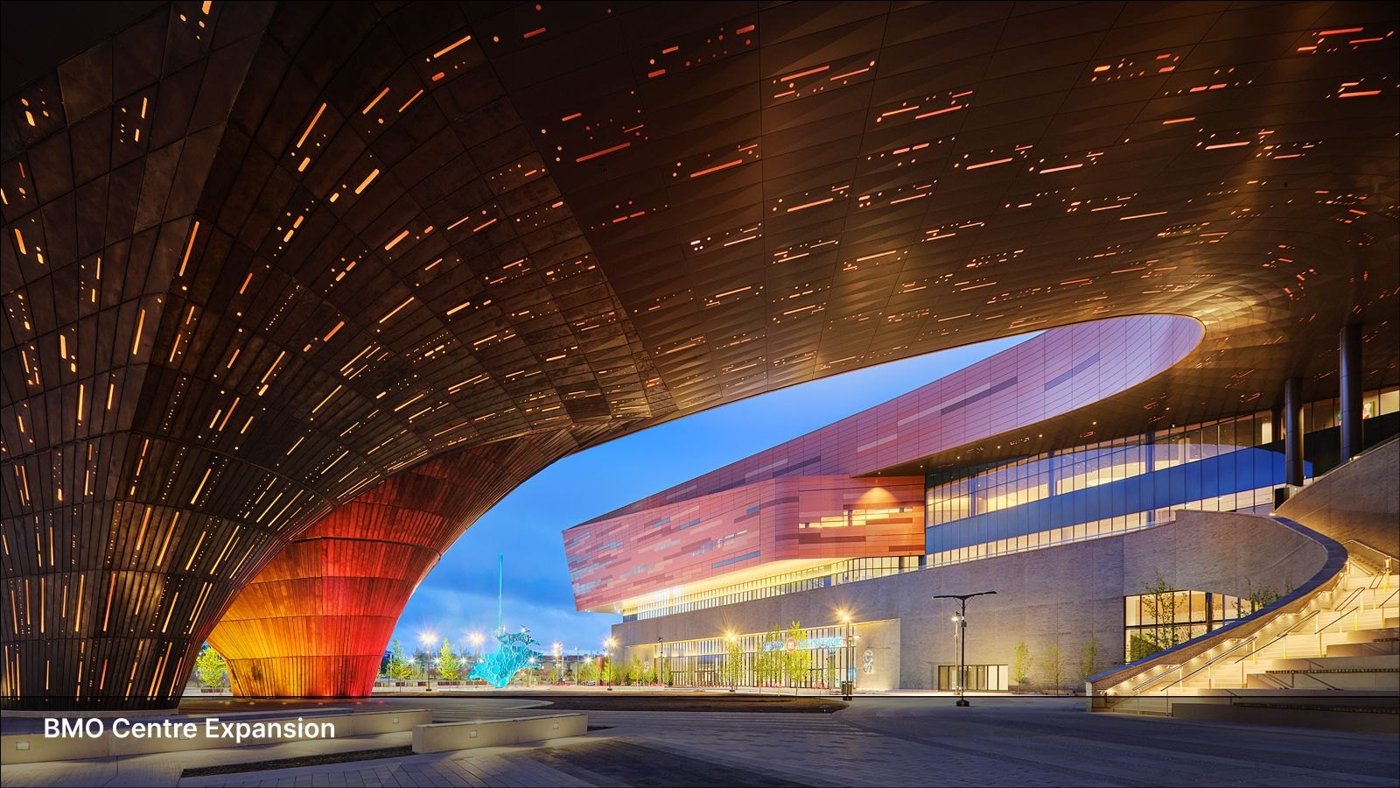
Leo Lejeune, vice president at Stantec and lead architect on the BMO Centre expansion, began with a measure of how far the architect has moved from the work. Reimagining a 100-year-old building at the University of Alberta, his team found the original drawings: eight sheets. A comparable building now needs hundreds. What those eight reflected was design intent carried on site, where decisions were made with the crafts people, sometimes on the fly.
Design-bid-build, the traditional answer, pushes the architect towards detailing every element in every corner to the nth degree, and its weakness was that nothing guaranteed the drawn design met the owner's budget, so an over-budget tender meant reworking it. Most of Lejeune's recent work has instead been construction management and CM at risk, where trade input arrives early enough to settle constructibility details and to price the work as it develops, avoiding the deep, painful value engineering that follows surprises. Design-build relinquishes some control over the design in exchange for cost certainty, owner and contractor working constantly against an agreed number. On an integrated project delivery job for the University of Calgary, trade partners sit at the table almost from the beginning, and risk transfers from the design team to collective ownership of the budget and the technical outcome.
Kelly Coles described the same models from the client's side. CMLC was development manager on the BMO Centre and holds the same role on the Werklund Centre and Olympic Plaza. On the BMO Centre a second client, Calgary Stampede, added another layer. Construction management gave the client access it would not otherwise have had, where design-bid-build confines the client largely to the front end. Coles was candid that access cuts both ways, noting that what she would call input into the process, "Leo and team might define as a headache".
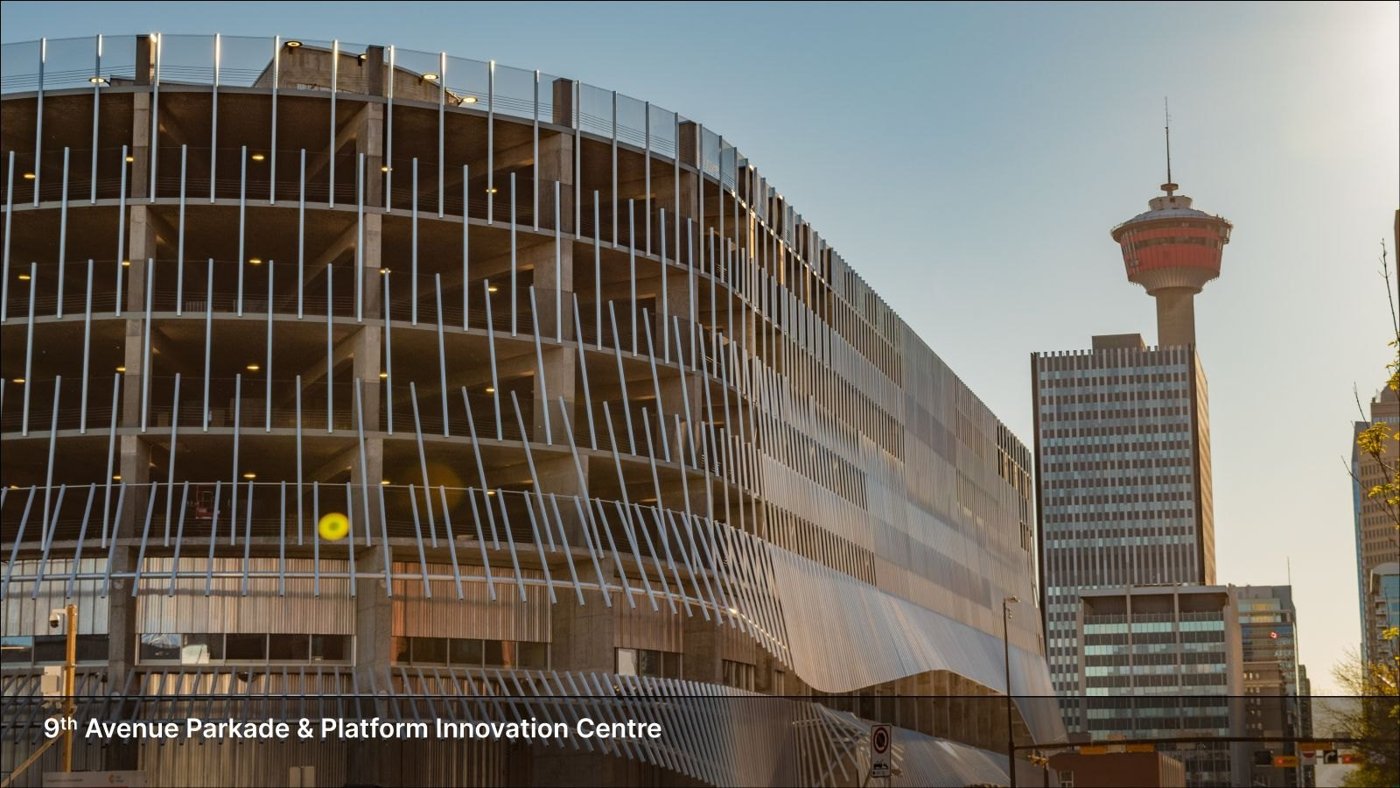
The value showed in cadence. CMLC's processes put the client in front of full-scale mock-ups on a regular rhythm, with adjustments made quickly rather than reported back once the design team had landed them. Coles pointed to the barn elevation as the place where client comment could land while it was still useful. Working through colour with the fabricators, one of them suggested some panels be flipped upside down to read as a slightly different shade, removing the cost of a fifth colour.
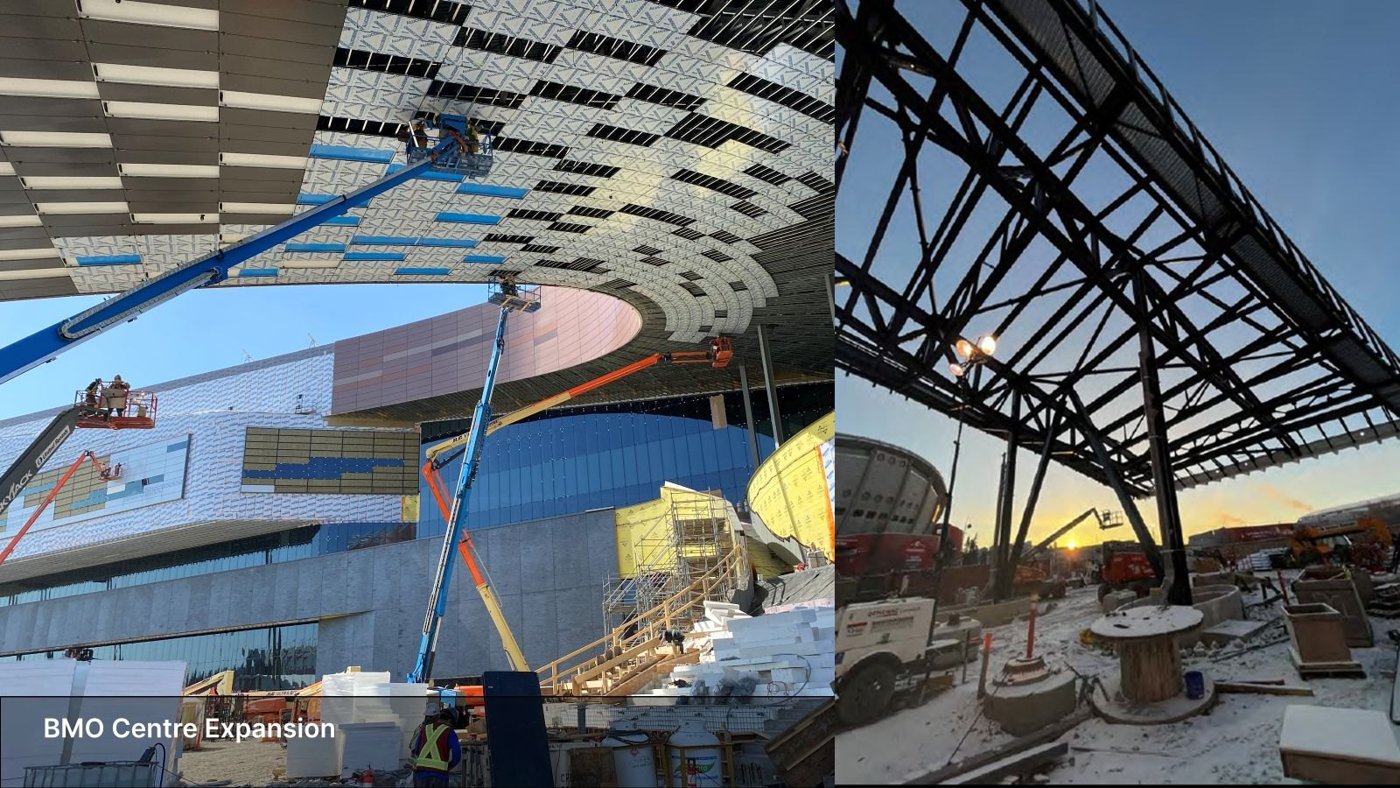
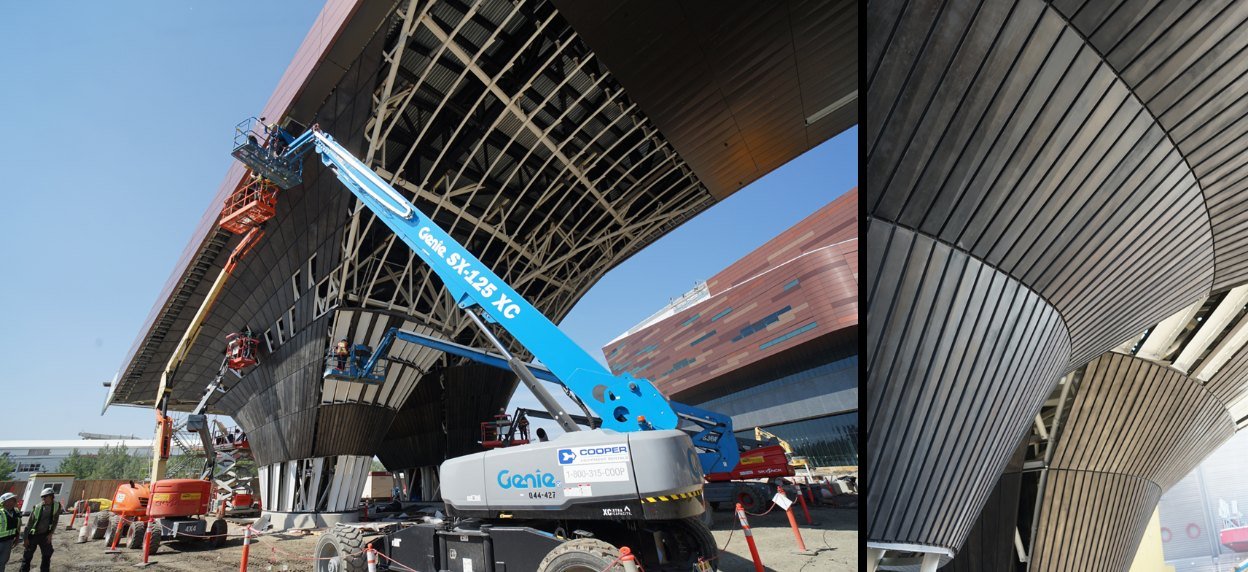
Lejeune took the pavilion, the swooping black leg that comes down to the plaza, as the clearest case. Flynn detailed the soffit to the underside, working hands-on with the architects on the folds in the panels, and Heavy Industries fabricated the blackened aluminium that forms the face. Two sets of cladding had to meet on a single fine line, which Lejeune said would not have worked without partners willing to detail it together, meet on site and build mock-ups. The model also let the team park the question of what that element would be; the name has stuck even though it is not a pavilion at all.
Joel Schwartz of JRS Engineering, thirty years in building science, traced the cost of arriving late. In the traditional model a typical window system was resolved through shop drawings, which worked while buildings were simpler. Systems are now far more complex, and once budget and form are fixed there is very little flexibility left in a curtain wall design, producing schedule and cost problems or plain contradictions with the architecture. His practice is mainly in British Columbia, where the BC Energy Step Code and thermal energy demand intensity targets set what the envelope must deliver. A curtain wall effectively designed at shop drawing stage may simply not reach that performance, depending on how much steel is required and on mullion spacing. Brought in at preliminary façade design, while the engineering can still be worked out, thermal penalties can be identified and rationalised with far less conflict later. Engaged early, he said, consultants can be the yes people who help realise the architecture; engaged late, they become the no people. Reviewing finished drawings a week before building permit, as he once did, leaves nothing meaningful to change.
Coles described how CMLC resources that front end on the Werklund Centre. Prequalification establishes that whoever comes aboard can actually meet the design intent. Then come what the team calls demystifying meetings, where trade contractors ask whatever they need to. The aim is information rather than cost certainty, and information translates directly into savings, because anyone will price and carry risk for something they do not fully understand. Selection of partners is the critical variable, she argued, because tolerance for client involvement varies widely; under integrated project delivery, where fees are shared, that becomes the good, the bad and the ugly.
Lejeune named two shifts: pulling trades, design partners and building science specialists forward, and pulling budget forward to support them, including a tolerance for mock-ups. Decisions on colour and on the perforation of panels hanging fifty feet up were taken with owner, development partners and trades standing around a mock-up. Schwartz saw a parallel opening in supply, with more products arriving from every corner of the world, while acknowledging the pull against local economies and embodied carbon: "You pull it somewhere, it gets short somewhere else." Coles agreed, noting that disruption and cost swings over the past five or six years forced plan B and plan C.