


Jochen Regenauer argues that laminated safety glass needs more precise carbon accounting. With many projects still relying on generic environmental declarations, designers may miss the effect of interlayer choice, glass thickness and production route on the actual façade footprint.

Environmental declarations are only useful if the numbers describe the products being designed. Jochen Regenauer’s concern is that generic datasets can flatten meaningful differences between glass and interlayer production routes. In laminated glazing, that can hide both the penalty of an inefficient build-up and the benefit of a product whose structural or acoustic performance allows the façade to use less material.
Generic EPDs can overstate or conceal the real footprint
Regenauer contrasts industry-average figures with product-specific declarations. In one interlayer comparison, the generic value is about 6.3 kg CO2e per kilogram while the specific standard product is around 4.2 kg CO2e/kg. The gap is large enough to change the result of a façade-level calculation before any geometry has changed. The problem is amplified when several generic values are stacked together. Regenauer notes that more than half of the data used in many early calculations may still be generic, making a detailed-looking result less precise than it appears.
A laminated build-up should be calculated component by component
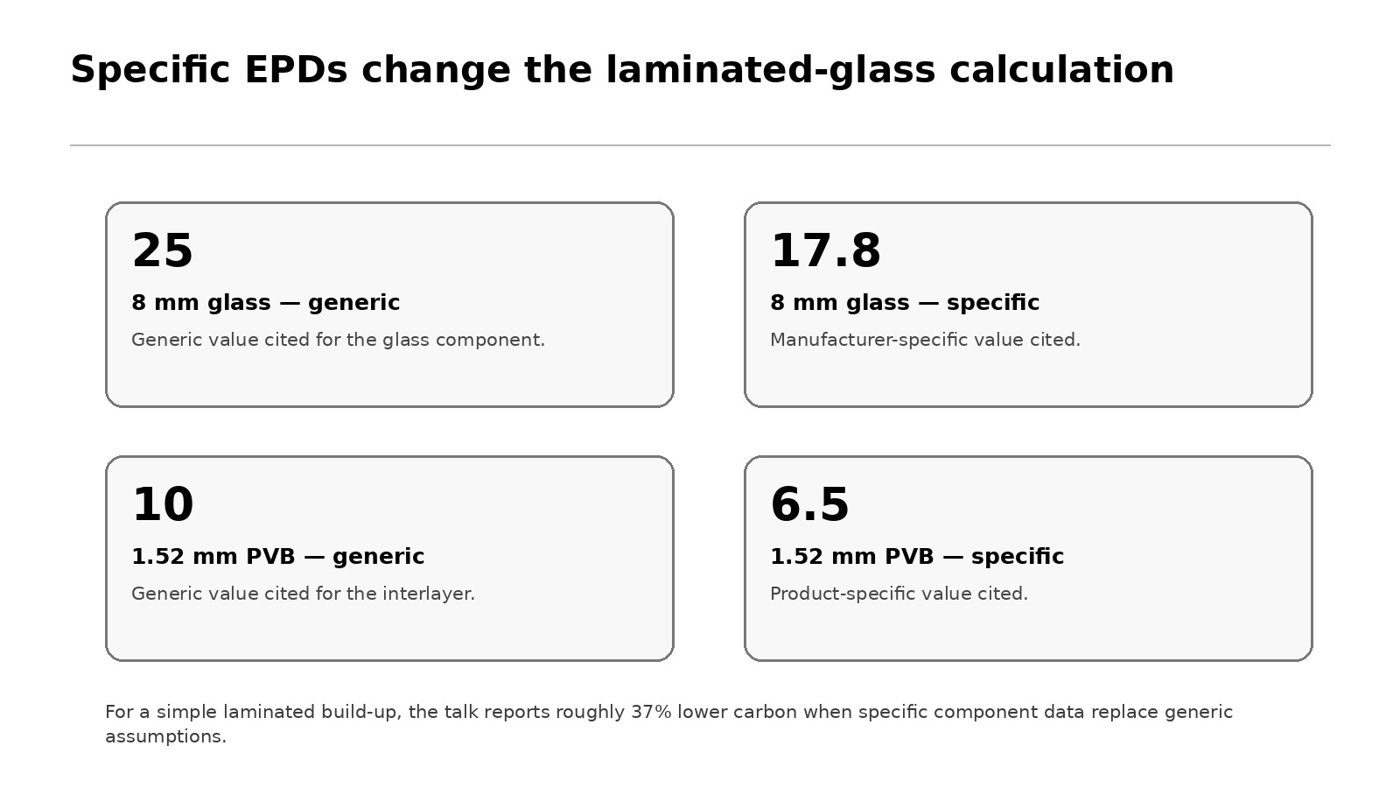
His simplified example compares generic and specific values for both glass and PVB. An 8 mm glass layer is shown at roughly 25 kg CO2e using generic data versus about 17.8 with a specific dataset; a 1.52 mm PVB interlayer is shown at about 10 versus 6.5. When the layers are combined, the example produces an overall reduction of roughly 37% without changing the architectural function, only the accuracy and source of the data.
This does not mean the lowest single product number always wins. Laminated glass is specified for post-breakage behaviour, fall protection, security, acoustics, UV control and structural action. Those functions have to remain explicit in the comparison.
Structural performance can reduce glass mass
The Montparnasse Tower refurbishment is Regenauer’s example of performance affecting material quantity. The project involves roughly 27,000 square metres of checkerboard unitised façade. A stiffer structural interlayer can increase composite action and allow glass to be down-gauged where engineering checks permit it. Regenauer reports an embodied-carbon saving of about 20% for the outer lite in the studied option.
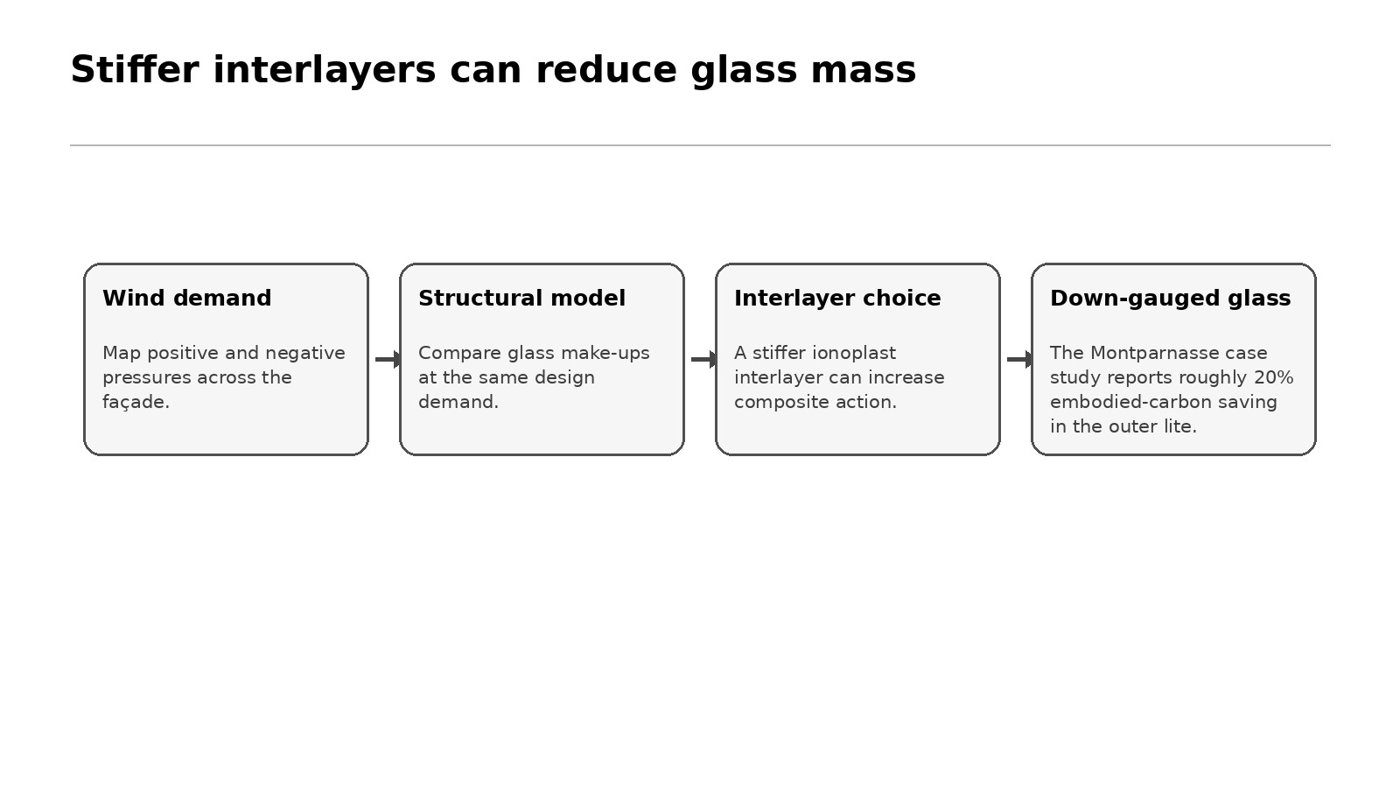
The same logic applies to every optimisation: compare equivalent safety and serviceability, then count the material actually required.
Bird protection is another performance layer
Regenauer also treats bird collision as a façade-performance issue. Reflected sky and greenery can make clear glass read as open habitat. His examples use a tested marker interlayer with a dot pattern covering less than 0.1% of the surface, designed to be legible to birds while remaining visually discreet to occupants.
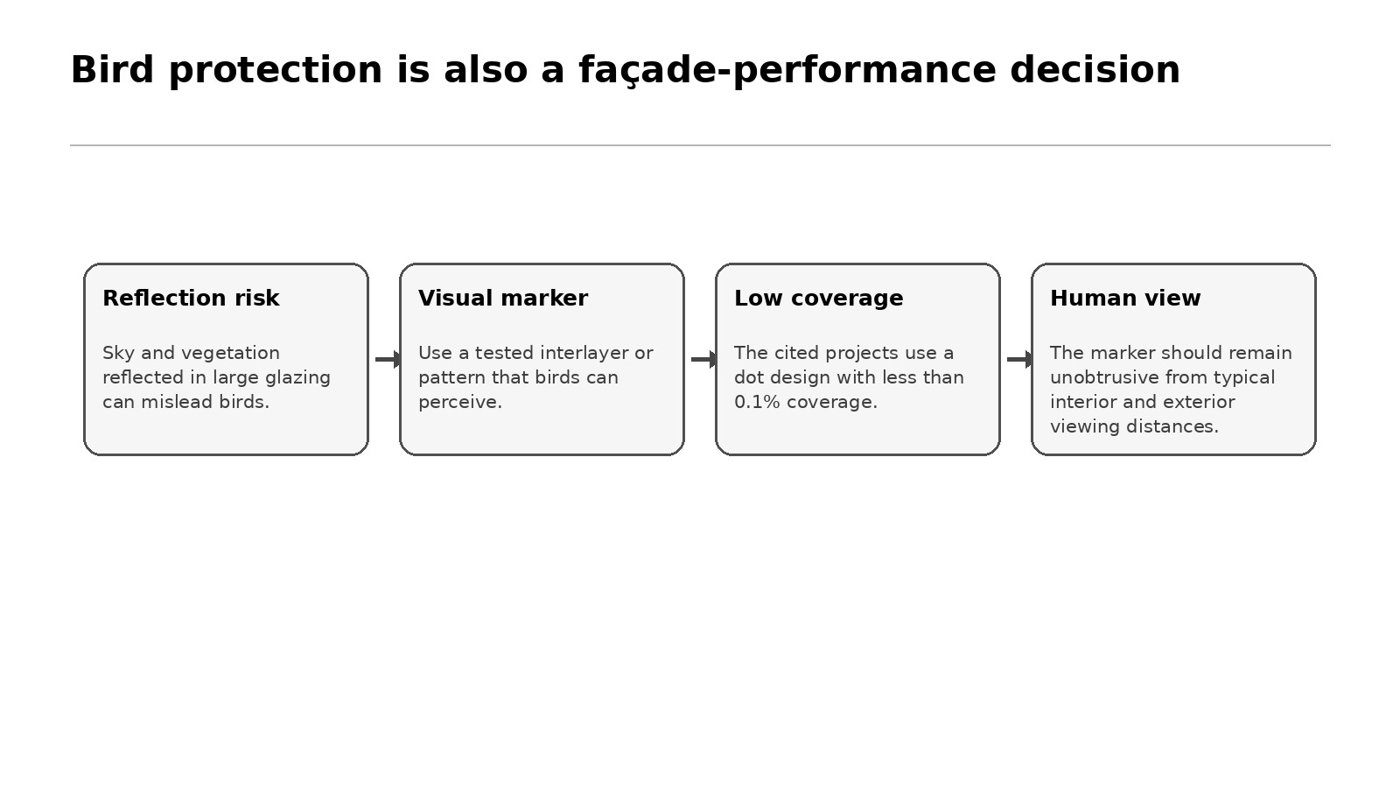
Projects including bent insulating units at Hambach Castle and a scientific building for the German Aerospace Center illustrate how that layer can be integrated into complex glazing rather than treated as an applied afterthought.
Interlayers should be specified for the job they perform
Safety, security, acoustics, structural stiffness and bird protection place different demands on a laminate. Regenauer’s broader point is that an interlayer is an engineered component, not a generic line item between two sheets of glass.
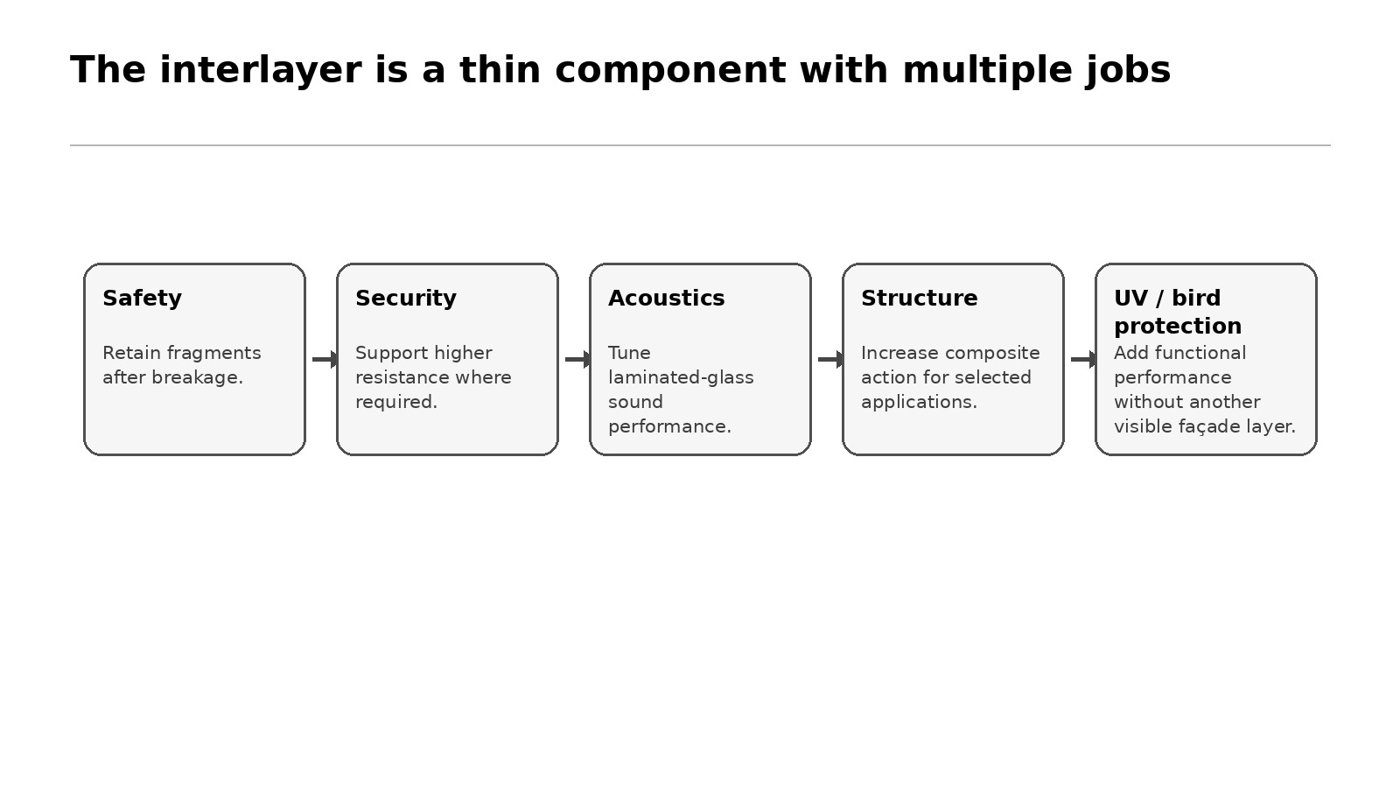
That discipline turns EPDs from reporting paperwork into a design tool. Use specific data where it is available, model the whole laminate, and let material efficiency emerge from verified performance rather than from a generic average.
The bird-protection examples are useful because they combine a visual requirement with test evidence. At Hambach Castle, the strategy had to work in bent insulating-glass units; at the German Aerospace Center project, it had to remain appropriate for a scientific building with demanding transparency. Regenauer notes that the marker is difficult to perceive from normal interior viewing distances of roughly five to ten metres, even though it interrupts the reflections that create collision risk. That balance mirrors his carbon argument. A product claim becomes useful only after the design team can connect it to the actual assembly and an appropriate test method. Whether the subject is embodied carbon, post-breakage strength or bird protection, specific evidence is more valuable than a generic label.