Exterior-wall fire safety depends on interactions between materials, cavities, openings and slab-edge details. Daniel A. Martin explains why individual component ratings cannot be used as a shortcut for testing the complete wall assembly that will actually be built.
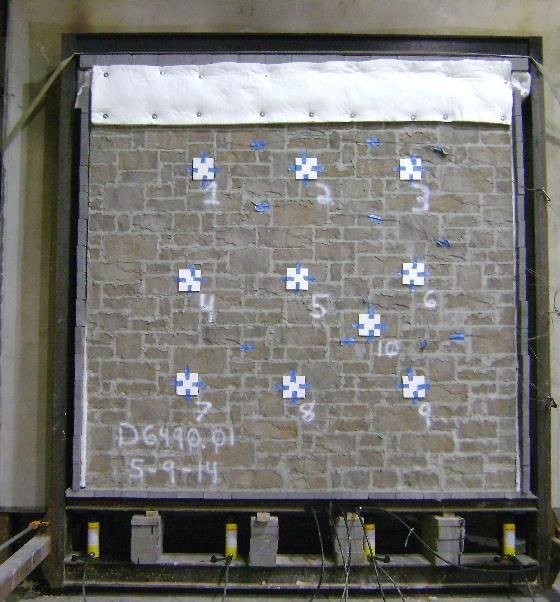
A façade wall is asked to control several distinct fire paths. A rated wall may need to resist fire through its thickness. A curtain wall needs to prevent fire and hot gases from bypassing a floor at the slab edge. A combustible or partly combustible exterior assembly may need to show that flames will not spread vertically or laterally across its face or through concealed layers. No single component test answers all three questions.
Different fire questions need different tests
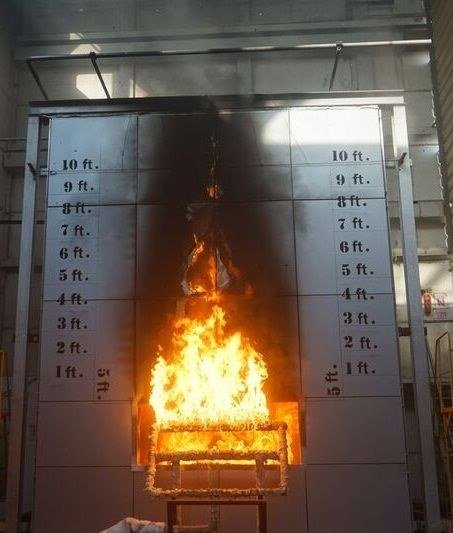
Martin’s core message is that teams must begin by identifying the performance question the code is asking. ASTM E119 and UL 263 address fire-resistance ratings. ASTM E2307 addresses the perimeter joint between floor and façade. NFPA 285 evaluates flame propagation in multi-storey exterior wall assemblies. Treating these standards as interchangeable can leave a project with impressive certificates but an unverified wall.
NFPA 285 is deliberately an assembly test
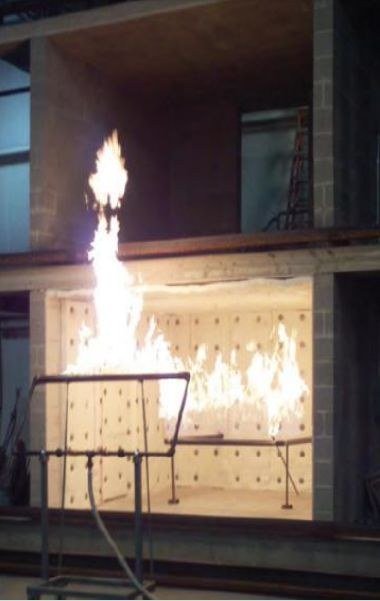
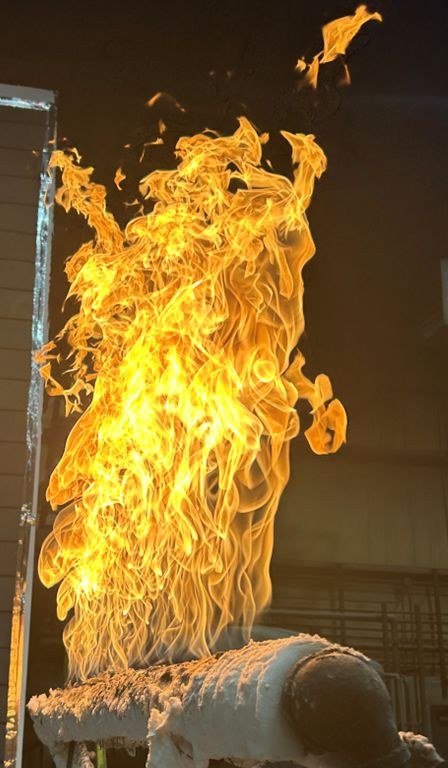
The NFPA 285 configuration is large because fire can exploit interactions that small-scale product tests do not reproduce. A representative wall is built around an opening and subjected to an interior fire that produces an exterior plume. The test then measures whether flames propagate vertically within the wall, across the exterior face or laterally into adjacent areas. That geometry matters. Insulation, sheathing, membranes, air gaps, cladding and attachments all influence the path of heat and flame. A material that performs well alone may behave differently when it is placed behind another layer, connected through a cavity or exposed around a window opening. The test is therefore not a ranking of ingredients. It is evidence for a particular recipe and configuration.
Substitutions can invalidate the evidence
This is where procurement decisions become a fire-safety issue. During construction, teams routinely substitute products because of cost, availability or lead time. If an exterior wall relies on an NFPA 285 test, a seemingly minor change can move the installed assembly outside the tested configuration. Changing insulation thickness, membrane chemistry, cladding type, cavity dimension or attachment detail may alter heat transfer and flame spread. The correct response is not to prohibit every substitution. It is to evaluate whether the proposed change is covered by existing test evidence or by a qualified engineering analysis. That requires the design and construction teams to know which aspects of the tested assembly are critical. Fire performance should therefore be part of the substitution workflow, not a document checked only at permit stage.
Perimeter containment protects compartmentation
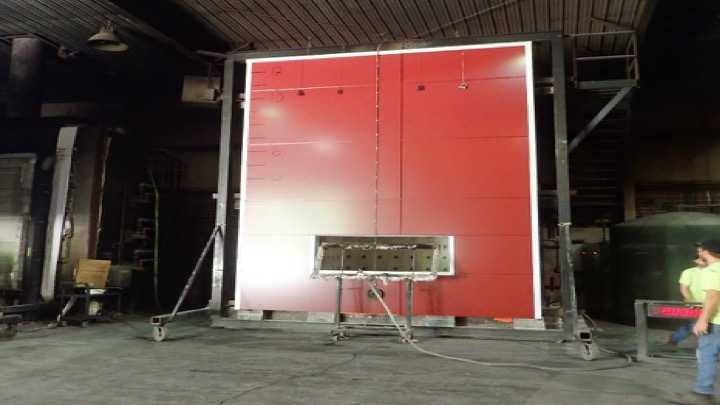
Curtain walls introduce a second vulnerability at the floor line. The gap between the slab edge and the façade is necessary for construction tolerance and movement, but if it is left unprotected it can become a direct path for smoke and flames. ASTM E2307 evaluates the firestop system installed in that joint together with the curtain-wall spandrel condition. The test recognises that the perimeter barrier does not work independently. Curtain-wall framing can deform under fire exposure; aluminium components can lose strength; spandrel insulation and anchors influence how compression is maintained. The slab-edge system therefore needs to be specified and installed as a tested arrangement rather than as an arbitrary line of mineral wool and sealant.
Fire strategy should survive construction reality
A robust façade fire strategy connects code intent, laboratory evidence and field execution. The design documents should identify which assemblies require testing, the basis of design for each and the limits on substitution. Shop drawings should maintain critical cavity and spandrel dimensions. Site inspections should verify that barriers, safing insulation and sealants are installed continuously around anchors and other interruptions. The broader lesson is that façade fire safety is rarely located in a single product. It lives in joints, interfaces and combinations. Complete-assembly testing is valuable precisely because it exposes those relationships. Project teams gain the most from that evidence when they preserve the tested logic through procurement and installation rather than treating the test report as a generic approval for any wall that looks broadly similar.
Engineering judgements are often the bridge between tested assemblies and real projects. Few buildings reproduce a laboratory specimen exactly, so qualified fire engineers may need to assess changes in dimensions, materials or attachment details against available evidence. That judgement should be traceable and conservative. It should identify which tested configuration is being used as the basis, what has changed, and why the change is not expected to reduce performance. Treating the process as a generic letter of approval weakens the value of the original test.
The same discipline should continue into submittal review. Fire-critical layers are easily obscured by the number of products in a façade package. A clear matrix linking wall types to test reports, engineering analyses and permitted substitutions can make review far more reliable. It also gives contractors a practical reference when procurement pressures arise. Martin’s emphasis on complete assemblies is ultimately a coordination message: fire performance has to survive the movement of information from code analysis to specification, shop drawing, purchasing and installation. The laboratory test is only the beginning of that chain. The building is safe when the logic demonstrated in the test is preserved in the wall that reaches site.
Design teams can simplify this complexity by making fire-test basis visible in the wall-type schedule. Instead of burying test references in a specification section, the drawing set can identify which façade zones rely on E119, E2307, NFPA 285 or another route, and which transitions create special conditions. That helps reviewers and contractors see when two adjacent walls that look similar actually have different fire-performance obligations. It also supports commissioning and close-out. Test reports, engineering analyses and inspection records should be retained with the as-built façade information so future renovations understand what was proven. Drilling a new opening, changing insulation or recladding a wall years later can disturb the basis of compliance. If that evidence disappears after construction, future teams may have no practical way to distinguish critical layers from replaceable ones. Complete-assembly thinking therefore has a long tail: it should shape both construction quality and the information handed to the building owner.