


The closing panel traced Cyprus from low-rise development to a skyline of towers, and located the trigger in the 2013 crisis: finance stopped, developers went abroad for investors, and the investors who came wanted height. George Sergiou put the harder questions to a developer, three architects and a façade contractor: what clients expect now, why the render is being dropped, and whether a good prompt is any substitute for a good brief.
George Sergiou opened by asking what had taken Cyprus from low-rise development to a skyline of towers in barely a decade. The answer was the crisis. In 2013 finance stopped, the banks closed and the buyers vanished, so developers went abroad persuading investors that Cyprus was worth investing in, lobbying the state until incentives arrived. What those investors wanted was not another four-storey apartment block but a high-rise, a large unified development, and many of the buildings presented earlier began that way, the Oval among the first. A foreign buyer, said Antonis Kakoullis of Imperio Properties, was never going to want four levels.
Elena K. Tsolakis of Kyriakos Tsolakis Architects, asked which of aesthetics, sustainability and commercial viability is hardest to hold, took it back to the design process, where a client arrives and everything matters at once: what they need, what the ambition is, and what they are trying to achieve. On projects running for years the work is keeping all three alive, because none of them simply wins.
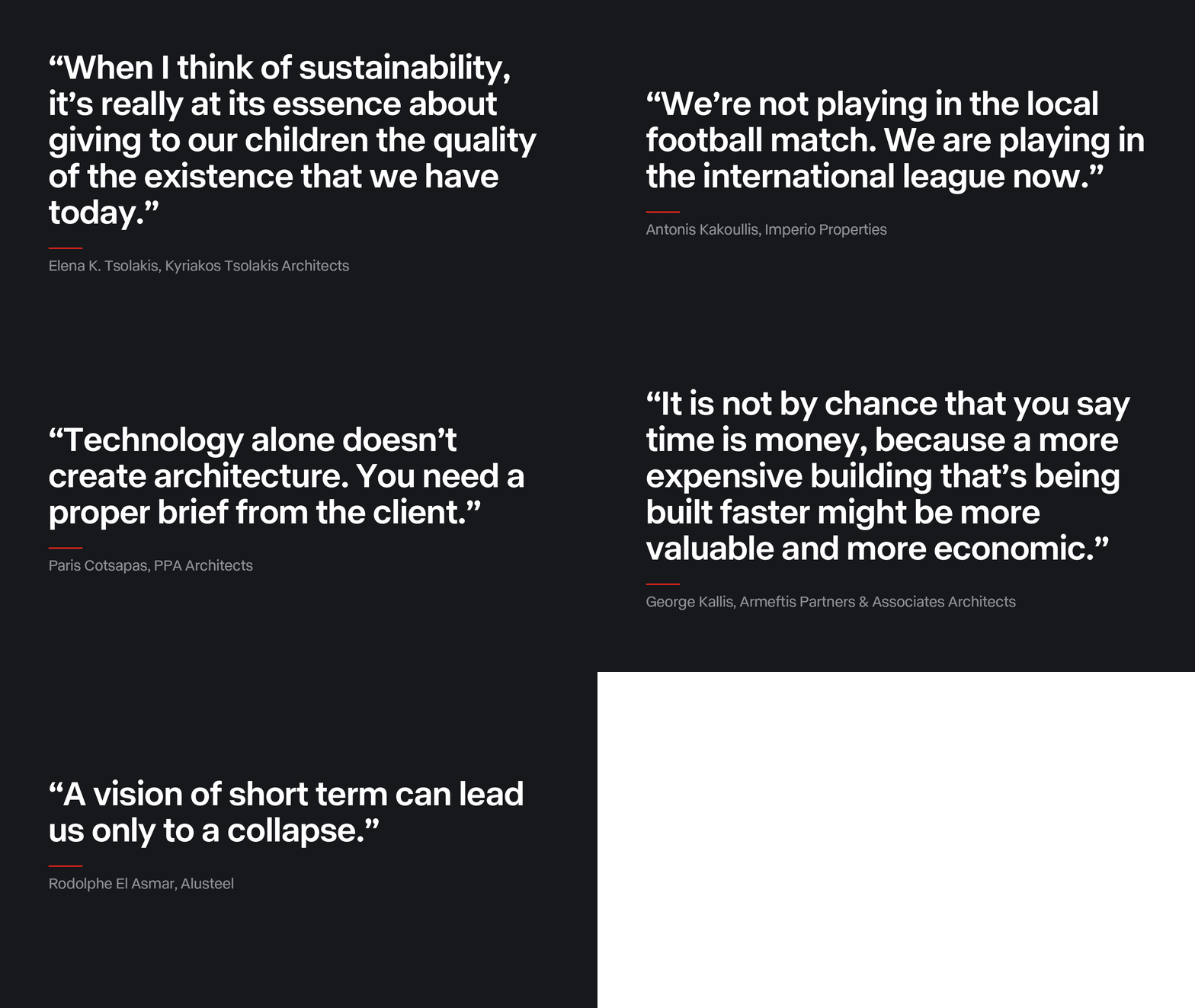
When I think of sustainability, it’s really at its essence about giving to our children the quality of the existence that we have today.
Elena K. Tsolakis, Kyriakos Tsolakis Architects
George Kallis of Armeftis Partners & Associates took what clients now expect. They have become educated in the best sense: nobody arrives asking for a beautiful object to sell any more, because a building is something you live in and an inheritance to the next generation.
Paris Cotsapas of PPA Architects traced the physical change. The conventional Cypriot building of the 1980s and 1990s was a reinforced concrete frame, a rendered façade and standard aluminium openings. Massing is now more complex, driven by shading, environmental performance and the need to be recognisable, and the render is being dropped for systems, composite panels and ceramic cladding whose purpose is longevity: an economy cannot absorb constant maintenance. The harder shift is the public one: the framework now requires part of a large development to become public square, and developers accept it, but the instinct that the pavement outside is private has not gone.
Rodolphe El Asmar of Alusteel answered on delivery. Ambitious architecture can be resolved through proper engineering, he said; what remains is execution: responsibility carried from early design to completion, coordinated across developers, investors and consultants. Island logistics add their own risk, from sourcing to shortages and shipping, so the answer is early involvement, the façade contractor becoming an engineering partner rather than a supplier.
Kakoullis agreed from the client’s side: engage the whole team at the start, with a brief clear enough that everyone knows what they are responsible for, and appoint somebody to coordinate, because the real difficulty is communication. El Asmar’s example was The Icon, where the client sat at the coordination table weekly.
We’re not playing in the local football match. We are playing in the international league now.
Antonis Kakoullis, Imperio Properties
That answered whether Cypriot clients judge a façade by more than image and initial cost. Competition has made everyone better, and Cypriot developers now compete less with each other than with developers an hour’s flight away. A building is made to feel good inside, but far more people only ever see it from outside: count everyone who will look at The Icon over the next sixty or seventy years, and the exterior stops being a marketing question.
Tsolakis thought the gap between design intent and construction reality had narrowed while ambition grew. Modelling lets ideas be tested almost in real time, and clients are more aware, which makes expert guidance more important, not less. A mountain-top observatory, she noted, would have been unbelievable here twenty years ago.
Cotsapas, asked how much of this is technology and how much client ambition, refused to choose: information technology first, then the regulatory framework, then the ambition to invest in a landmark, then technology again in computational fluid dynamics, CNC manufacturing and fully unitised systems.
Technology alone doesn’t create architecture. You need a proper brief from the client.
Paris Cotsapas, PPA Architects
Which produced the sharpest exchange. The risk has inverted, they agreed: the old constraint was being unable to build what you imagined, the new one a tool doing what you never imagined, so imagination has to stay a step ahead. Ask a model for an amazing building and you will not get one, Cotsapas said: the quality of the result depends on the quality of the prompt, and writing one good enough still takes a team of professionals.
Kallis closed the cost question by refusing its terms. Do not discuss cost without value: proper value engineering counts not only the construction figure a client fixes on, but longevity, minimal maintenance, operational as well as capital expenditure, and time.
It is not by chance that you say time is money, because a more expensive building that’s being built faster might be more valuable and more economic.
George Kallis, Armeftis Partners & Associates Architects
The last word went to the city: the state must coordinate the road network and the new neighbourhoods at the speed the private sector is already moving, or Limassol becomes a two-speed city. El Asmar pointed at the population growth expected over the next decade and asked for infrastructure and planning to be foreseen rather than discovered.
A vision of short term can lead us only to a collapse.
Rodolphe El Asmar, Alusteel