


A façade can look resolved on a drawing and still leak at the corners on site. A developer, two architects, a fabricator and a systems supplier traced the journey from concept to delivery, and kept returning to one theme: the earlier every stakeholder is involved, the fewer “unknowns” survive to the site, where they become water ingress, blown budgets and missed programmes.
A façade begins with the architect's vision and has to survive, intact, all the way to delivery on site. Shrikrishna Ginde of L&T Construction framed that arc, bringing together Sruthi Reddy of the developer Ceebros and an architect herself; R. Vijayan at L&T Construction; Ajay Sethi of URBN Design Studio, practising across Bangalore, Chennai and Singapore; Rohit Sharma of Innovators; and Pratik Doshi of Schüco.
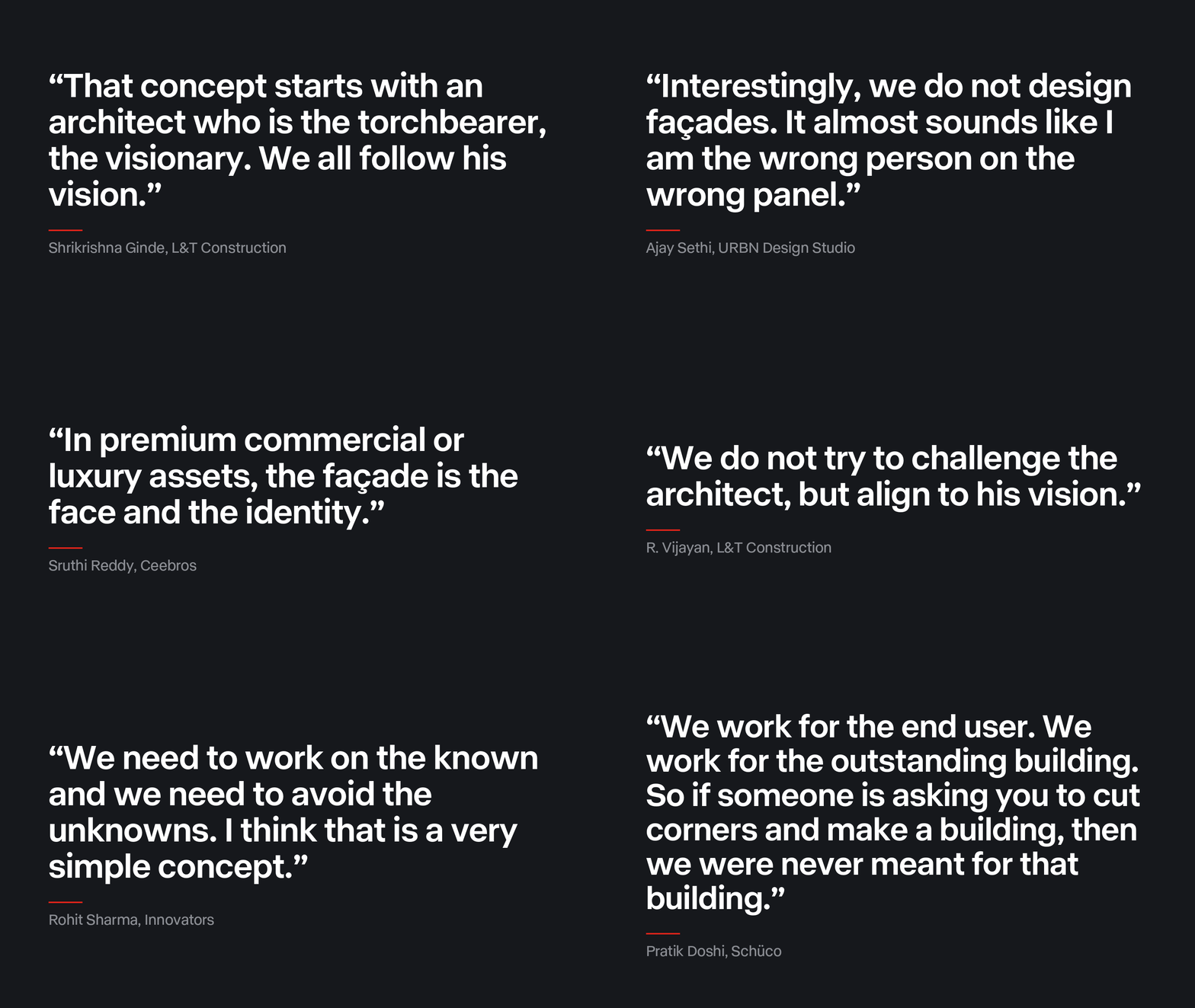
That concept starts with an architect who is the torchbearer, the visionary. We all follow his vision.
Shrikrishna Ginde, L&T Construction
Sethi opened with a deliberate provocation: “we don't design façades.” Architects, he argued, design buildings from the inside out, not the outside in, the layouts and the way a building works are what shape what you eventually see. The envelope is not a cosmetic application but an active performance layer driven from within: form, functionality and light, yes, but maintenance and operations too, all of which have to come together in the final built form.
Interestingly, we do not design façades. It almost sounds like I am the wrong person on the wrong panel.
Ajay Sethi, URBN Design Studio
From the developer's chair, Reddy made collaboration the first principle: bring the structural engineer, the consultants and the specialised contractors in before the project is really developed, so the building can be optimised. Budget, she argued, is less a constraint than a question of where the value lies, and in premium and luxury assets the façade is the face and the identity. A high-performance envelope buys superior acoustic comfort and better daylight, which translate into premium rentals and sales and, ultimately, into asset valuation.
In premium commercial or luxury assets, the façade is the face and the identity.
Sruthi Reddy, Ceebros
Both returned to how much the ground has shifted. Fifteen years ago, Reddy noted, Chennai did not have the skyline it has now; today the local ecosystem, talent, solution providers, structural engineers, contractors, has matured enough to deliver it. Vijayan, sitting as both an architect and a contractor, called that dual view a boon: he can align to the architect's vision while stress-testing performance, maintenance and constructability at the tender stage, raising the gaps in a specification as queries so every stakeholder can respond and the project can be priced fairly, including asking the client early whether they are pursuing a green rating that will set the performance bar.
We do not try to challenge the architect, but align to his vision.
R. Vijayan, L&T Construction
Sethi was careful about language. What is often called value engineering is better understood, he said, as working through specifications and substitutions, because a façade is a complex system in which a single element out of place leads to water ingress or air leakage. The place to look first is what you cannot see: the structure holding the envelope up. Re-open the structural calculations and there is almost always saving in the number and size of the mullions and the steel behind them, provided you keep asking why a thing is the way it is.
Sharma, from the fabricator's side, put the discipline plainly: every project juggles time, quality and cost; you prioritise two and work the third, and quality is the cruel one, because it is only really judged two years after handover. The true sense of value engineering, he argued, is value, not cost-cutting: it is catching what has been over-designed or over-estimated, set right at the very first pass through collaboration with the structural engineer, the architect and the material supplier. Doshi drew a hard line around it, Schüco works for the end user and the building's life, takes a specification through the structural route first, and will not move the building line simply to save money.
Tooling and supply have moved with the ecosystem. Where systems were once largely imported, Reddy noted, aluminium composite and honeycomb panels and glass are now made domestically, cutting dependency and logistics; and BIM lets the team visualise and integrate the envelope before construction, making programmes and deliverables more predictable. Sethi pressed for more, though: architects still lack good tools to take the decisions that matter most, massing, orientation, energy, at the moment they matter, and too often depend on a lead consultant who arrives months later, when nobody wants to re-orient the building. Reddy's caveat: a tool cannot overtake what you imagine; it stays a tool, and the architect is not going anywhere.
On delivery, Sharma reduced it to a maxim: work on the known and drive out the unknown. Once the drawings are signed off, genuinely signed off, with a mock-up and everything visualised, the concept has to be carried through the whole chain, from design to fabrication to the supplier of the raw material. The biggest problems, he argued, only ever come from an unknown: a labour shortfall, a spell of weather. Know them, plan for them, and never let them compromise the final delivery.
We need to work on the known and we need to avoid the unknowns. I think that is a very simple concept.
Rohit Sharma, Innovators
Doshi located quality control right at the start rather than on site. Check serviceability first, how big the glass is, whether the building even has a maintenance unit to reach it, whether a broken pane can be replaced. Corners are the most critical detail and the one that most often fails the water-penetration mock-up, precisely because the design did not resolve them. The answer is a process, followed religiously: design, then a structural check, then a fitment check in Germany, then a check that the profile can actually be extruded, with water and air tested on Schüco's own rig before anything goes to a third party, all in service of the thousand-pascal water tightness that is now the baseline.
We work for the end user. We work for the outstanding building. So if someone is asking you to cut corners and make a building, then we were never meant for that building.
Pratik Doshi, Schüco
Vijayan added an honest caveat: Indian specifications still too often omit the standards, ASTM, AAMA or the Indian codes, and the support-system details a contractor needs to price and build with confidence, which is exactly why forums like this one matter. And Reddy closed the loop on testing: where a full-scale physical mock-up once had to travel to another city, she recalled sending a Schüco project to Mumbai, premium developers now test statically, dynamically, for water and for seismic movement, locally and up front, to fix the foreseeable problems before they reach the site.