


The industry is not short of expertise: ask anyone what makes a façade perform and they will answer correctly. Osama Abbas, of IBECE Group, on why intelligent teams still deliver failing envelopes, and the order the questions should come in.
Osama Abbas, chief executive of IBECE Group, put the case that a façade's quality is settled before anybody discusses design, materials, procurement, testing or construction. It is settled by the way decisions get made.
His opening move was to prove that expertise is not the problem. Ask any façade professional what criteria decide technical performance and they will answer correctly: structural performance, acoustic performance, U-value and thermal behaviour, cleaning and access. The industry can define success. What it cannot reliably do is arrive there.
Six aims, all of them legitimate
The stakeholders are as well understood as the criteria. The developer seeks value, the contractor buildability, the architect vision, the consultant compliance, the engineer performance, and the facilities management team maintainability. Nothing on that list is unreasonable. The trouble starts when each of the six optimises towards their own narrative.
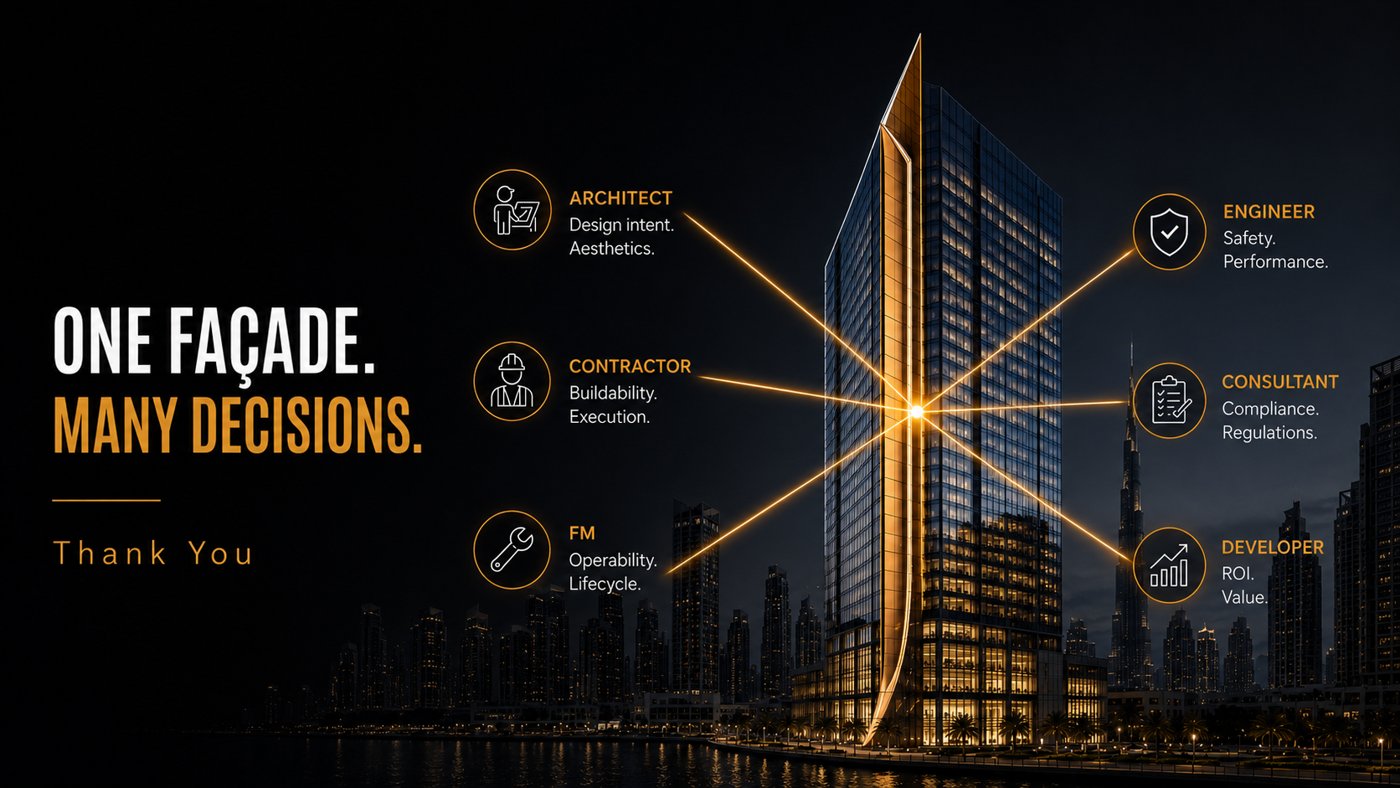
Which raises the question Abbas built the rest of it on: if we know what makes a façade succeed, and we know who is involved and what each of them wants, why does one project win awards while another ends in disputes, arbitration and legal claims? Why do intelligent teams still deliver failing façades?
The instinct is to blame a bad product, bad engineering or bad workmanship. His answer is a disconnected mindset. Each team thinks inside its own silo and optimises its own end, the architect for beauty, the engineer for performance, the contractor for programme, and nobody aims at the façade itself. What the façade actually receives is a stretched version of everybody's optimum. One detail and one fact, read through six different narratives.
He gave that a name worth keeping: local optimisation produces not global optimisation but global consequence. And the consequence has an address. The project finishes, the teams leave, the building remains, and the owner is the one person still holding it, answerable for decisions other people made. Behind the owner sits the FM team, living with difficult access, constant inspection, routine cleaning and the replacement of materials, at the cost of the building's image.
Time does not compromise
Some decisions do not reveal themselves at once. They look brilliant on day one and become expensive mistakes two decades later, because time does not negotiate the way a design meeting does; it only exposes what was decided. An icon on opening day turns into a construction site in five or ten years, with capex and opex both up, and sometimes a sick building nobody can diagnose without destructive investigation.
The questions move with the project, too. Concept asks whether this can be iconic. Design asks about performance. Construction asks about delivery. Handover asks whether it met expectations. Then, Abbas argued, the real journey starts: can it be maintained efficiently, can it be repaired when it needs to be, and would we make the same decision again? That last one is the question the industry almost never returns to ask.

Three dimensions, and the order they come in
His framework holds a decision against three things. People: who is involved and who is affected. Time: when the decision is being made, and whether it is already too late. And life cycle: how long it will perform, through inspection, cleaning, repair, replacement, upgrade and adaptation. A building is not a finished product but a living asset, and the test is domestic rather than technical. Do the tenants have thermal and acoustic comfort? Can the glass be cleaned weekly, or monthly, or is it effectively impossible, so it is done once a year and the building simply looks dirty? That shows up in the developer's return and the property's value.
Timing is the part he pressed hardest, because the right question at the wrong moment is useless. Ask about façade access and maintenance once the design is frozen and there is no flexibility left to answer with. Ask about budget after the design is finished and the budget is not really the subject any more. Knowing what to ask is not enough; knowing when to ask shapes the outcome, and without a stated destination you are optimising in space.
So he proposed a sequence. Vision first, and the operative word is not vision but all: what are we all trying to create? Vision is usually authored by the architect and almost never delivered by the architect, because it cannot survive five of six stakeholders resisting it. The contractor's job is not only to push back but to help achieve it; the engineer's is not only to issue compliance certificates. Budget second, as an estimate the moment the line is drawn, because the alternative is the familiar dead end: detailed design goes to tender, a cost consultant says 120 million, the contractor bids 180, and what follows is called value engineering when it is really cost engineering. Physics third: water tightness, air tightness, thermal and acoustic performance, building movement. Buildability fourth, which means talking to a contractor who has built one before, and choosing that contractor deliberately.