


Donald Lawson argues that façade coating sustainability should be judged over decades, not only at application. FEVE powder systems combine solvent-free application with long colour and gloss retention, shifting attention from first cost to recoating cycles and service life.
Façade coatings are easy to evaluate at the moment of specification: colour range, gloss, texture, application method and initial cost all fit neatly into a product comparison. Lawson argues that the more consequential question is how often that finish will have to be renewed over the life of the building. A coating that is inexpensive at day one but fades, chalks or requires repeated recoating can accumulate cost, material and disruption. His case for fluoroethylene vinyl ether, or FEVE, powder coatings therefore starts with service life. Durability is not treated as a separate aesthetic benefit; it becomes part of the environmental and economic performance of the façade.
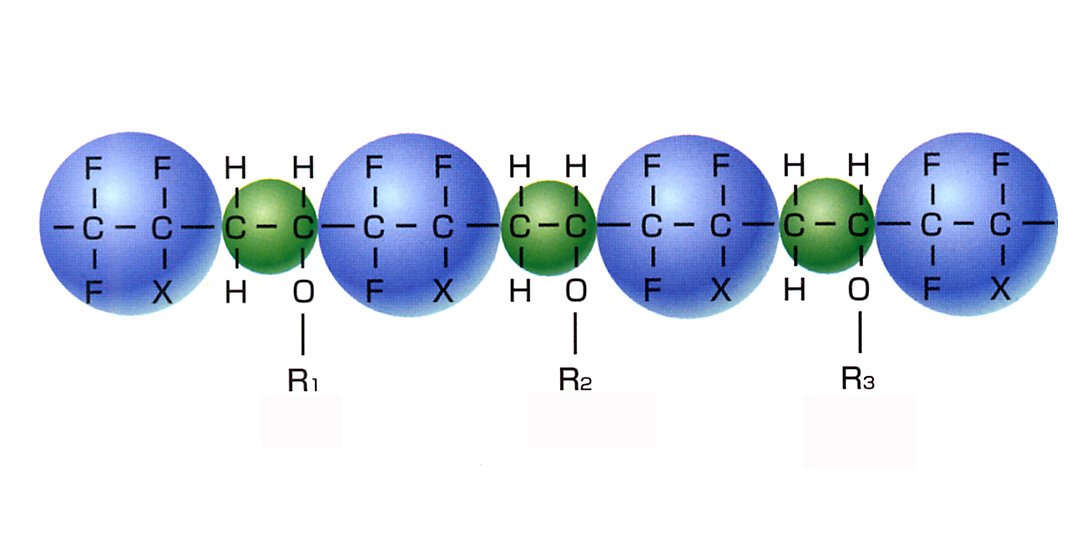
FEVE is a fluoropolymer resin system. Lawson explains its weatherability through the strength of the carbon-fluorine bond, which is resistant to the ultraviolet energy that drives degradation in many exterior finishes. The alternating polymer structure also allows different FEVE formulations, including liquid grades and thermally cured powder systems. His focus is the powder route, where the coating is applied without the solvent carrier associated with many liquid finishes and then baked to cure. For architectural aluminium and steel, the result is intended to combine the application advantages of powder with the long-term weathering associated with high-performance fluoropolymer chemistry.
Recoating frequency changes the lifecycle calculation
Lawson cites 30- to 50-year performance expectations for FEVE systems, with colour and gloss retention as key advantages, and notes that powder formulations can be designed to meet AAMA 2605 requirements. Those are product-performance claims and need to be assessed against the specific formulation, substrate, pretreatment and project exposure, but they establish the logic of his lifecycle argument. If a coating retains its appearance for several decades, the building avoids one or more major recoating cycles. That saves not only coating material but access equipment, labour, surface preparation and the operational disruption involved in refurbishing occupied façades.
This is why first cost can be misleading. Lawson compares FEVE with initially cheaper coating families whose expected service intervals are shorter. A project may spend more per square foot at installation yet less per year when the cost is spread over a longer period. The calculation is particularly relevant for high, complex or difficult-to-access façades, where the cost of returning to the surface can exceed the cost of the coating itself. The sustainable option is therefore not automatically the chemistry with the lowest manufacturing impact at the factory gate; maintenance frequency and replacement intensity also belong in the assessment.
Case studies make longevity a façade decision
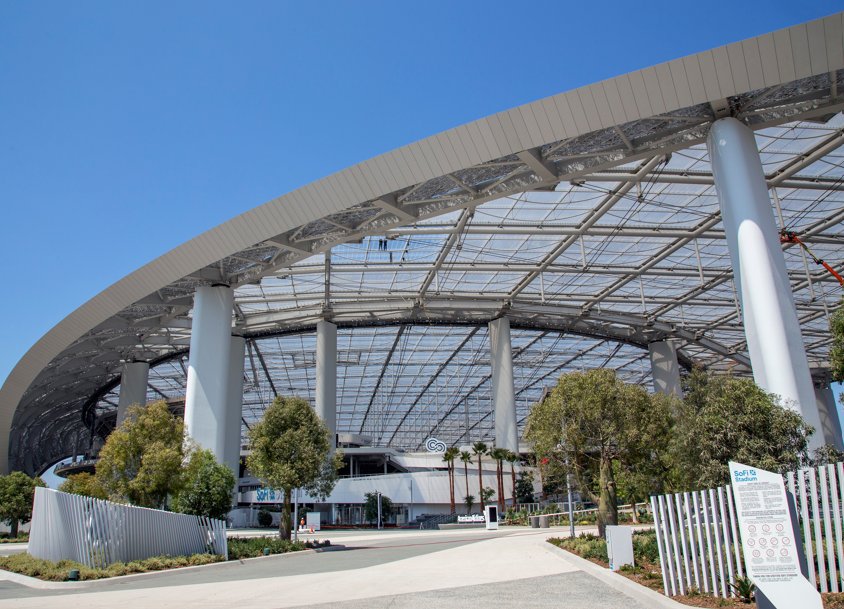
Lawson uses several completed buildings to show where this approach is applied, including structural steel at Las Vegas City Hall, exterior aluminium at Salt Lake City Public Safety Building and a two-coat system at San Diego International Airport. The examples are significant because the coated elements are not small decorative pieces. They sit in exposed architectural positions where colour shift and gloss loss would change the reading of the building. In that context, finish durability is part of design continuity. A façade that depends on a precise red, white or metallic expression has not truly maintained its architecture if the coating rapidly diverges from the intended appearance.
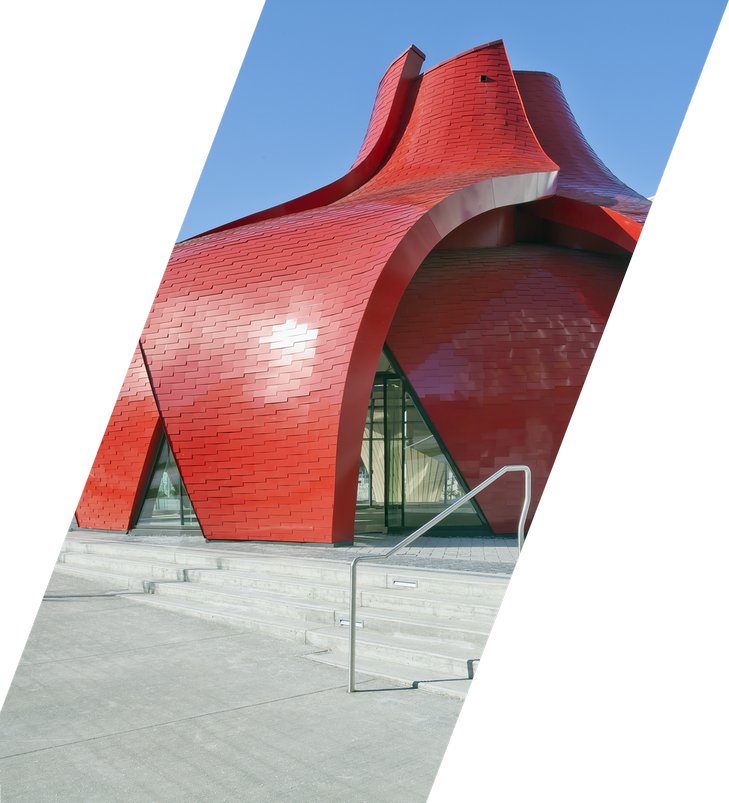
The same logic applies to highly saturated forms. Bright colours are unforgiving because fading is immediately legible across a large surface. Lawson's examples include strongly coloured civic and entertainment buildings where the finish operates at urban scale. A durable coating can reduce the risk that one elevation ages differently from another because of solar orientation or maintenance sequence. This is not a guarantee that every colour will weather identically; pigment, formulation and exposure still matter. It is a reason to include long-term colour and gloss data in the specification rather than treating the colour chip as the end of the decision.
Powder reduces one impact but does not end the analysis
The environmental case for powder coating includes the absence of solvent in the applied system, but Lawson's stronger point is that a coating should be evaluated across its use phase as well. A solvent-free application process does not make a finish automatically sustainable if it requires frequent replacement. Conversely, a very durable chemistry still has to be considered alongside substrate preparation, curing energy, repairability and end-of-life handling. The useful framework is lifecycle thinking: how much material and work are required to keep the façade performing and looking acceptable for the period the building is expected to serve?
Lawson also links long-life coatings to rating-system projects, but the practical takeaway is more general than any certification credit. Façade teams routinely spend substantial effort selecting systems that will resist water, movement and structural loads for decades; the finish deserves the same horizon. Colour stability, gloss retention and corrosion protection affect whether an aluminium panel, steel screen or feature structure remains serviceable or is refurbished prematurely. Those consequences are especially visible in climates with intense ultraviolet exposure. A long service interval is also valuable because recoating is rarely a simple factory operation once a façade is occupied. Existing finishes may need cleaning, abrasion or other preparation before a new system is applied. Adjacent glass, sealants and public areas have to be protected, and access may require lifts, swing stages or closures. On large structures, the environmental burden of that intervention includes transport, temporary works and discarded consumables as well as the coating itself. Lawson's lifecycle comparison is therefore most persuasive when read as a prompt to count the whole maintenance operation. The more difficult a façade is to reach, the more important it becomes to specify a finish whose expected weathering life is aligned with the owner's realistic maintenance strategy.
There is also a design implication in selecting durable colour. Replacement or touch-up material may be applied years after the original construction, when batches, application conditions and surrounding weathering have changed. A finish system with strong retention reduces the frequency with which those local repairs have to be blended into a much older field. For architects, that means durability protects visual uniformity as well as substrate. For owners, it reduces the risk that a nominally sound façade starts to look prematurely tired and is recoated for aesthetic reasons before corrosion protection has actually failed.
The specification question therefore shifts from "what is the cheapest acceptable finish?" to "what service life are we buying, and what will it cost to maintain that appearance?" FEVE powder coatings are one answer Lawson puts forward, supported by long-term weathering claims and examples of exposed architectural use. The broader lesson is independent of brand or resin: durability should be counted as an environmental resource. Every avoided recoating cycle saves material, labour, access and disruption. When the finish is expected to last as long as the façade system beneath it, sustainability and aesthetics stop being separate conversations.