Sunnie Shen built her account around the two questions she is asked most: how to choose a laminator you can rely on, and how to prove that the interlayer sealed inside a finished façade is the product specified. Her answers are an audited network running since 2012, and a token tied to every batch.
The layer nobody can see once it is installed. PVB and ionomer interlayers do the structural and safety work in laminated glass, which is precisely why substituting one is hard to detect.
An interlayer is the one component of a laminated glass unit that becomes invisible the moment it is installed. It does the safety and structural work, it is specified by grade and thickness, and once the panel is glazed nobody can look at it. That is the whole problem Sunnie Shen set out to address, and it has two halves: whether the laminator was competent, and whether the material they used was the material on the drawing.
A token for every batch
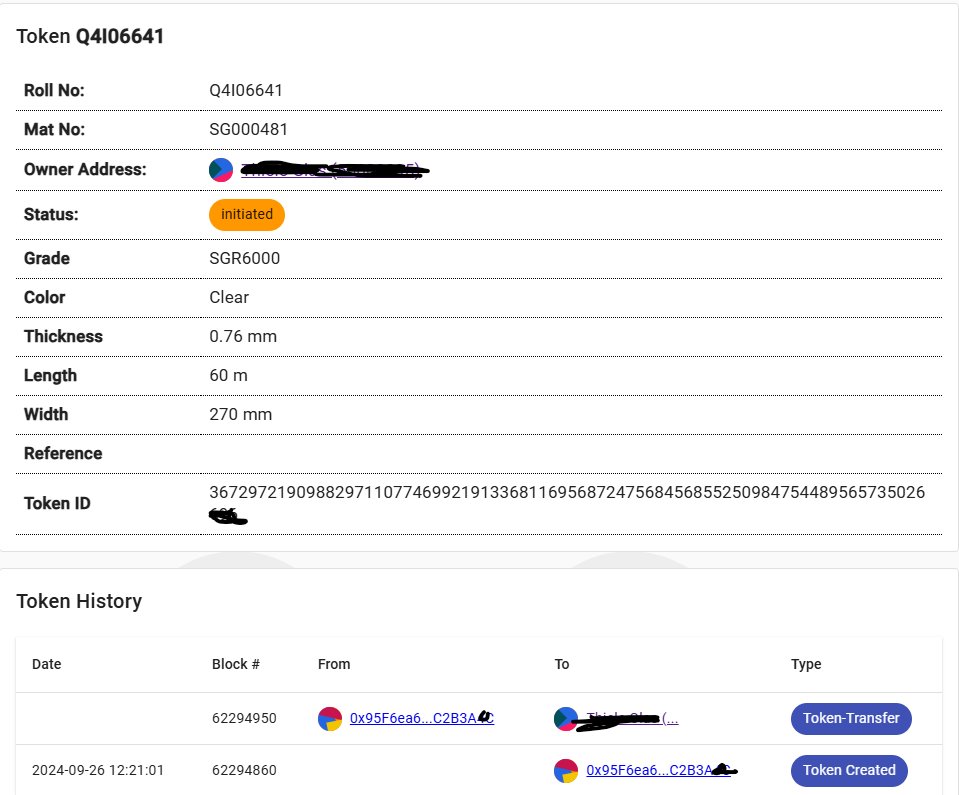
What the token actually carries. Roll and melt number, grade, colour, thickness, length and width, the current owner, and a history showing when the token was created and each time it changed hands.
Kuraray's answer to the second question is Certiply, which issues a token for every batch of material sold. The token is a digital twin of a physical batch, created at production and tied to the batch number, and it carries the metadata that matters: production date, material specification and ownership history. The record sits on a distributed ledger, where each block holds a timestamp, the transaction data and a reference to the block before it, linked by cryptographic hashes into an unbroken chain.
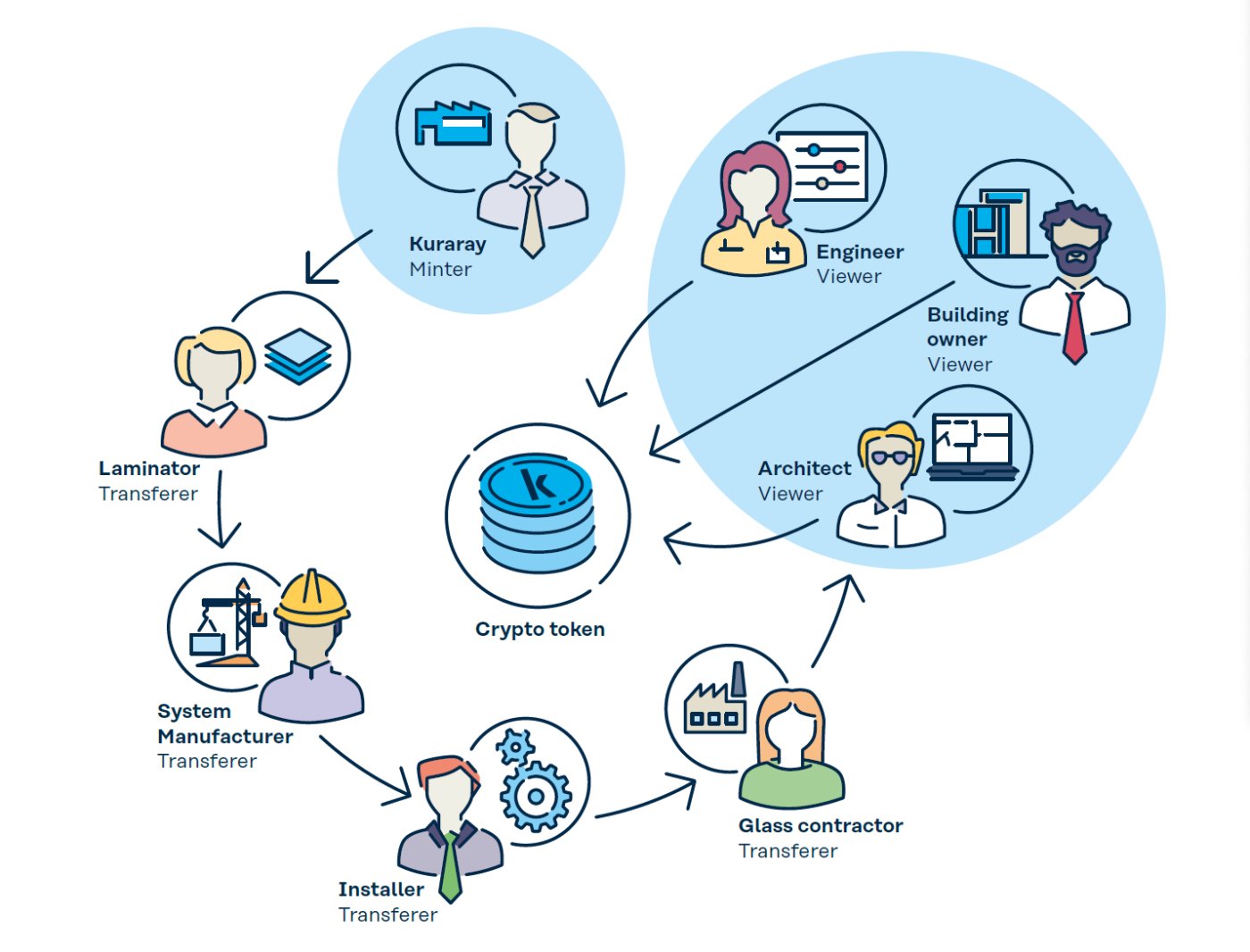
One token, the length of the chain. Kuraray creates it, the laminator, system manufacturer, glass contractor and installer transfer it, and the architect, engineer and building owner can read it.
What makes it useful is that the token travels the same route as the glass. It passes from Kuraray to the laminator, on to the system manufacturer, the glass contractor and the installer, and every transfer writes to the ledger: who moved it, when, and what changed, whether the batch was processed or shipped. The architect, the engineer and the building owner sit at the end of that chain as readers rather than holders. Shen's own summary is that it is a digital passport for the laminated glass.
The argument for putting this on a chain rather than in a database is that there is no central party to trust or to corrupt. Altering a record would mean overpowering the whole network, which is not practical. Two smaller benefits follow: ownership transfers and certification checks stop being manual paperwork, and the paper that traditional tracking generates disappears.
Getting on the network. Access runs through the product path portal or a scanned code, then a browser wallet that talks to the chain.
The practical barrier is that this is unfamiliar territory for a façade team. Joining means reaching the product path portal or scanning a code, installing a browser wallet that can talk to the chain, and keeping a password and a recovery phrase safe. That is a real ask of a supply chain used to certificates as PDFs, and it is the part most likely to decide whether the idea spreads.
And an audited list of laminators
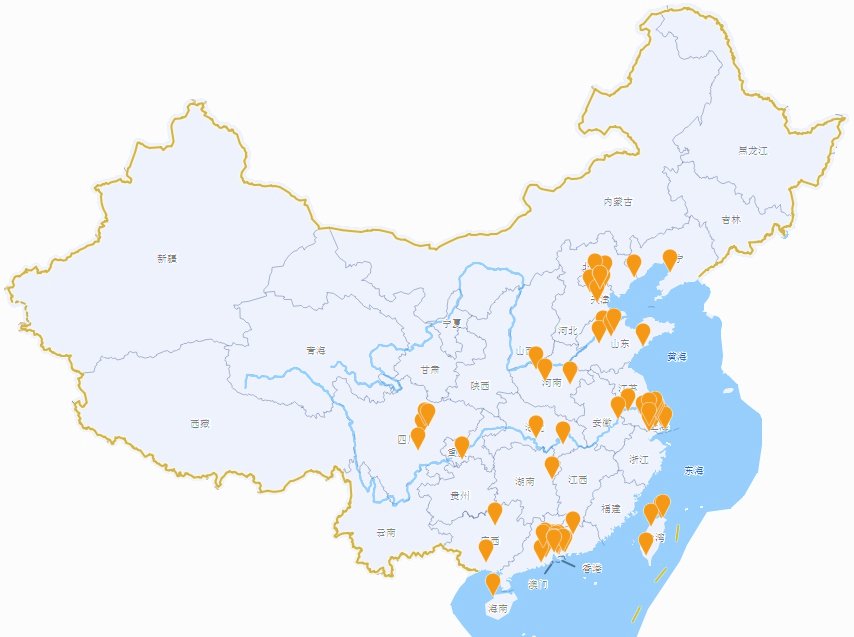
Sixty-four audited laminators. Twenty lines in South China, eighteen in the east, twelve in the north, five each in central China and the southwest, and four in Taiwan.
The first question, about competence, is answered by something much older and less novel. The Quality Network of Laminators has run since 2012 and now covers 64 certified laminators, weighted heavily towards southern and eastern China. Admission has three parts: a business review that gathers the laminator's details and inspects the plant, a technical audit that examines the facilities, oversees sample trials, provides training and requires approved samples with zero defects, and then maintenance, which means quarterly testing of submitted samples, regular site visits and unannounced technical reviews.
The newer element is a star rating on three criteria, and they are worth reading as a statement of what Kuraray thinks separates a good laminator from an adequate one. Facility asks whether the plant environment and equipment comply with the production guidelines. Stability is measured by how often the laminator actually processes the material, judged from submitted samples, on the reasoning that a line which runs the product regularly makes it better than one that runs it occasionally. Reliability asks whether the laminator treats it as their primary ionomer interlayer rather than an alternate. Ratings are reviewed annually and can move down as well as up, and the higher tiers earn co-marketing, logistics support and technical help.