


Allan Gibson argued that a laminate stiffens according to how firmly the interlayer couples its plies rather than to the glass thickness, and that the comparison worth making is retained stiffness at service temperature rather than at twenty degrees.
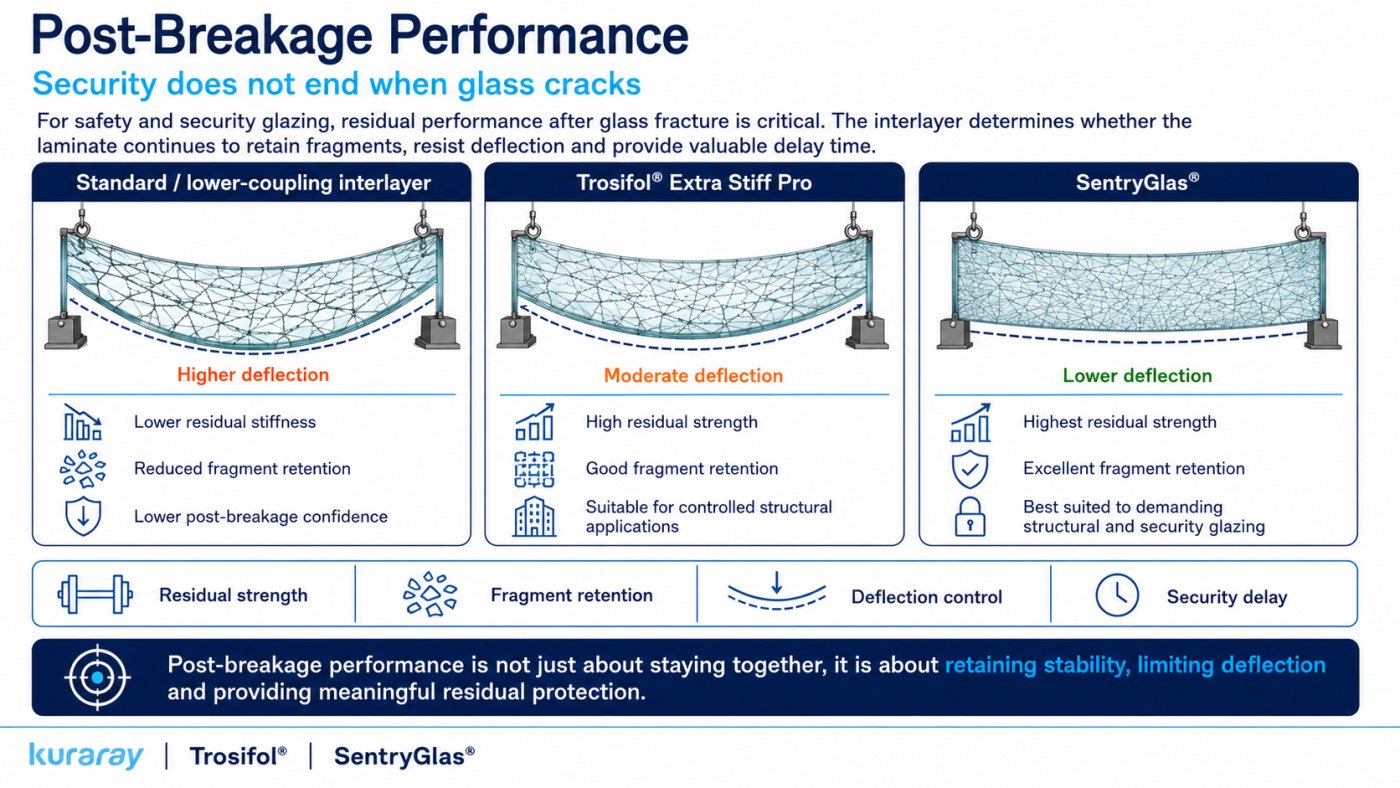
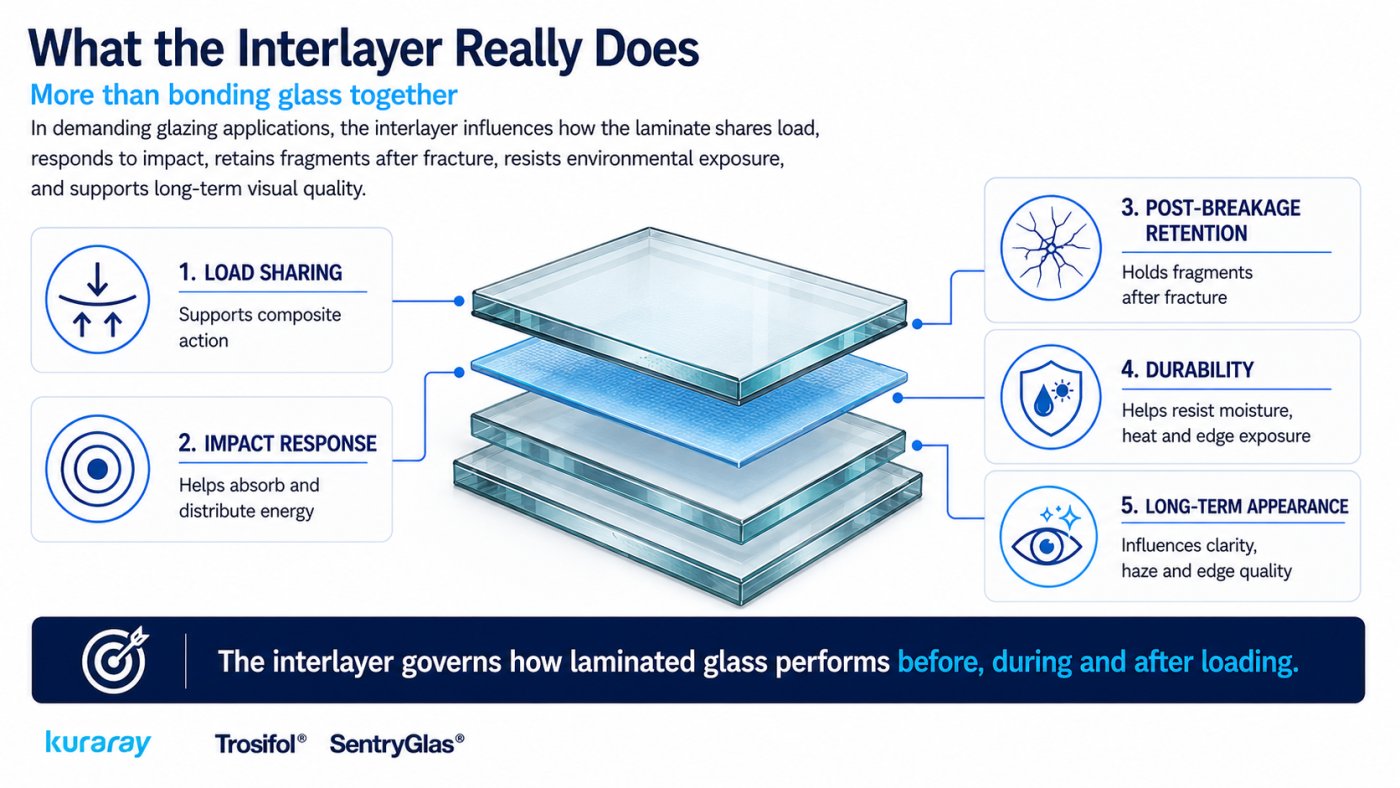
Twenty-six years of specifying materials for construction sit behind Gibson's argument, and it opens by demoting a word. The interlayer in laminated safety glass is not the thing holding two plies together; it is the thing deciding how they behave. It supports load sharing, absorbs and distributes impact energy, retains fragments once the glass has fractured, resists moisture and ultraviolet at an exposed edge, and sets how clear the laminate still looks after years of service. Gibson's framing is temporal rather than functional, and it is the sentence the rest follows from: the interlayer governs performance before loading, during loading and after damage. Which leaves a selection problem rather than a bonding problem.
Where the stiffness actually comes from
A large pane under uniform wind pressure deflects, and the instinct is to reach for thicker glass. Gibson's central point is that deflection is not a function of glass thickness alone. It is heavily influenced by how firmly the interlayer couples the two plies together. With a softer interlayer, standard or acoustic PVB, that coupling is limited, the laminate behaves closer to two independent sheets, and deflection is higher. With a stiffer one the plies act compositely and deflection under the same load falls sharply. The material between the glass is therefore a structural decision taken with the build-up, not a finish chosen afterwards, and design standards are trying to capture exactly that.
Wind is one load out of four
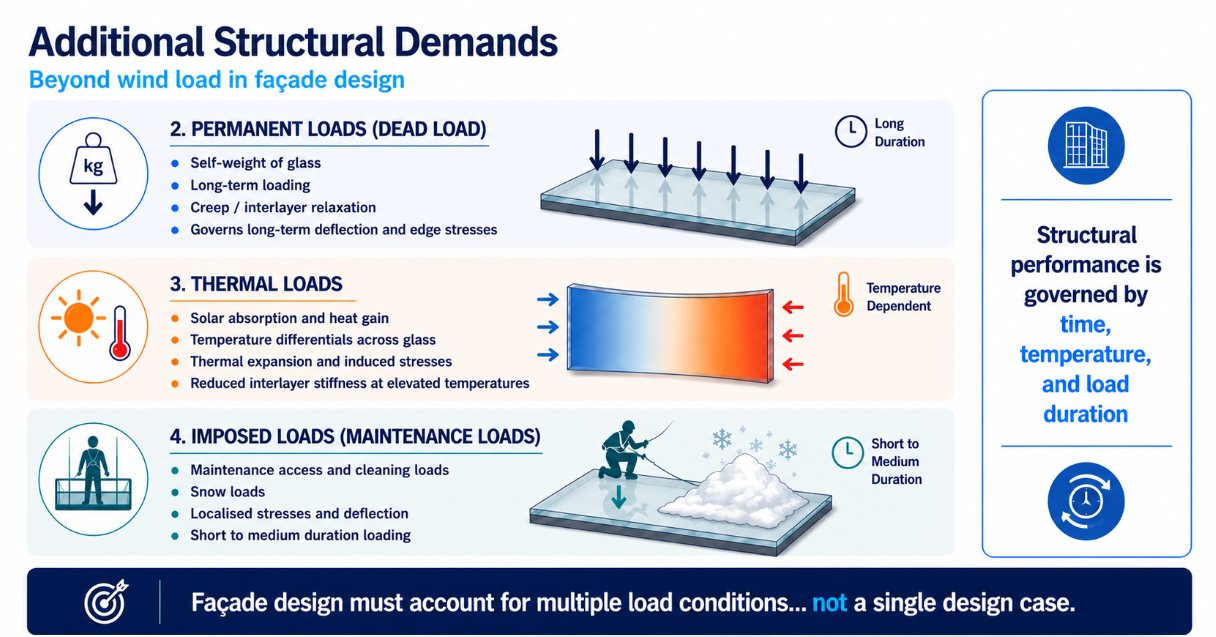
Wind is also only one of the cases. Self-weight acts permanently and over a long duration, which introduces time-dependent behaviour, creep in the interlayer and relaxation of it, governing long-term deflection and edge stresses. Thermal loading is equally critical, because solar absorption and temperature differentials across the glass reduce interlayer stiffness at precisely the hours the sun is doing most work. Imposed loads, maintenance access and localised point loads, arrive short and concentrated and put their own stresses into the system. Gibson's conclusion is that structural performance is governed by a combination of load types, duration and temperature, and that an elevation designed against a single case has not been designed.
The comparison that matters is at forty degrees
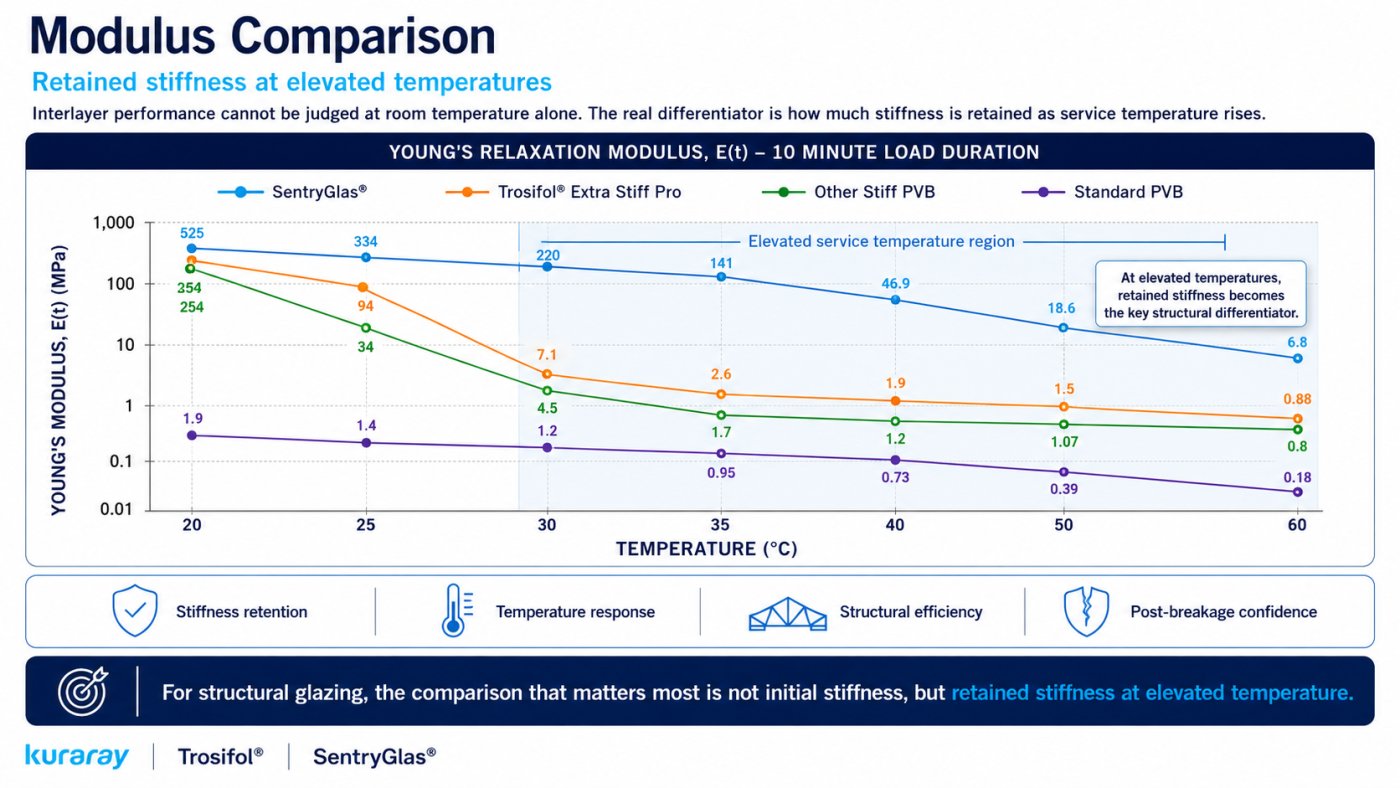
This is where the two structural interlayers separate, and Gibson is careful that they should not be specified the same way. PVB relaxation is governed by a threshold around thirty degrees, above which stiffness falls away quickly; the ionoplast holds a far higher Young's modulus past forty, which is the condition an exposed elevation spends its summers in. So the comparison worth making is not initial stiffness at room temperature but retained stiffness at service temperature. The same order shows up after fracture, where the interlayer decides whether the laminate keeps its fragments, limits deflection and buys any delay at all. SentryGlas therefore goes where elevated temperature, open-edge durability or maximum post-breakage strength are required, and the stiffer PVB where temperatures are lower or controlled.
An acronym somebody else is using
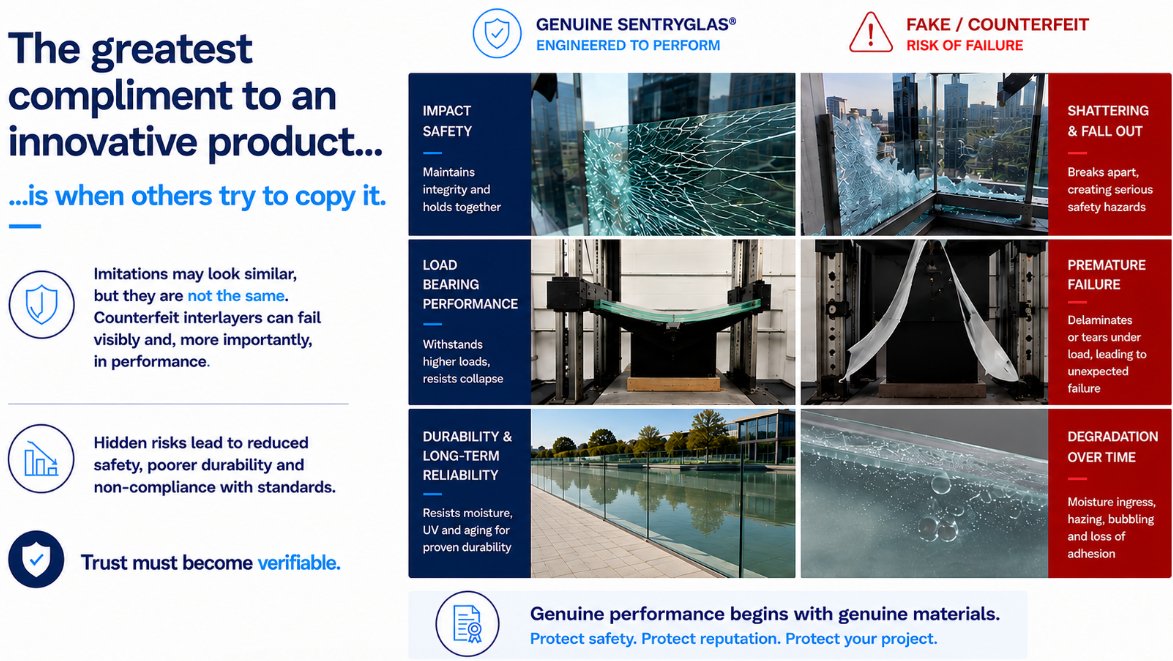
The closing argument is about supply rather than physics. Successful products attract imitation, and a counterfeit interlayer can be visually almost indistinguishable while performing nothing like the original, with consequences for safety, durability, structural integrity and compatibility with the sealants around it. Gibson is candid about how it happened to his own: SGP is an acronym borrowed from SentryGlas Plus, which nobody thought to protect, and it is now attached to material that is not it. The answer built since is an authentication layer, CertiPLY, tamper-proof and carried through each step of the chain from production to installation, so that what was specified is demonstrably what arrived.