


Jeroen Boersma frames sustainability in the façade industry around long service life, lower-carbon materials and the ability to recover components. Circularity is less about end-of-life recycling claims and more about designing connections, modules and maintenance so that value is not destroyed during change.
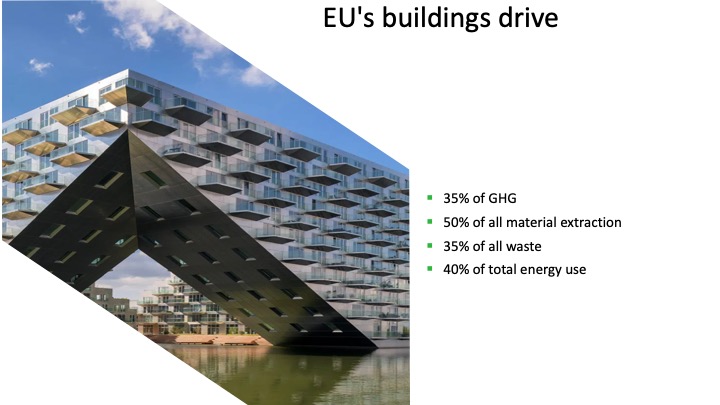
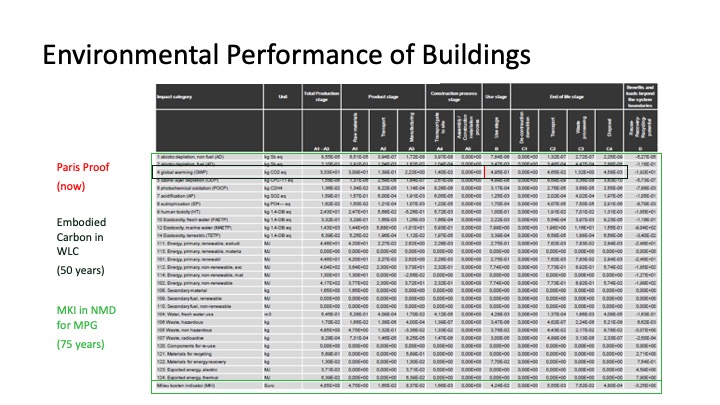
Boersma’s sustainability argument begins with a change in what the façade industry measures. Ten years ago, a “sustainable” window system might have been described mainly through thermal performance. Today that answer has to include the impacts of producing the aluminium, glass, gaskets and coatings, replacing components during use, cleaning and maintenance, and what happens after the first service life. A life-cycle assessment is useful precisely because it shows where the largest impacts sit instead of letting one preferred metric dominate the conversation.
Whole-life carbon changes the frame
Dutch environmental assessment already considers a wide range of impact categories through the national database and MPG methodology. Boersma notes that carbon receives increasing weight, while emerging whole-life-carbon regulation connects embodied emissions with operational energy over decades. That longer view matters because an apparently low-carbon replacement can perform poorly if it shortens service life, while a higher initial impact can be justified if it materially reduces energy or avoids repeated replacement.
Existing buildings are the main future market
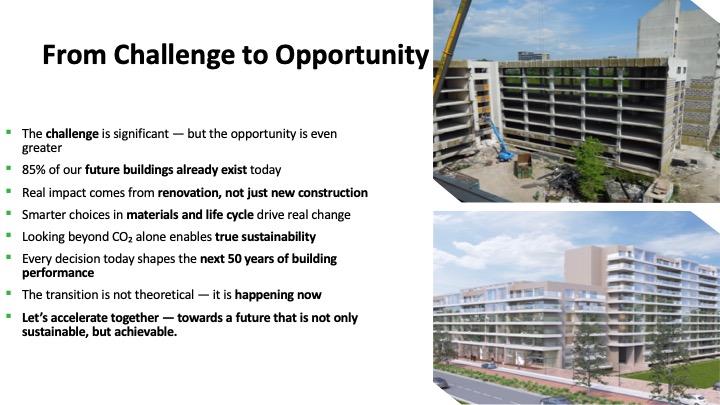
Boersma cites the expectation that most buildings in use today will still be standing in 2050. That makes renovation a central façade task. The first circular strategy is therefore longevity: keep frames, hardware, coatings and gaskets performing for as long as practical, and make routine repair possible before considering wholesale replacement.
Aluminium has particular advantages in that discussion because it is valuable, widely recovered and can be remelted with far less energy than primary production. Boersma says the Dutch national database has raised the assumed end-of-life recovery rate for aluminium framing to 99%. That does not make new aluminium impact-free, but it makes disassembly and material recovery realistic rather than theoretical.
Reuse is harder than recycling
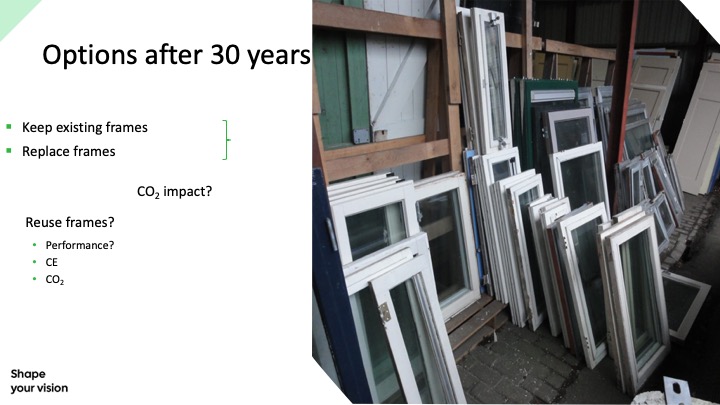
The frame itself can often be unbolted and the glass removed, but reuse at the same performance level raises more difficult questions. A façade near a railway, for example, may need verified acoustic, fire, airtightness and structural performance. An older frame may have no reliable declaration for those requirements, and testing enough reclaimed units to support a new warranty can become expensive.
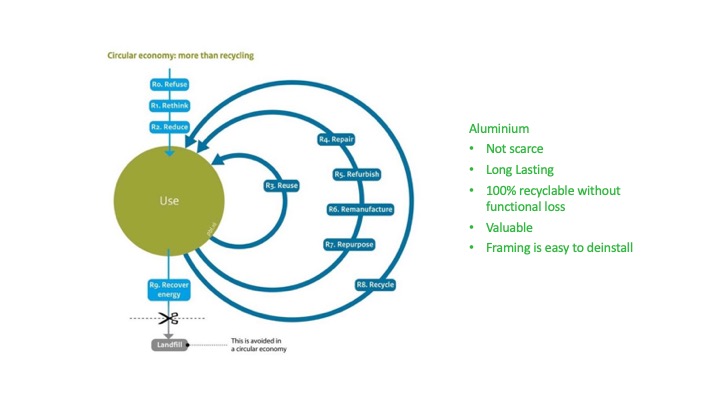
That is why Boersma distinguishes between repair, refurbishment, repurpose, reuse and recycling. Replacing old glazing while retaining a sound frame can be a sensible intervention; in other cases, replacing the complete frame may reduce operational energy enough to compensate for the new material. The decision should come from a project calculation, not a slogan.
Recycled content has a system limit
Demanding extremely high recycled content in one project does not create more scrap aluminium. If the available market supply is only enough to support a lower average, concentrating it in one façade can simply deprive another project. Boersma therefore argues for lowering the impact of primary aluminium as well as increasing the total amount of recycled material in circulation.
A circular façade is therefore not defined by one material claim. It is a system designed to last, be maintained, be opened without destruction and move through the highest-value next use that the real performance requirements allow.
Recycling rates do not automatically equal circular design
Boersma uses aluminium to show why a high recycling percentage needs interpretation. The Dutch environmental database moved its assumed end-of-life recovery for aluminium from about 79% toward 99%, and remelting secondary aluminium uses only a fraction of the energy needed for primary metal in his comparison. Those are strong arguments for keeping aluminium in circulation. They do not mean every project should simply demand the highest recycled-content percentage available. Secondary aluminium is a constrained resource; specifying an extreme recycled share for one façade can redirect scrap from another use without changing the total amount in the market. Reuse is more demanding still. Existing frames need evidence for acoustics, fire, air and water performance, and often a route to CE marking or warranty. His keep-versus-replace calculator is valuable because it makes those constraints visible before a circular claim is written into the brief.