


Tim Brans argues that circularity cannot be perfected in a spreadsheet before construction. Reusing stone and glass, working with market partners and documenting components through material passports creates knowledge that can be applied to the next retrofit.
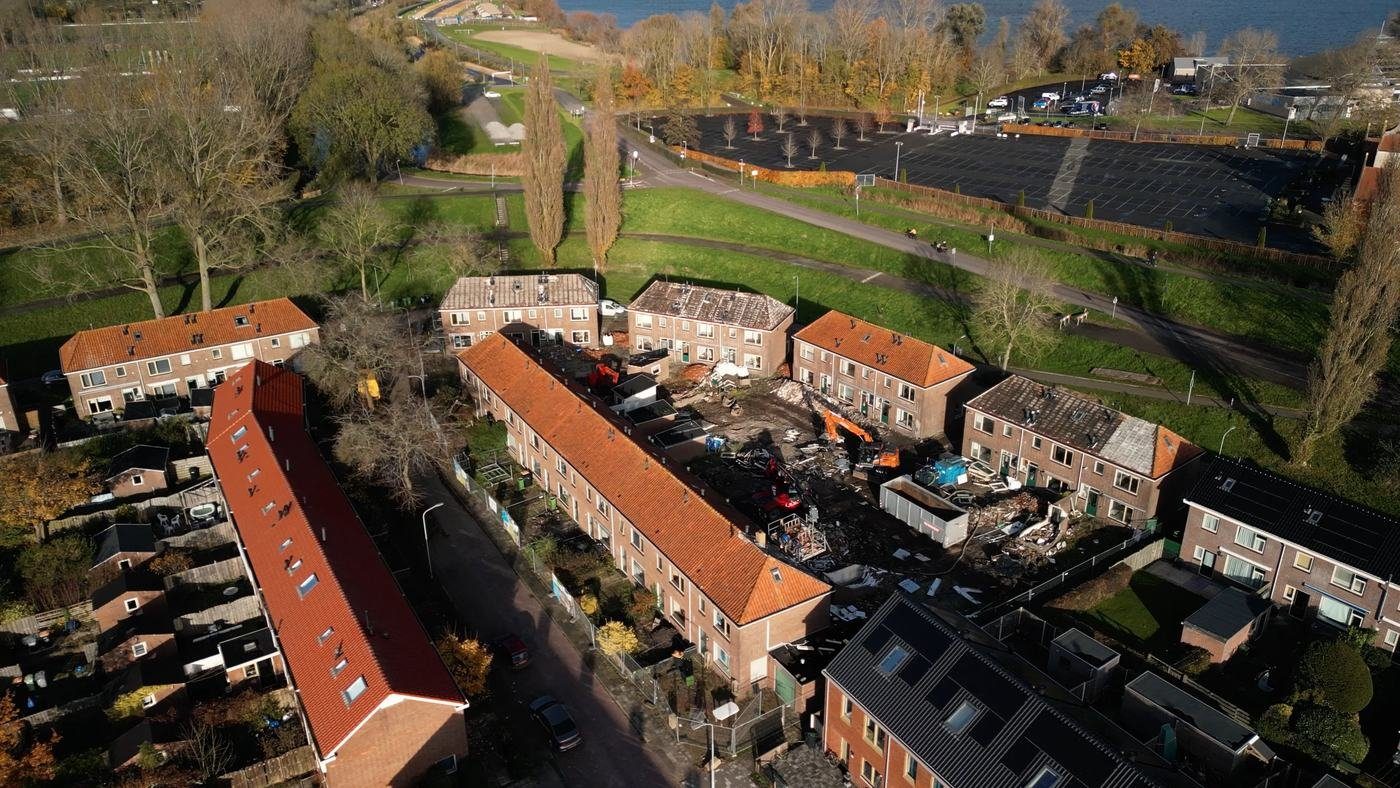
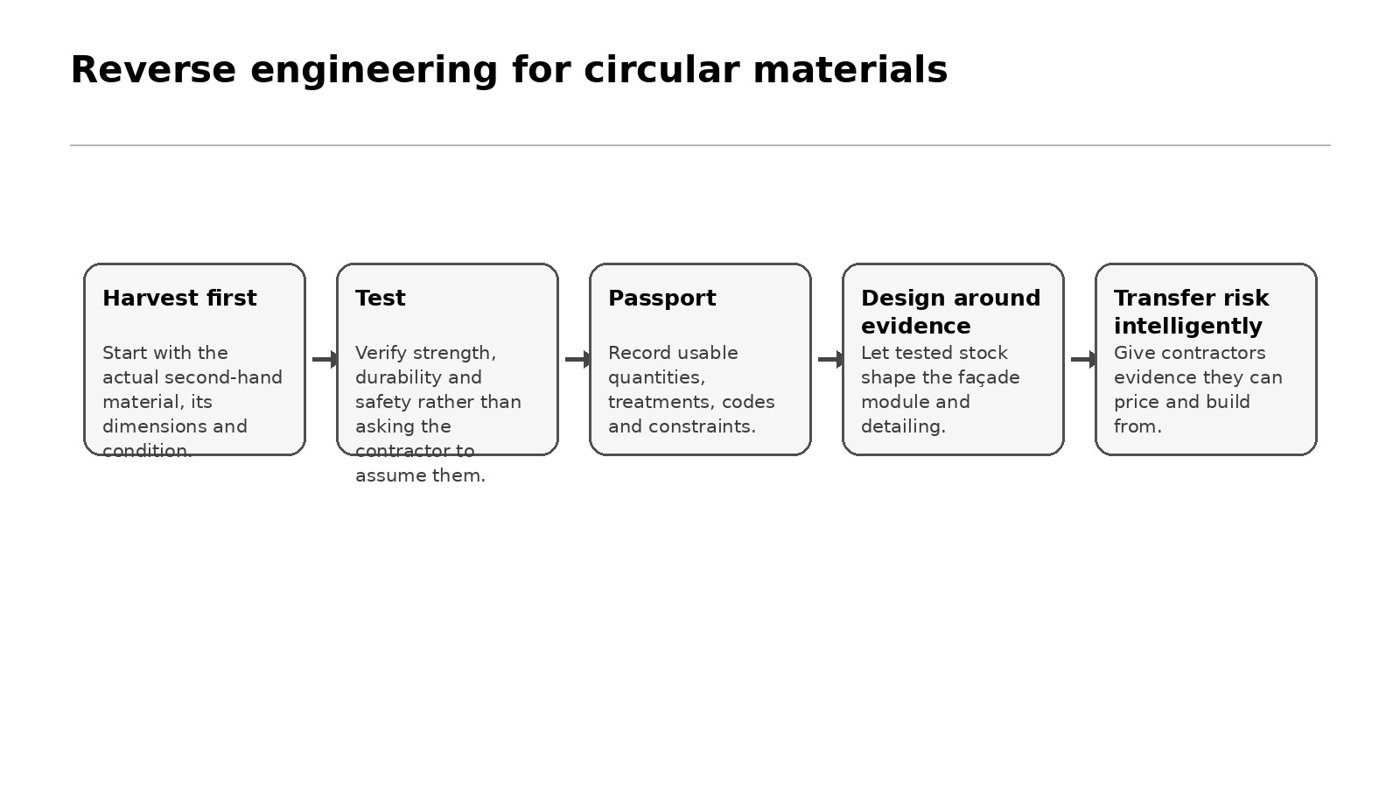
Circular design becomes credible when a project has to deal with real dimensions, dirt, damage, testing and warranties. Tim Brans describes Studio NUDUS as learning by doing: start with the material that already exists, involve the people who know how it behaves, test it, document it and then let that evidence shape the new architecture. Two projects show how different that process can be.
Matrix turns an old roof tile into a façade material
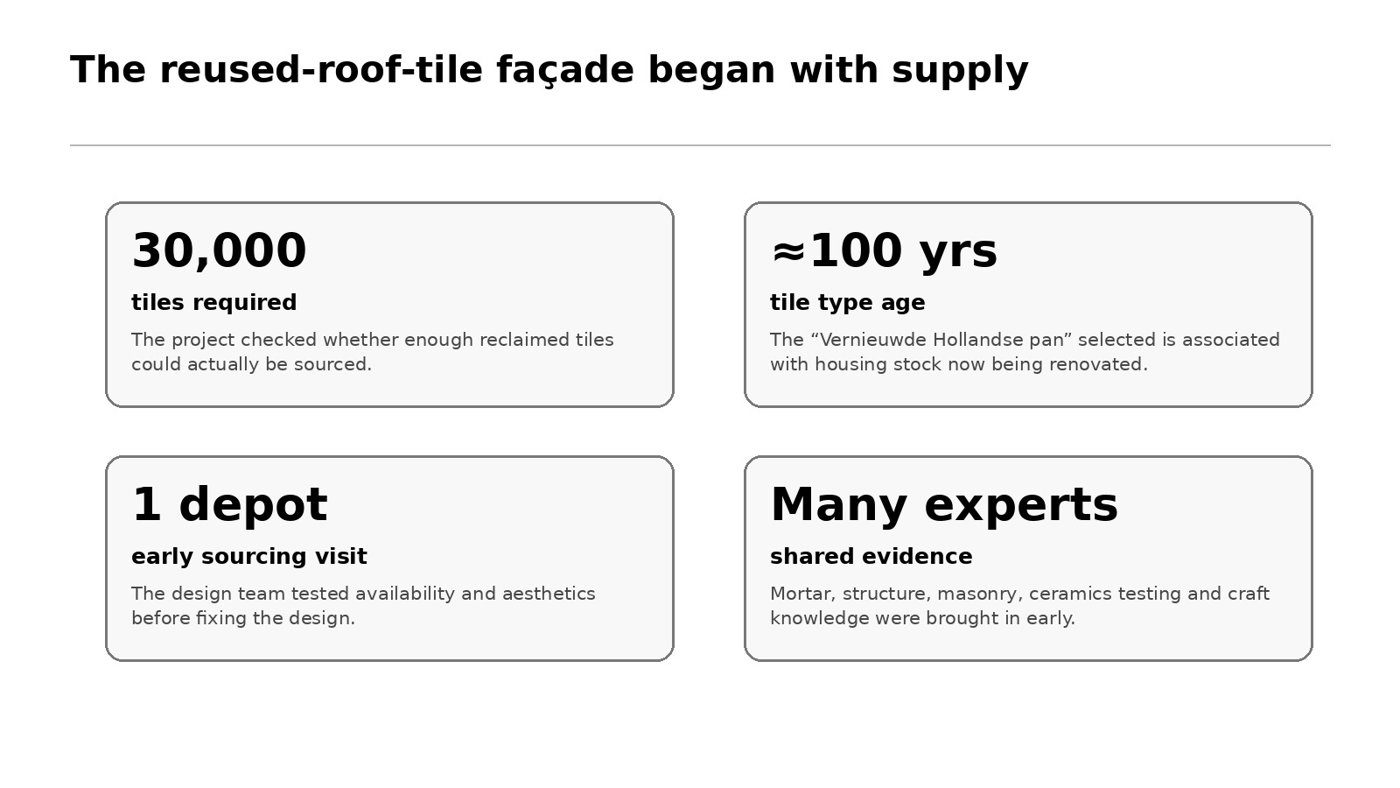
At the Matrix Innovation Center on Amsterdam’s VU campus, the team wanted a hybrid-timber life-science building with BREEAM Excellent and Paris Proof ambitions. A reference to Arturo Franco’s use of recovered roof tiles in Madrid suggested a way to give the new façade a material history rather than specify a new cladding product. The quantity was not trivial: about 30,000 tiles were needed. The selected “Vernieuwde Hollandse pan” stock was roughly a century old, which meant the project needed evidence about freeze-thaw resistance, thermal shock, bond and weathering rather than nostalgia for reclaimed material.
Testing created a new craft process
Brans describes a team that included mortar specialists, structural engineers, masonry expertise, testing laboratories and bricklayers. The old tiles were soaked before placement, which improved the mortar bond. Lime mortar reduced carbon compared with a more conventional option but brought a slower construction rhythm that had to be accepted in the programme.
The same project reused floor pieces elsewhere, reinforcing the principle that circularity is easier when every available material stream is treated as a design input rather than a waste category.
The Palace of Justice turns drawings into a reuse inventory
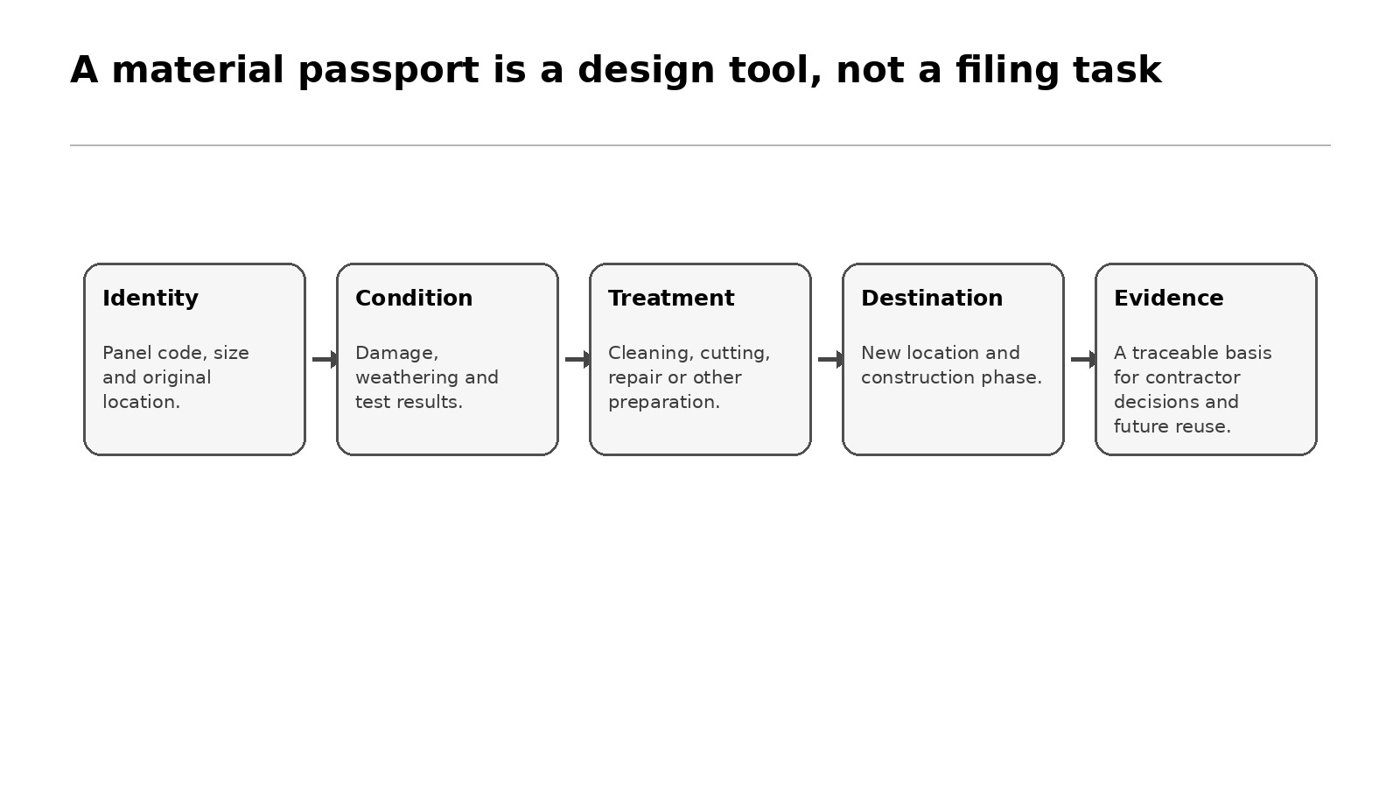
A much larger problem appears in the roughly 80,000-square-metre refurbishment of the Palace of Justice in The Hague. The ambition is to retain and reuse extensive quantities of existing glass and stone. Original panel codes and historic drawings become valuable because they provide a first map of what is already installed. Panels are removed, taken to a testing centre and assessed for remaining performance and possible treatment. That information becomes a material passport recording identity, condition, intervention and intended destination.
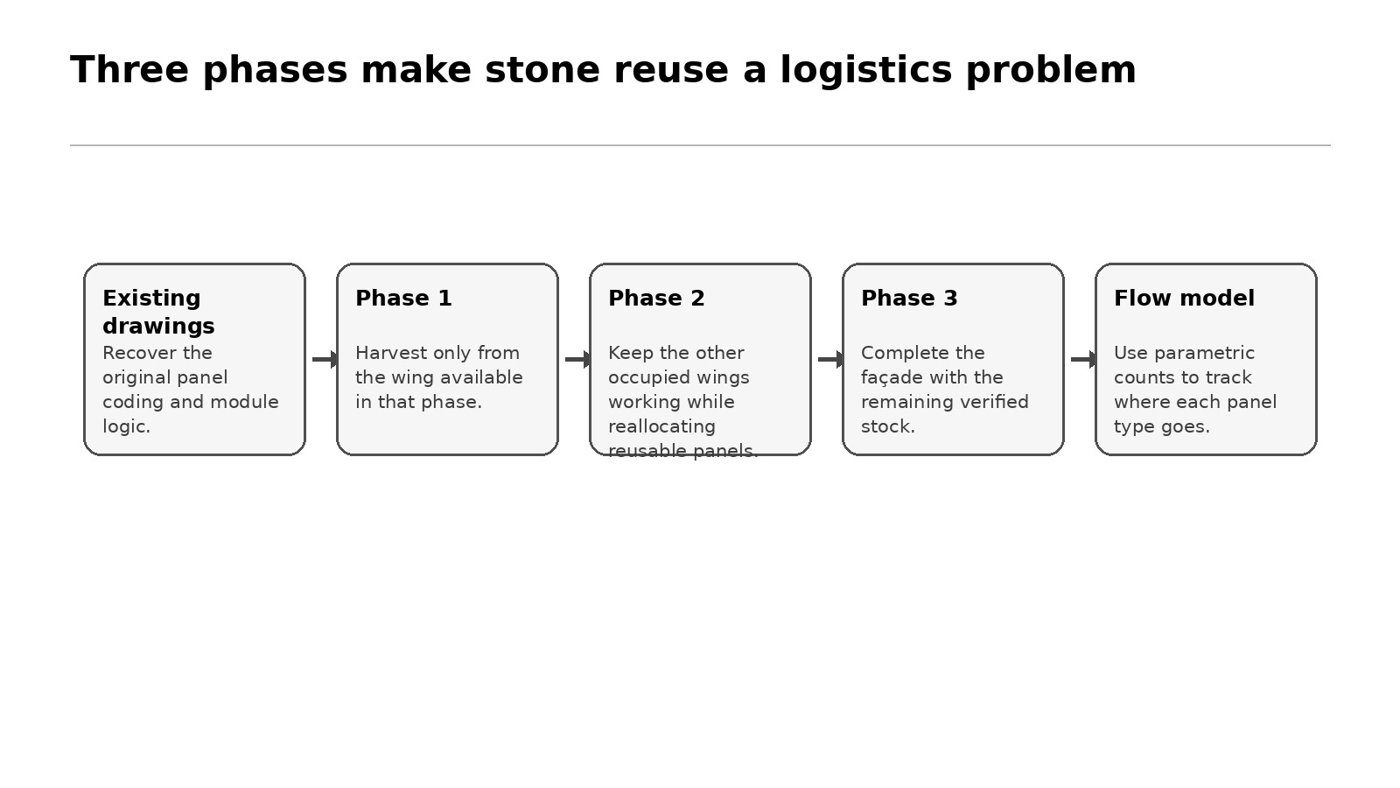
Grasshopper helps count and map those components through the phases. The tool is useful because it translates an irregular stock of existing panels into quantities and locations that designers and contractors can coordinate.
A material passport is evidence, not decoration
Circular projects often describe passports as future-facing databases. Brans’ examples make them more immediate. A passport can record whether a panel has been tested, what treatment it received, where it can be reused and what uncertainty remains. That makes it useful to the next person who has to accept risk.
The larger lesson is that circular design is not achieved by writing “reuse where possible.” It requires a supply chain, a testing plan, programme allowances and people willing to work outside a catalogue. Each completed project then becomes evidence that can make the next reuse decision less exceptional.
Circularity changes the programme as much as the material palette
The tile façade illustrates this clearly. Recovered stock had to be located, transported, cleaned, tested and prepared before installation; lime mortar brought its own curing rhythm; and craftspeople needed a repeatable method for soaking and laying the old tiles. None of those steps exist in a conventional order for a new factory-made cladding product, so they have to be allowed for in design and construction planning. At the Palace of Justice, programme is even more decisive. The three-phase refurbishment means useful stone or glass in a future phase is not automatically available to the current one. The digital inventory therefore has to distinguish “exists” from “can be harvested now.” That timing constraint is why Brans treats the contractor and recovery market as design partners: circularity succeeds when material availability, testing evidence and construction sequence agree.
In that sense, the construction programme becomes another material property: if timing is ignored, a technically reusable component may still be unavailable when it is needed.