Andreas Hiersemenzel argues that residential handover has quietly broken the assumption ASTM C1036 rests on. The person inspecting a very large pane now owns it, stands close to it and has no reason to care about viewing conditions. His answer is not a stricter standard but a second, dearer track through the whole chain.
Where the problem now sits. Not commercial work but residential: very large panes and wide sliding doors, bought by people who are not professionals and simply want to enjoy the place.
Owners organise. New owners take the question to their general meetings and into WhatsApp and WeChat groups, and the emotional attachment to a high-end home is part of what is being answered.
Andreas Hiersemenzel could have shown a 60 metre free span arena and chose not to, on the grounds that a demonstration of capability is less useful than an argument about where the industry could get to if architects, developers, façade contractors and glass suppliers all moved together. The argument starts with a standard that works, and with the circumstances in which it stops working.
ASTM C1036 tells you how to look at glass. As long as the glass moves from one professional to the next, everybody is content: there is a fixed reference and it can be worked to. The trouble is what happens at the end of that chain in residential work, which is where the very large panes and the wide sliding doors have gone. The person inspecting the glass now owns it, is not a professional, and stands about 20 centimetres from it. Two separate complaints arrive together: scratches, and the aesthetic effects that are really an architectural matter, anisotropy and the so called leopard spots.
Hiersemenzel is unsparing about the industry's stock reply. Telling somebody who has just spent a very large sum on a flat to stand three metres back and view the pane against a white background is not an answer. It is technically correct and socially useless, and it is why handovers in Hong Kong have become adversarial, with owners organising and lawyers circling.
Not a stricter standard
What he does not want is instructive. He is explicitly against tightening ASTM, because a more stringent standard would only move the argument rather than improve the product. The change he wants is commercial. Part of the industry has already moved to panes of a size that was recently unthinkable, up to 20 metres by 3.6, because some firms saw a business model in it. His proposal is that the business model should now be modified to match what purchasers expect, instead of the industry continuing to ask purchasers to lower their expectations to what it happens to deliver.
First hands on the glass. The glass supplier touches it before anyone else, from the float line through cutting, grinding and tempering to the assembled insulating unit.
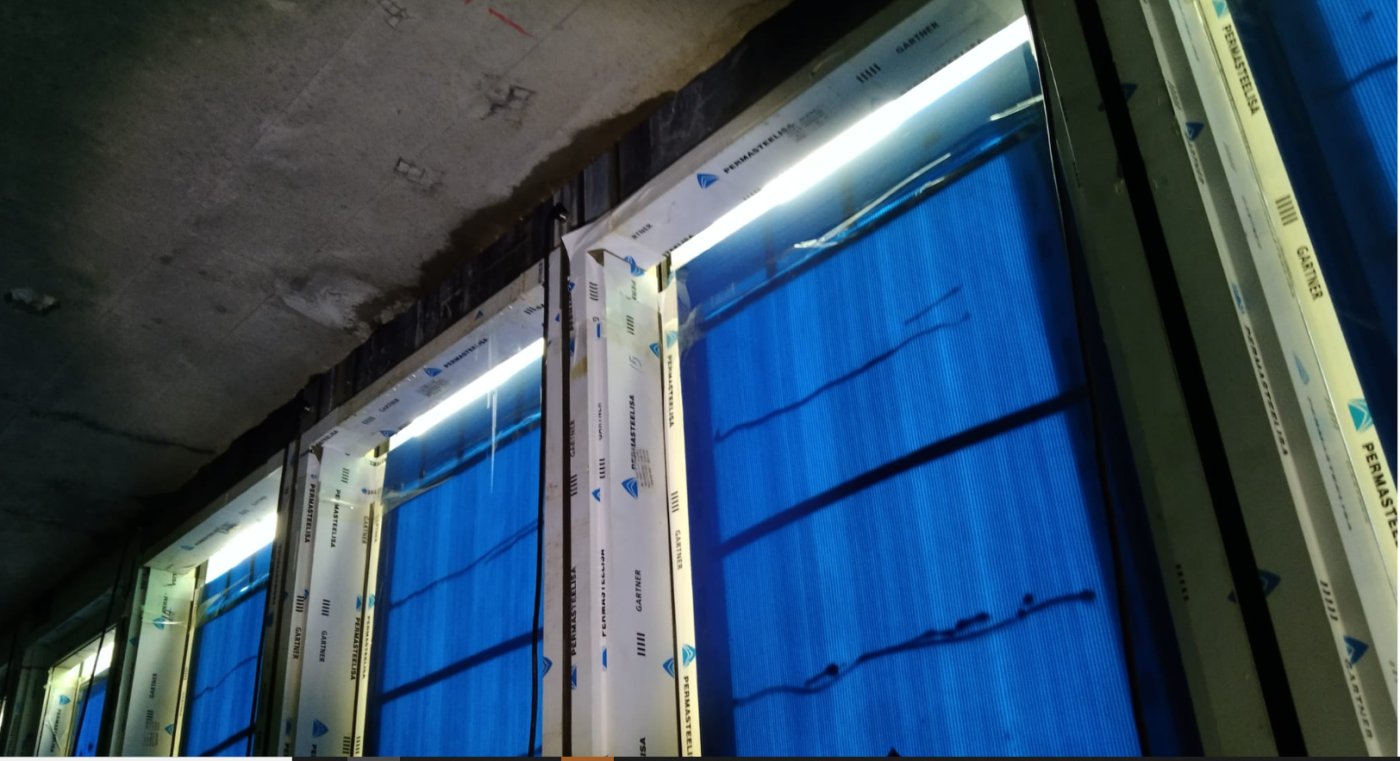
The comparison he keeps returning to is consumer manufacturing. Nobody accepts a scratch on a new phone, because a scratched one is simply unsellable. Companies like Apple and IKEA define what is acceptable along their whole quality chain, and production then meets that definition. He notes that making an ordinary television involves a dozen different protective films, applied and stripped at each stage of production, and asks whether some façade projects should be doing something equivalent.
A second track, and who pays for it
Then it has to survive the building. If waste is piled on every floor the installers cannot work cleanly; if it can be trolleyed to the edge and lifted out, far less damage is done.
The proposal is a parallel route through the industry for work that needs it: not everything, and not cheap. Every party carries part of it. Glass suppliers come first because they handle the material from the float line through cutting, grinding, tempering and the assembly of insulating units. Glazing contractors have to get that glass into the frame without loss and deliver the frame to site intact. Main contractors and developers then have to let it be installed properly, which is a site logistics question as much as a workmanship one: a floor stacked with waste makes clean installation impossible, and a route that lets material be trolleyed to the edge and lifted out prevents damage that nobody can repair afterwards.
One house that did it. The owners looked at the glass and glazing at every stage and every time a corner changed, had their own people present, and got it installed as they wanted it.
He is careful not to overclaim. Most of the industry is neither interested in this nor ready for it, and he says so. But part of it could be, and he points to a small private villa whose owners simply did it: they inspected the glass and the glazing at every stage and every change of detail, kept their own people present throughout, and received what they had asked for. His closing position is that a segment of the industry could deliver a materially better product than purchasers are currently offered, and that the obstacle is how the work is bought and sold rather than what the factories can make.