Jamison Guest and Nathan McRae drew a parallel between automotive and façade design through a vast Michigan campus for an automotive company, where a fritted curtain wall borrows the language of airflow and vector fields to break down scale and tune solar exposure, and a monumental curved storefront pushes glass toward near-invisibility through lamination bending and anti-reflective coatings.
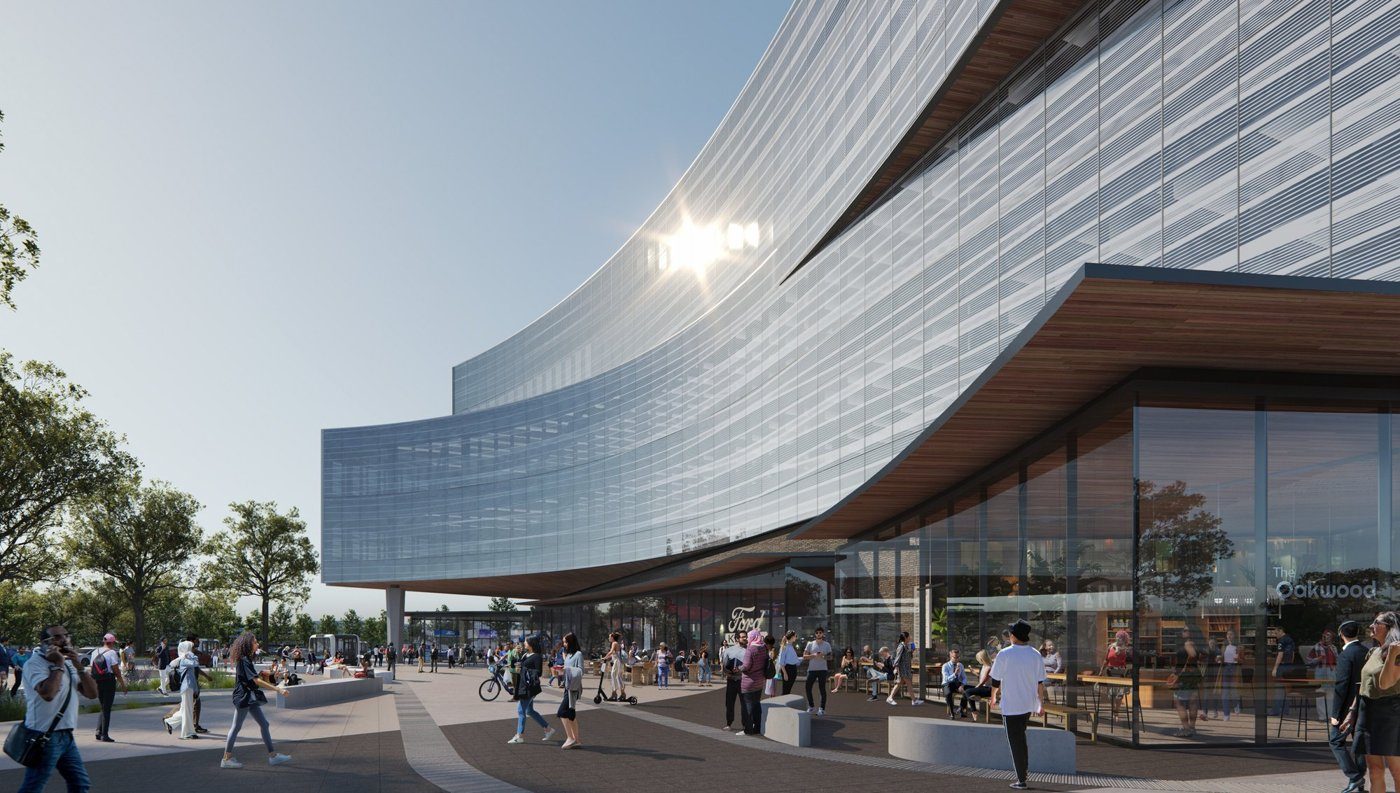
The project at the centre of it is a design-and-engineering building for a major automotive company in Michigan, since announced as its world headquarters, that the presenters were careful to leave unnamed. Its scale is the point: two million square feet in a first phase of a seven-million-square-foot plan, roughly a quarter-mile end to end. McRae's fritted, unitized curtain wall on the upper perimeter is one answer to making that scale comprehensible.
Frit from airflow
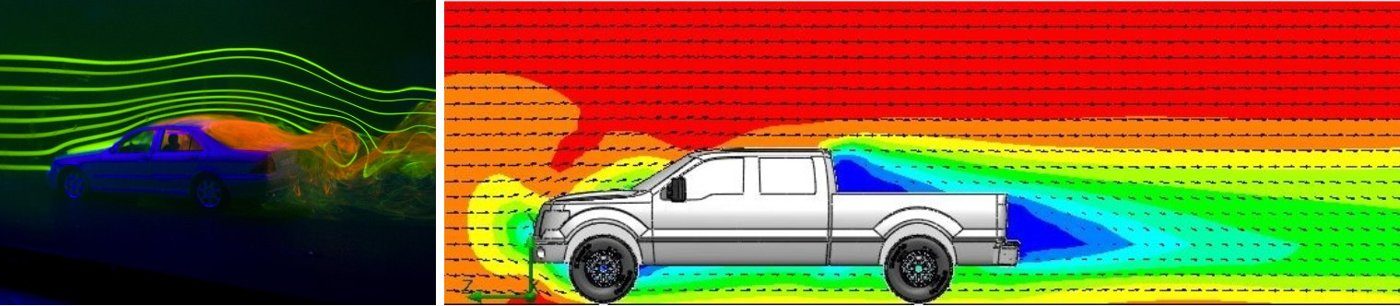
To manage the length, the façades were curved to absorb program and break down the scale, with the frit enhancing that reading while doing real work, tuning solar exposure, holding transparency, and coming in cheaper than the external solar shades first considered. Its language was borrowed from how the company designs cars: the flow of air studied in wind tunnels, the sound waves coming off a vehicle, the vector fields historically used to test airflow, all translated into a suggestion of movement across a building. The smallest-scale motif resolved, fittingly, into an oval echoing the company's own emblem.
Black in, white out
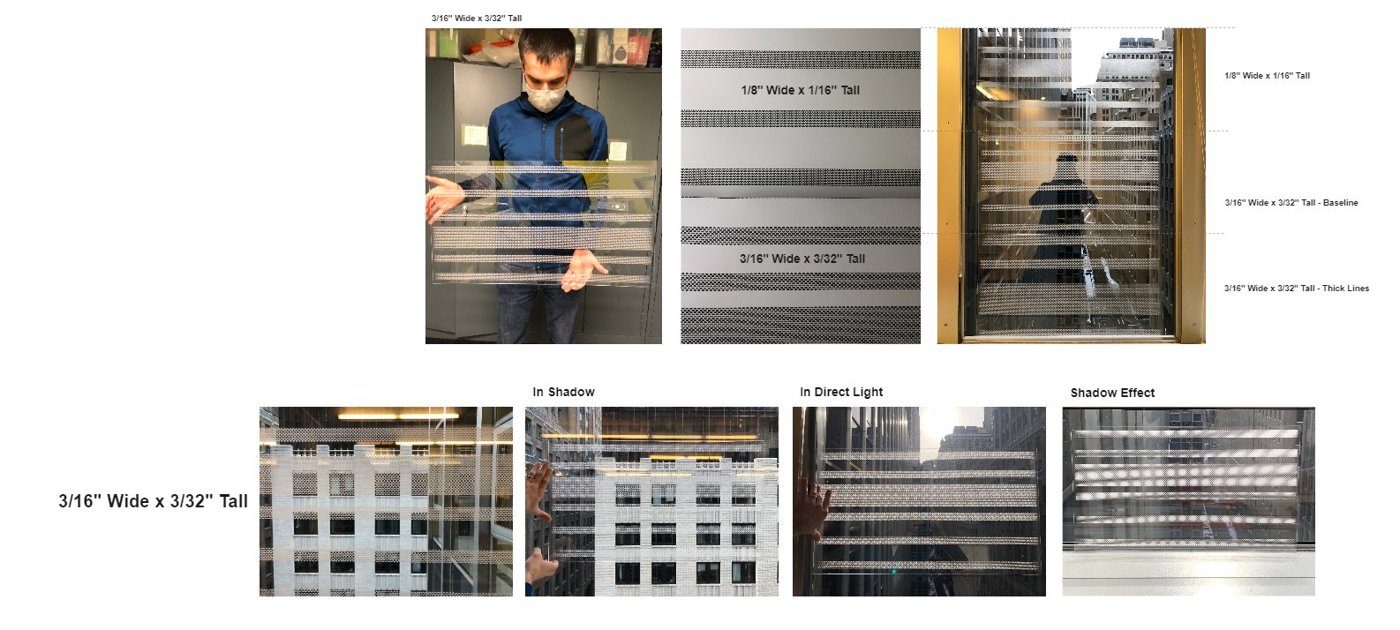
A key decision was to use silk-screen frit rather than the cheaper, more flexible digital print. The team wanted black on the inside face and white on the outside, so the pattern reads crisply from outside while staying see-through from within, a white inner frit lights up and causes glare. Digital print can't do this: fire white on one side and black on the other and it turns grey and muddy both ways. The trade-off is that silk-screen limits the number of distinct panels.
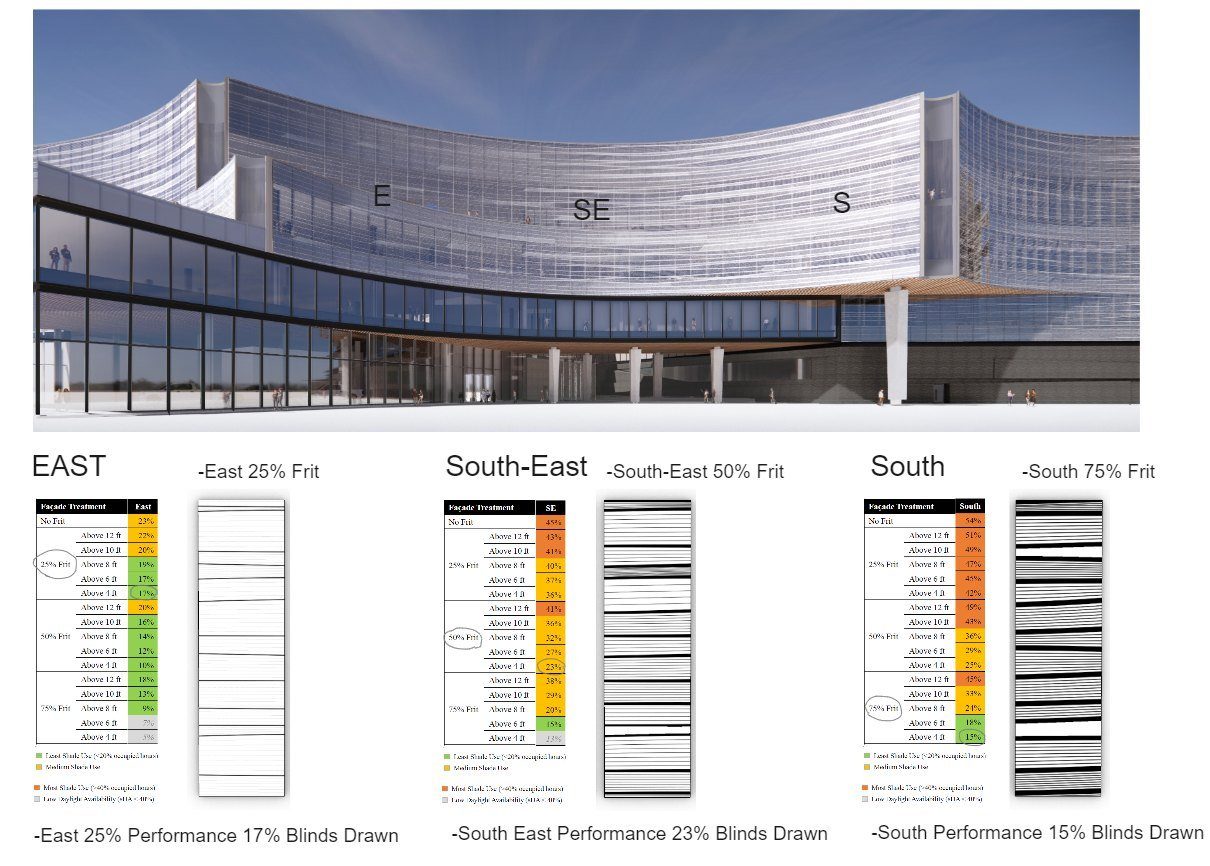
Coverage was then set by performance, heavier frit on southern exposures, lighter to the north, running from 10 per cent at the lowest to 40 per cent at the highest, with "slashes" of dot infill pushing toward the denser end.
Rationalising a graphic
Turning a continuous graphic into buildable panels took real discipline. The longest segment was broken down per floor and then into four curtain-wall segments that match every four courses, so they can be used interchangeably, extended, compressed, mixed and even reversed to perform in the opposite direction on the far side of the building. What began as vectors became dots in a scaled CAD file through a mass of Grasshopper scripting, 32 patterns in all, combined across the whole building, with hidden patent numbers embedded as an "Easter egg" for employees to find.
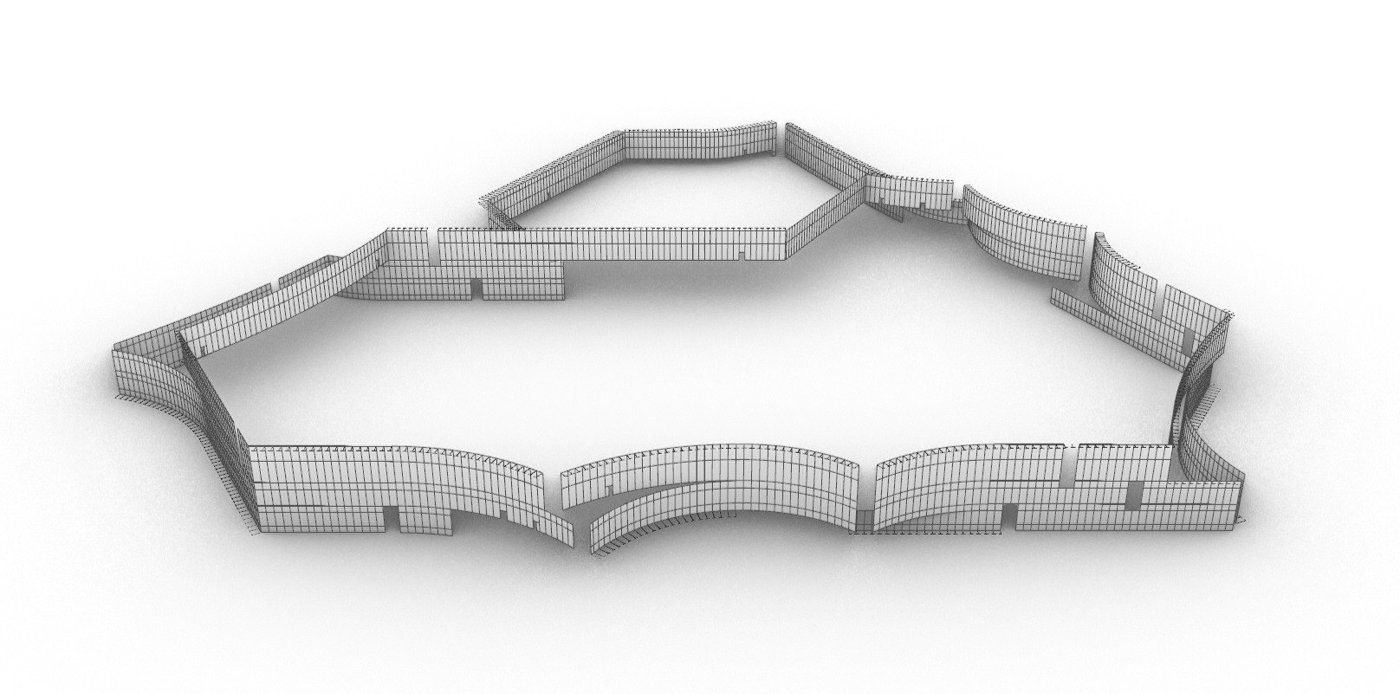
A single neutral coating was carried across the building so the three frit zones read differently in sunlight without the mismatched effects of different coatings, and the top system carries small fins on every mullion, so the wall turns nearly opaque when seen obliquely.
Glass toward near-invisibility
Guest took the automotive parallel further into the idea of the concept car, pushing a material past what exists, which is how his firm approaches full-scale prototyping. On the same project, one of the smallest systems, a roughly 2,000-square-foot monumental storefront, demanded ultra-transparent curved glass, and that meant testing two techniques together: lamination bending and anti-reflective coating. In lamination bending, glass is clamped to a curve and cured under heat and pressure in an autoclave, then rebounds slightly, an amount that has to be designed for, at units around ten by eighteen feet.
The anti-reflective coating tackles the roughly 8 per cent of light a laminated glass reflects, depositing a microscopic thin film whose outer and inner surfaces have different refractive indices, so the reflections cancel, the same trick a moth's eye uses with two layers of raised hexagons 200 nanometres apart. Because the coating had to survive being clamped in the autoclave, prototypes were made with and without it in case the experiment failed; it didn't, and the result reads as transparent in both directions, for cars placed inside and outside the showroom alike.