Gary Tongco worked through the fundamentals of window thermal performance, the difference between U-value, U-factor and R-value, and the three paths heat takes through an assembly, before showing how frame, coating, gas fill, spacer and, increasingly, vacuum insulated glazing slow it down, and why an NFRC test size can flatter a real project.
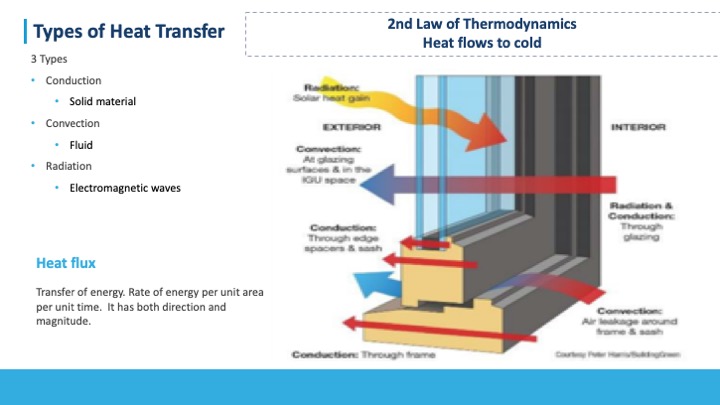
Tongco began with the vocabulary, because the terms are routinely confused. Heat moves three ways, conduction, convection and radiation, and always toward cold unless something stops it. A U-value describes a single material's transmittance; a U-factor is the weighted average across a whole assembly, and lower is better. R-value, its inverse, measures resistance and, unlike U-factor, is cumulative, two layers add up, which is why the industry historically avoided it for whole products but is now returning to it.
The metrics
Those numbers only mean something against a baseline, which is what the NFRC set out to provide from the late 1980s: a way to compare one company's window to another's. The catch is that its gateway test sizes are chosen for comparison, not reality, a curtain wall is rated at a 79-by-79-inch opening with a single mullion, a size no one actually builds, so a headline U-factor can flatter a real project. The comparison software the industry relies on, THERM and WINDOW, came out of the same effort.
Slowing the frame
In a frame, the job is to slow heat flux, to buy time. That means separating inside from outside with non-conductive materials to blunt conduction, and killing air movement in the hollows to blunt convection.
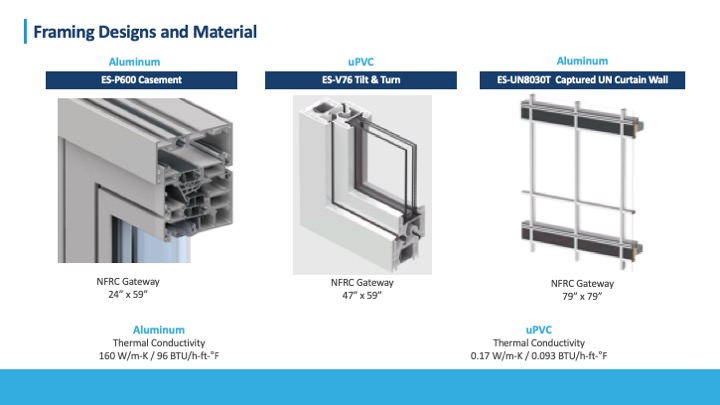
Tongco walked through a high-performance aluminium casement using polyamide fins and a sweep gasket to break the path, and a uPVC window, a material roughly 800 times less conductive than aluminium, whose many internal chambers do the same work by trapping air.
The glass does the work
Glass is the biggest contributor, and there are four levers. A low-E coating, now reaching triple-silver; an argon fill, an inert gas about two-thirds less conductive than air; the spacer, small but real, with thermally broken and TPS types outperforming the old aluminium; and insulation, stepping from a single pane to double and triple units. In centre-of-glass R-value terms, a one-inch double unit sits near R4, and adding a second airspace lifts it to roughly R6.6, not double, but a clear gain.
Vacuum, and the size gap
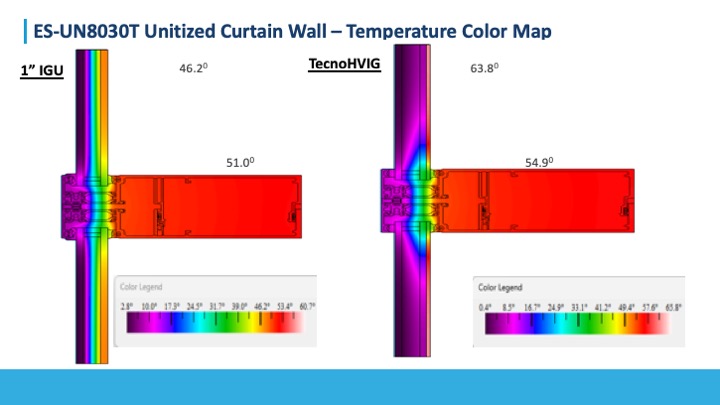
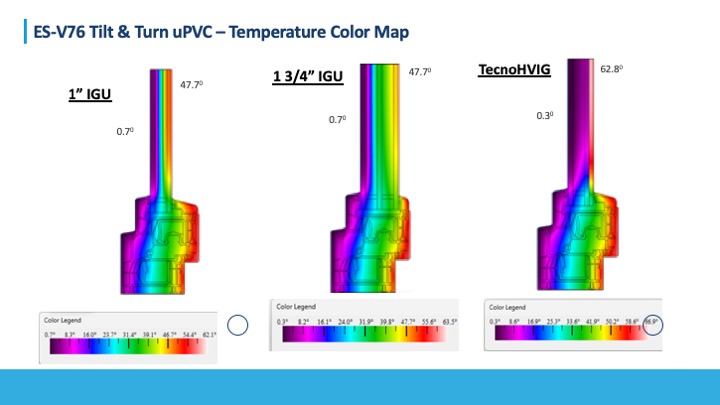
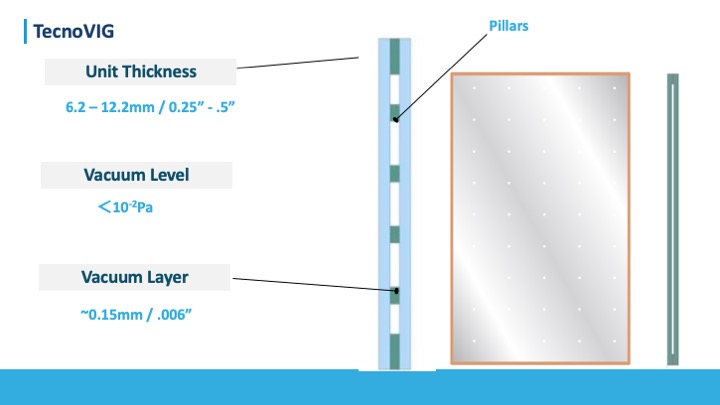
The next step is vacuum insulated glazing, two panes with an evacuated layer between them, which pushes centre-of-glass R-values into the low-to-mid twenties, far beyond a conventional unit. On a time-temperature map, the interior glass of a vacuum unit runs close to twenty degrees warmer than a standard one-inch unit.
Tongco closed on the gap that frames the whole talk: run the same curtain wall at an NFRC gateway size and at something nearer a real project, and the U-factor can swing dramatically. Codes will keep pushing these numbers, but the payoff, he argued, only shows up in holistic modelling, where a better glass cost is weighed against smaller perimeter-heating loads and future mechanical replacements.