


Johan Hermijanto made the case for terracotta, ‘baked earth’, ancient and enduring, from the Ishtar Gate to the Terracotta Warriors. Now mass-customisable and low-carbon, it already shapes Melbourne, from Harry Norris’s 1930s faience to three Bates Smart projects where battens became panels, a uniform glaze became a varied one, and precast lost to fired clay.
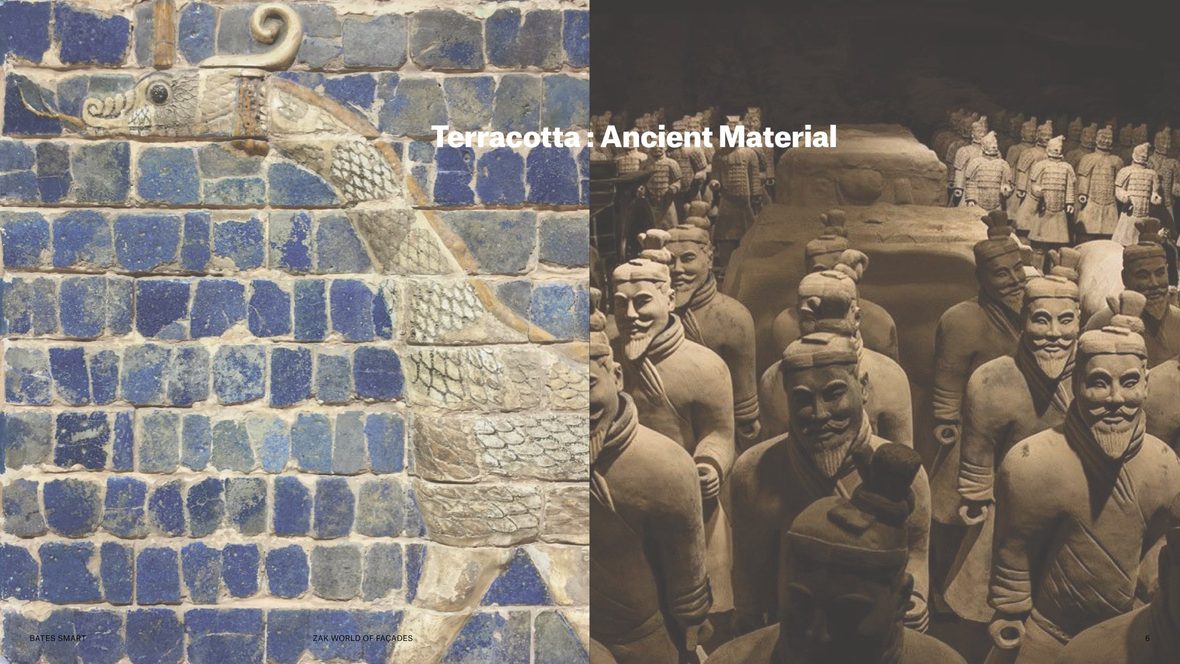
Bates Smart is one of the longest continuously running practices in Australia, and it adores this material. The word means baked, or cooked, which Hermijanto found poetically apt for a country and a place. It is ancient, a fired clay used from the Babylonians onward: the Ishtar Gate, which you can visit in Berlin, and more famously the Terracotta Warriors. That endurance is the argument. The most sustainable materials, he suggested, are the most enduring ones, and there is nothing quite like a 2,000-year-old testimonial.
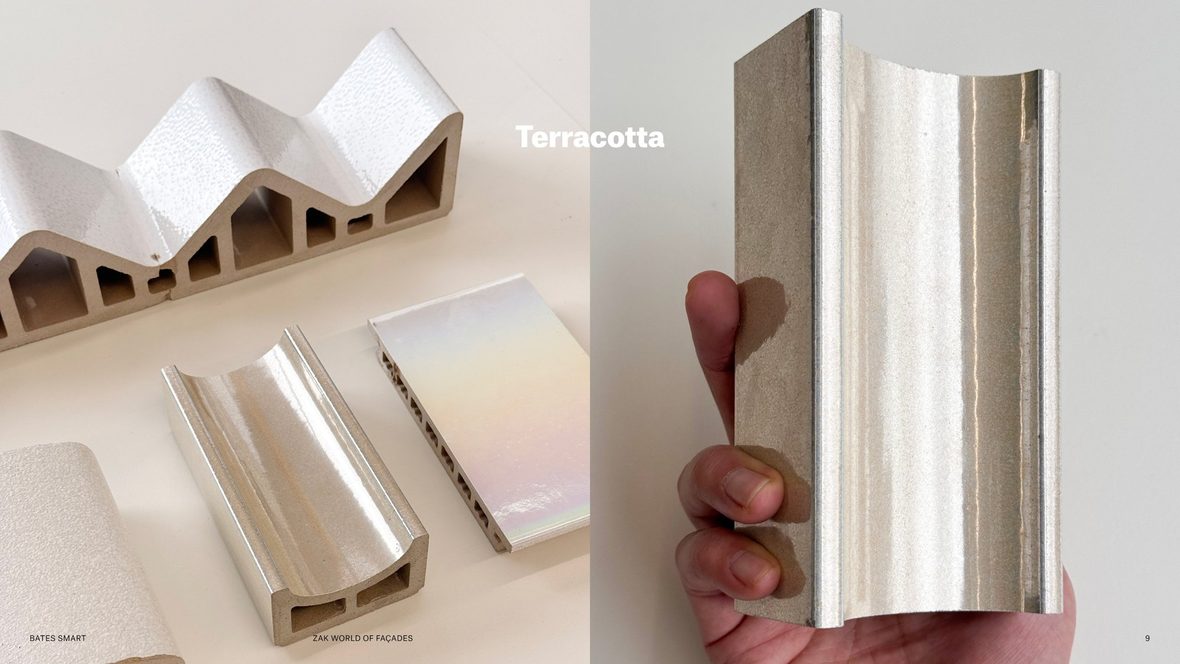
Made today it offers real mass customisation, which is what interests an architect chasing project specificity: a wide range of profiles, shapes, forms and finishes, shown through photographs from a factory visit in China for a Queensland job. And the virtues hold. It is recyclable, non-combustible, low-carbon, natural and adaptable at almost any scale.
Melbourne is already built from it, often without anyone noticing. Harry Norris’s 1930s McPherson’s building on Collins Street uses glazed faience for its streamline modern expression, and Marcus Barlow’s Manchester Unity took some 250 tonnes of faience tile to reach its Gothic verticality. On Bourke Street there is a vintage Bates Smart building from the early 1930s that won the street architecture medal in 1934: dark glazed tile in a portal frame, fine steel windows, and three cast terracotta frieze figures in different forms of dress made for the menswear floor of the Buckley & Nunn department store. Beside it, 299 Bourke Street, another Norris, whose rose-mauve faience now houses the Mecca store after a Bates Smart base-build upgrade.
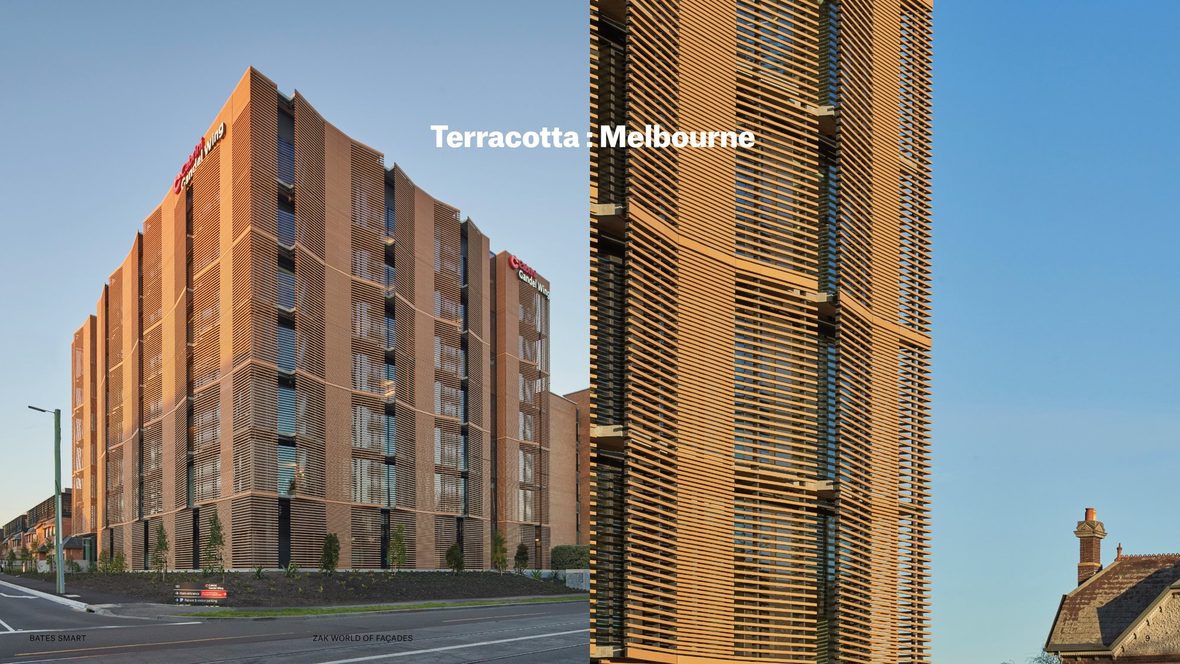
The studio’s own earlier work is lighter in touch. The Gandel Wing, 2019, uses terracotta as a diaphanous screen, its colour in dialogue with the masonry hospital beside it, giving the appearance of solidity while screening the houses across the road and casting a dappled light inside the inpatient unit. In Sydney the same year, the Boomerang tower at Olympic Park pleats similar battens across a podium of car parking and offices; its precursor was the 2015 engineering school at UNSW, whose tile colours came straight from the brickwork of the Ainsworth building it extends.
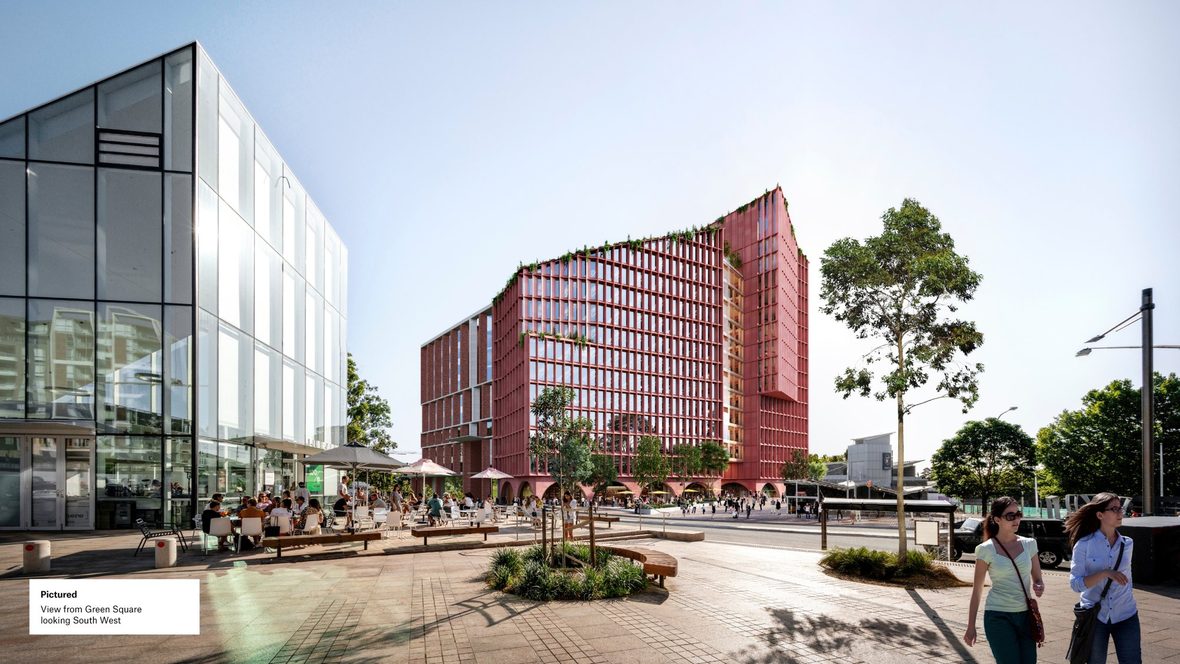
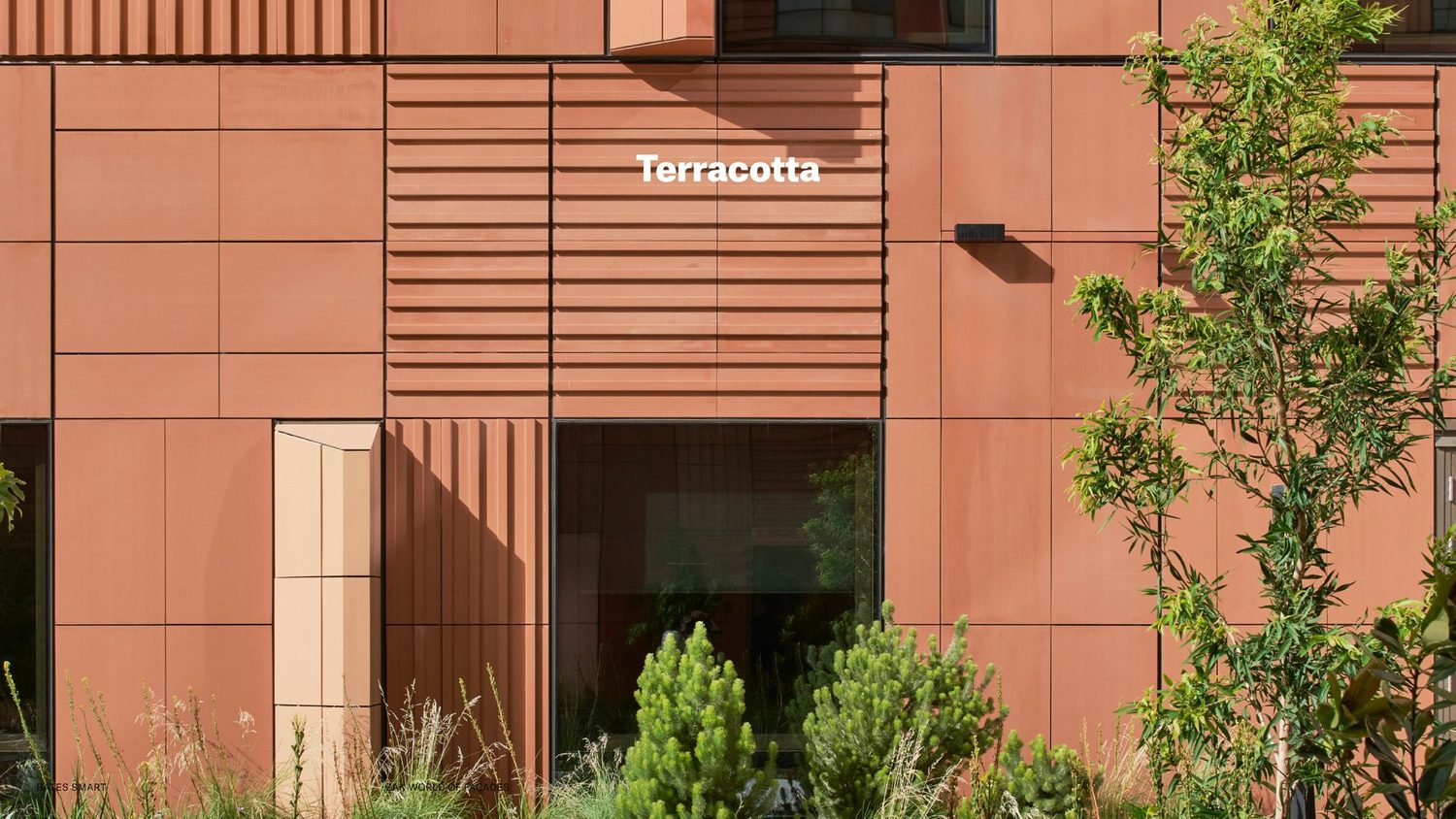
Then three current projects, one per typology. Balmain Street in Cremorne is the commercial one, in a post-industrial neighbourhood directly opposite the Bryant & May building, whose long façades and sheer repetition set the discipline: use the material for what it is. A grounded masonry base carries a lighter top, and the elevation became a sharp, almost origami grid that frames views, holds the desirable 60/40 glazing-to-solid ratio and builds the sun shading in. Battens were the intent, but realising it meant a panelised system instead, units around 900 by 550 to 600 mm in two types, a deeper façade on the northern half and a flatter one on the south. That southern half was originally to be precast for programme reasons, until terracotta proved it could do the job, so it reverted to a curtain wall. Everything is mechanically fixed and unitised, with large immersive windows from within, and one circular extrusion was made in twelve parts, pieces up to about 1,400 mm long.
Iglu William Street is student accommodation for a long-standing client that holds its assets, which buys an interest in enduring quality. The forms take their cue from the small drill hall on the corner, its striated base and fluted columns setting a three-storey street wall. Above that, the podium is a glazed green terracotta chosen so the building recedes and reads as background, extrusions roughly 450 deep, 400 wide and 900 tall, with curved corner pieces and longer lintels. The first glaze was a uniform light green, and it was the visual mock-up that flagged the uniformity as a missed opportunity: the client asked for something more varied, closer to a precious ceramic, and that is what got built. The façade now shifts through the day with the light and answers the colours of Flagstaff Gardens.
The health project is Peninsula University Hospital, known in the studio as Frankston. Its concept comes from the catchment: the landforms of the peninsula and the change in the waterline, marking strata and geological change, which sorted the building into layers. Terracotta was always the intent, then went through precast studies, and what got built is porcelain on the flatter, honed upper levels with terracotta lower down, where the variation, depth and tonal change are available. The result is a patchwork of textures and colours against those landforms, on a site close to the coastline where an inert material earns its place. Even the above-ground car park is a terracotta-look aluminium, naturally ventilated and colour-matched, and the staff courtyard is where the whole thing is met at human scale.
The thread, Hermijanto suggested, is that terracotta brings warmth and craft back into a city: an old material, reinvented, that ages into an asset rather than a liability.