


Bob Zhang shows how multi-curved architectural glass has moved beyond basic form-making into a demanding quality-control discipline. As panels become larger and more geometrically complex, distortion, anisotropy and repeatable benchmarks matter as much as the ability to bend the glass.
The technical challenge of curved architectural glass has changed. It is no longer enough to prove that a panel can be formed to the required radius and survive handling. For Zhang, the next generation of work is defined by how the finished glass looks at full scale: whether reflections run smoothly across a façade, whether edges remain visually stable, and whether tempering produces anisotropy that becomes obvious under certain light. These questions grow more important as architects ask for larger sheets, tighter transitions between concave and convex geometry and façades made from thousands of unique pieces. Geometry creates the demand; optical quality determines whether the result is convincing.
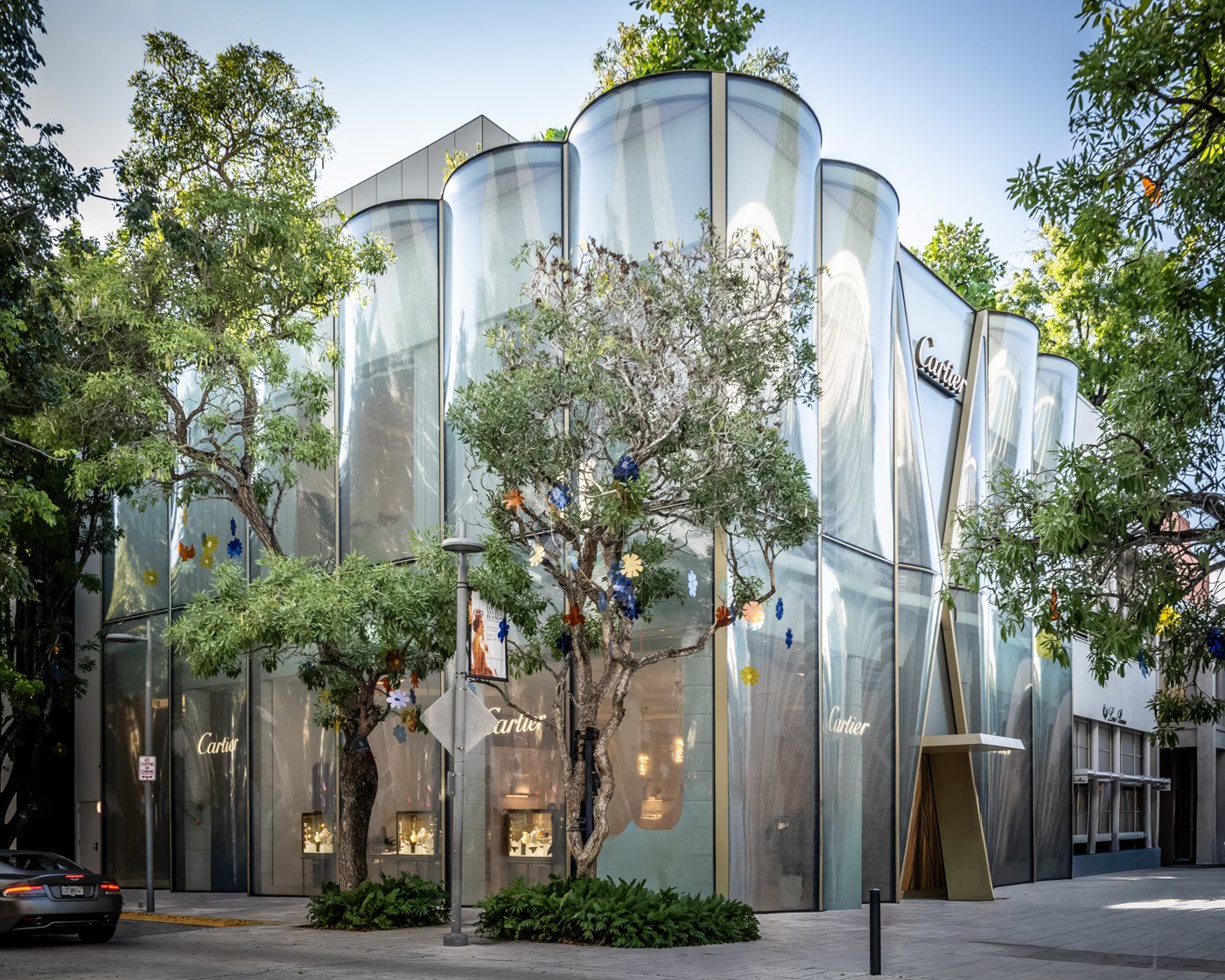
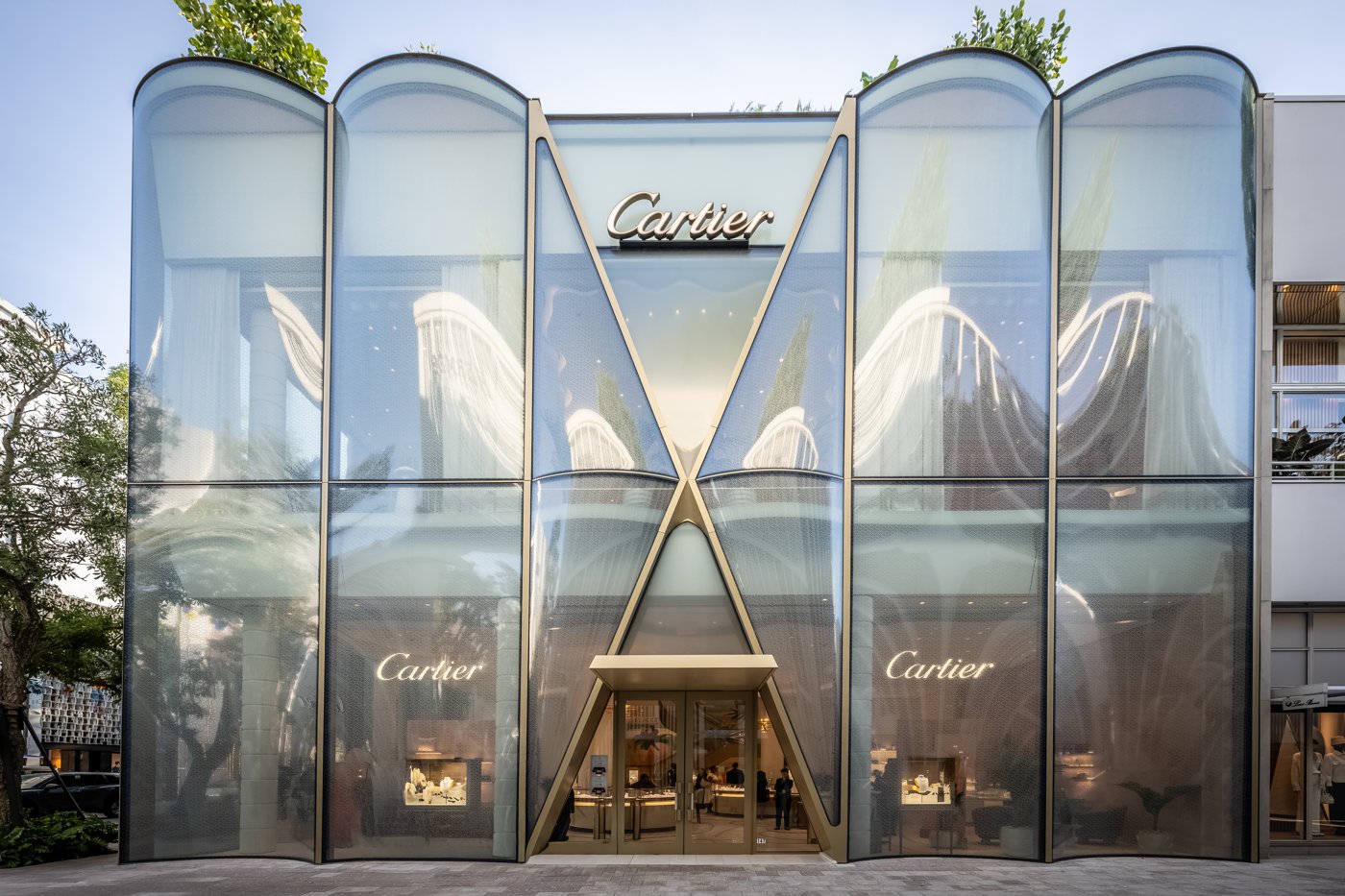
A small Cartier project in Florida is useful precisely because it contains relatively few pieces. The two-level façade uses large curved glass to create a highly continuous storefront, with panels moving through concave and convex forms rather than following one simple cylindrical bend. Zhang describes pieces around 22 ft high and more than 10 ft wide, with the geometry changing through the panel so that top and bottom conditions curve while other portions approach a flatter joint. The project demonstrates that multi-curved heat-treated glass can now be produced at architectural scale, but it also exposes how unforgiving the joints become when a small number of highly visible panels define the whole façade.
Multi-curved means more than a single radius
Traditional bent glass is often described by one radius or one axis. Multi-curved panels behave differently: curvature can vary in two directions and can reverse from concave to convex within the same architectural composition. That makes production control harder because the glass must be heated and shaped without allowing unwanted local deformation. Zhang's examples show the difference between designing a smooth digital surface and manufacturing a heat-treated sheet that reproduces that surface closely enough for reflections to read continuously. The engineering problem is therefore both geometric and thermal, involving tooling, furnace behaviour, cooling and the way each pane relaxes during processing.
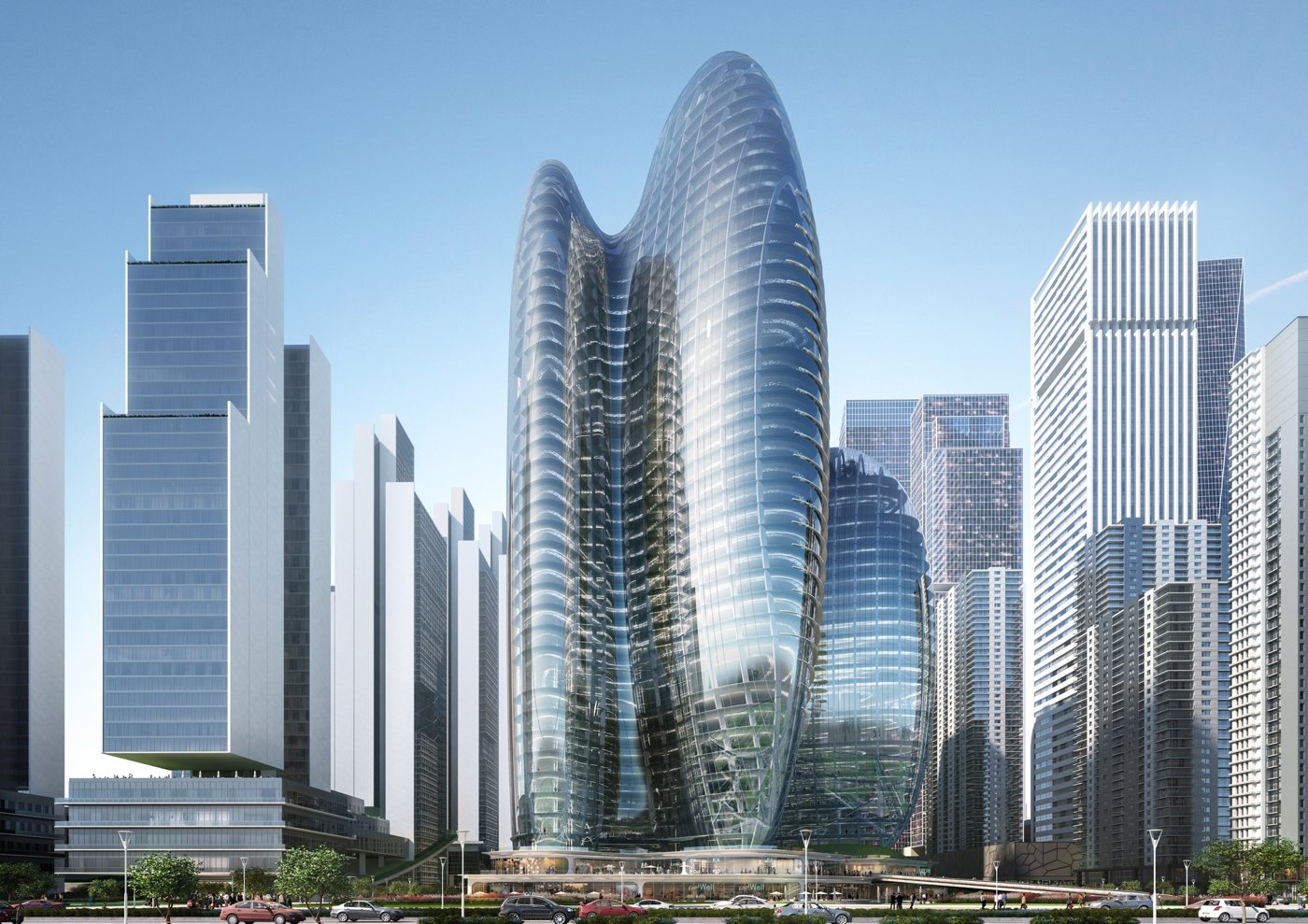
Scale multiplies the challenge. Zhang points to a Zaha Hadid Architects project in Shenzhen as NorthGlass's largest multi-curved reference, with more than 20,000 unique glass pieces across a group of connected towers and roughly 900,000 sq ft of façade. At that quantity, even a modest variation in optical quality can become a repeated visual pattern. The project therefore required a much more explicit system for defining and monitoring acceptable distortion. Zhang describes frequent reviews, close consultant involvement and the use of approved samples as physical standards throughout production. The emphasis shifts from making one exceptional panel to making thousands of different panels look as though they belong to one continuous surface.
Physical benchmarks make quality discussable
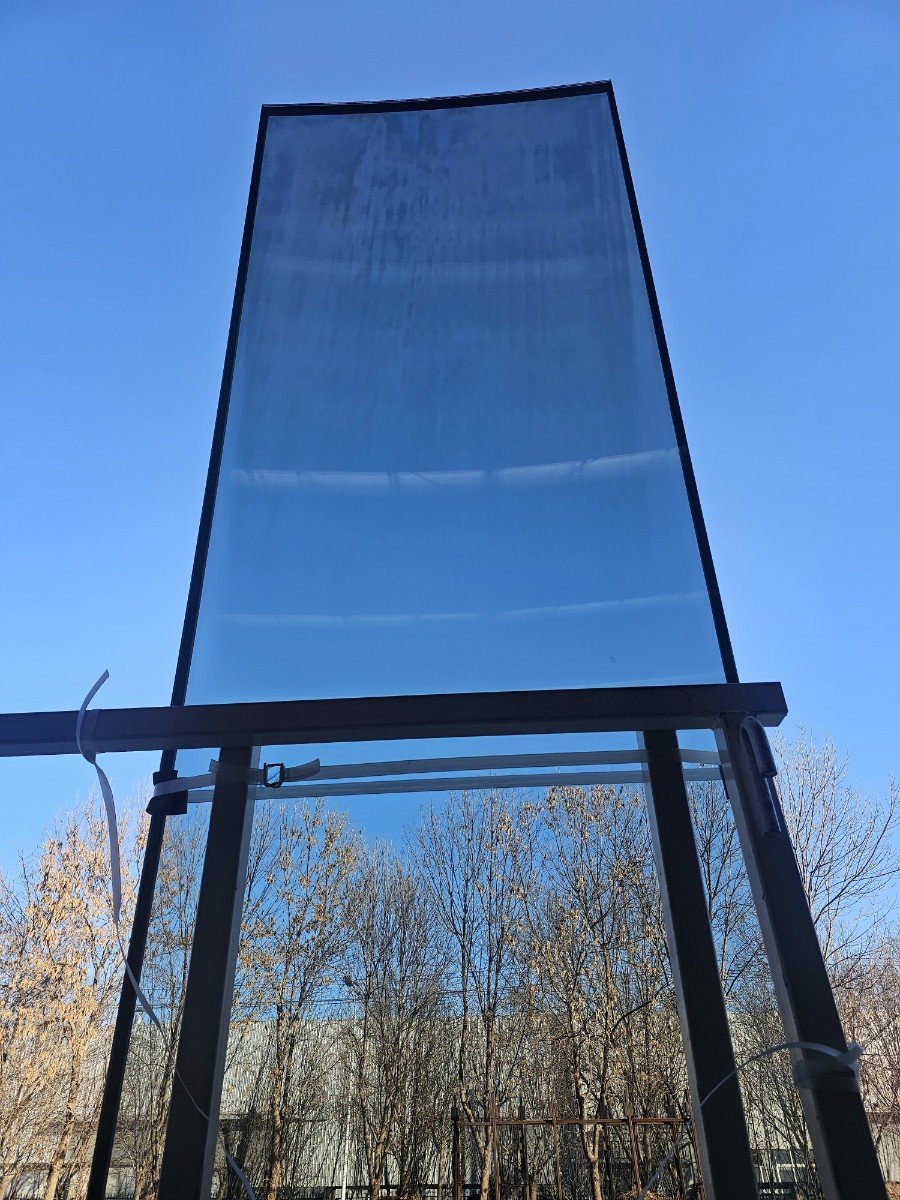
Flat architectural glass benefits from familiar standards and established ways of discussing roller wave, bow and visual defects. Curved glass is harder because the intended geometry itself changes the reflection. A wavy image may be a consequence of the designed form, an unwanted local distortion, or a combination of both. Zhang's preferred response is to establish a project-specific benchmark. The team approves a control sample that embodies the agreed level of optical quality, then compares production pieces directly against it under similar viewing conditions. This creates a tangible reference when numerical tolerances alone do not capture what an architect or owner will see.
This approach also changes the relationship between factory quality control and design review. The question is no longer simply whether a pane meets dimensional tolerances. Teams have to agree on viewing distance, lighting and the way reflected lines should behave across the surface. Zhang describes owner and consultant involvement during production because optical acceptance can be subjective if it is left until installation. A control sample moves that conversation forward: quality is judged against something already accepted rather than against memory, renderings or a newly invented standard after thousands of pieces have been made.
Distortion begins in heating and cooling
Zhang identifies two recurring visual issues: optical distortion and anisotropy. Distortion is particularly sensitive at panel edges, where uneven heating can create local geometry that differs from the intended surface. NorthGlass's development work, as he describes it, focuses on controlling the heating and cooling cycle and on improving the transition between flatter and more curved areas. The target is not perfect mathematical geometry at all costs; it is a surface whose local deviations remain small enough that reflections appear calm at the distances that matter to the building.
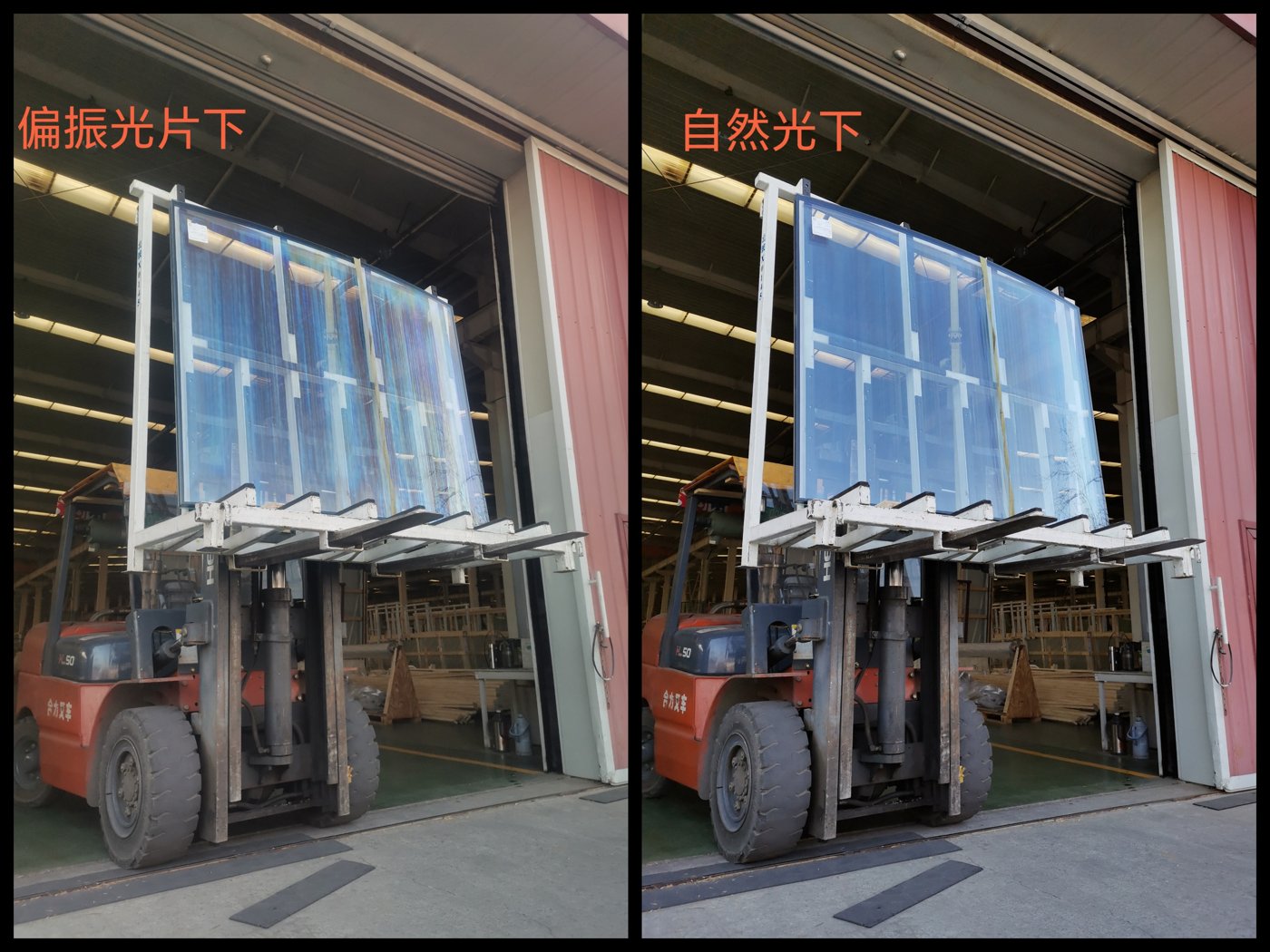
Anisotropy has a different origin. Rapid cooling during tempering creates residual stress patterns that can become visible under polarised light, particularly in bright skies or through sunglasses. The phenomenon is inherent to heat-treated glass, so Zhang's focus is on reducing its intensity through more uniform cooling rather than claiming it can be eliminated completely. As panel size increases, the distribution of cooling air becomes harder to control evenly. The aesthetic ambition of giant, seamless glass therefore depends on machinery and process control that may be invisible in the finished building.
Zhang also places these issues in the context of rapidly increasing glass size. NorthGlass cites furnace capability up to about 80 ft and references pieces approaching that limit, along with many North American projects using glass over 20 ft. Those are manufacturer claims rather than universal industry thresholds, but they illustrate the direction of travel. When a single pane becomes several storeys high, optical effects that would be minor on a conventional lite can dominate an elevation. Handling, heat treatment and support become more difficult, but so does the simple question of whether the glass looks flat where it should and smoothly curved where it should not.
Size also changes how a project team should think about mock-ups. A conventional sample can demonstrate coating, edge treatment or a typical joint without reproducing the full visual field of the building. With oversized curved glass, the sample itself may need to approach production scale because local roller-wave or edge effects are meaningful only when seen across a large reflected image. Zhang's factory examples show panels being compared upright and outdoors, where sky, trees and straight reference lines make distortion easier to see. That is a useful quality-control principle even when the final project has different geometry: inspect the glass in conditions that reveal the defect the specification is trying to control, rather than relying only on dimensional inspection at the rack.
The most important development in curved glass may therefore be the move from capability to repeatability. Producing one dramatic bent pane proves a process. Producing a façade of unique panels with consistent reflections proves control. That requires the architect, consultant, fabricator and owner to define quality early, agree on physical references and keep those references present through manufacturing. Digital geometry can describe the target with extraordinary precision, but the final acceptance still happens through the eye. Curved glass succeeds when the manufacturing process is sophisticated enough to disappear, leaving the intended surface - rather than the evidence of heat treatment - as the thing the viewer sees.