


Vibhakar Jha asked three architects what a hotel owes the city it sits in, and got experience rather than expenditure as the definition of luxury, brand DNA as the author of the façade, and a case for designing an envelope that can be taken apart.
Jha opened with a history rather than a question. In the 1970s the hotel business ran on two schools of thought, one designing around personal attention to the guest and the other adding amenity, and the chains of the mid-1980s blended the two; he traced Four Seasons doing exactly that across its first two Toronto properties. What he wanted argued is how a hotel now earns its place in a city rather than merely standing in one.
Iconic, and rooted
Sushant Verma took identity first. Hotels help define the urban fabric, so the identity they carry matters more than in most building types, and brands are pulled two ways: towards a single global language, or towards belonging to the place. What clients bring his practice is the demand for iconicity, and the discipline is to earn it contextually, so a property in Rajasthan gets stone and inlay rather than a metal skin. Iconicity, on his account, is not uniqueness; it is every contextual element becoming part of the identity, which is what makes a hotel a destination rather than an address.
Luxury is what is remembered, not what was spent
Shubham Solanki moved the definition. Luxury has stopped being a matter of spend or expensive automation and come back, over five to ten years, to experience rooted in the environment and the context. That order matters: a building relevant to the people around it becomes iconic because it is relevant, not the other way round. The commercial argument follows: a contextual design brings capital and operating cost down and leaves the owner something they can run. Budget should never be the measure of luxury; producing the experience inside a limited one is the architect's job.
Harsh Thapar answered with a memory. His father worked on the railways, and the railway hotel in Kolkata served as the family guest house; what he remembers as a child is the imposing form, its grandeur and power, and the relief of coming off a crowded street into order, easy parking, less noise and cleaner air. Hotels still represent the best we all seek, and most of it is the best the city outside can no longer provide. The industry delivers that at significant environmental cost, and his question is how to keep the experience and cut it.
A checklist finds the problem, it does not solve it
Twenty-four years in sustainable buildings have left Thapar defending checklists and distrusting them in the same breath. You cannot improve what you do not track, so towels changed, bottles used, litres drawn and energy burned all have to be counted, and his own approach works from a single occupant. But he is a green accredited professional who has delivered platinum-rated buildings, and his verdict on the collective result is that nothing has been solved. Green building was one slogan, regenerative architecture is the next, and the slogan changes faster than the outcome.
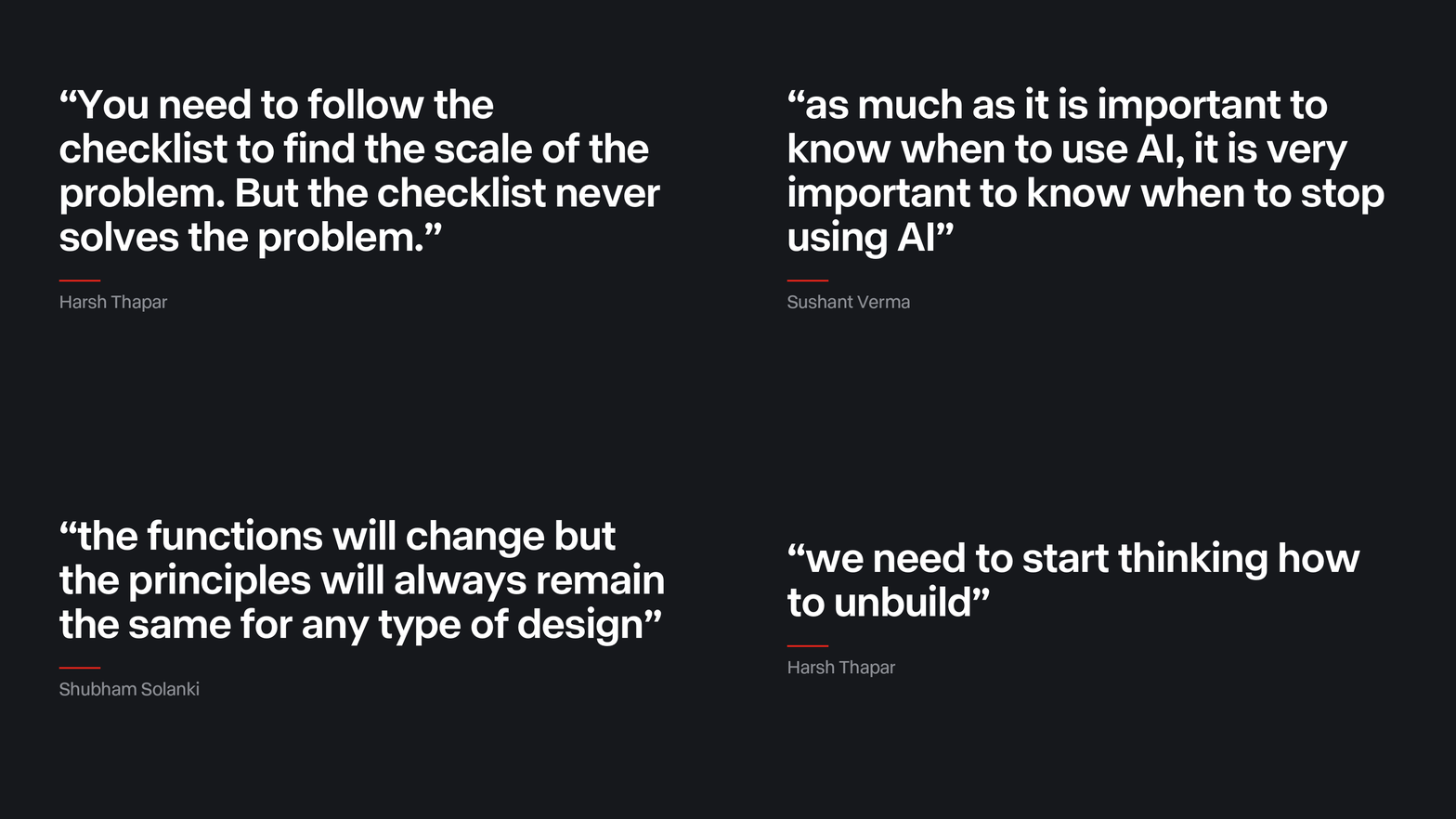
You need to follow the checklist to find the scale of the problem. But the checklist never solves the problem.
Harsh Thapar, HiT Works
Verma located the decision higher up. Sustainability reaches a façade through the brief, and the brief comes from the brand: some chains are sustainable to the core, others care about water and electricity without it being in the DNA, and both show up in the elevation eventually. Everyone downstream works from that brief, which is why he ends where he began, with the façade as a by-product of the brand.
Where to stop using the machine
On AI the two split by temperament rather than position. Verma is openly pro-technology: a couple of years ago it produced concepts that needed a human layer to become real, and generative image-making is now accurate enough that the layer is quietly being left behind. His practice now sketches, jumps straight to a three-dimensional model through it, and uses text prompts as a collaborator when an idea will not come, which changes the sequence of the design process, not one step in it.
as much as it is important to know when to use AI, it is very important to know when to stop using AI
Sushant Verma, rat[LAB]Studio
Solanki's observation came from the operators. One hotel he is working on had its first phase fully automated and its second built to run the way the same hotel ran in 2010, because guests missed the human contact and the automation proved operationally heavy without paying the owner back.
2035, and taking it apart
Thapar's answer for the next decade was the one the others picked up. Architects are trained in how to build and now need to think about how to unbuild, because the parts of a building have different lives: structure lasts sixty years and could be designed for a hundred, hotel interiors change every five or ten, a façade might reach twenty. So design the envelope from day one to be demounted, recycled and standardised enough to be used elsewhere. Verma liked it as plug and play, a new skin when the brand identity changes rather than a new building. Asked for one thing each would change, they gave no glass buildings, efficient buildings as the standard, and nature-based biomaterials.
the functions will change but the principles will always remain the same for any type of design
Shubham Solanki, CoLEAD LLP