


Gautam Bhasin put a developer among three architects and asked what a city of forty-five degree summers, single-digit winters and off-the-chart particulates does to a design brief, and got an argument about ecosystems, orientation, value engineering and whether the glass box survives.
Gautam Bhasin set the terms before anyone answered. Delhi runs past forty-five degrees in summer and into low single figures in winter, its particulate readings leave the charts in the bad months, and seventy-five millimetres of rain had stopped a neighbouring city the day before. Very little of that is within an architect's gift; how a building is designed and built against it is, which is what he put to three architects and, in his own words, a developer brought along to keep the conversation in check. The first answer came back with the brief rather than the elevation: in a city of that range, the façade is not settled late.
A system rather than a skin
Bhavin Mehta's reframing did much of the work after it. Most hot cities present one or two variables that bear on a façade; Delhi presents nearly all of them at once, summer heat to keep out and winter cold to harvest, days of heavy rain to stay tight against, dust, and the quality of incoming air. A bouquet, he called it, which means treating the wall as an ecosystem rather than a skin, and competence across every element rather than mastery of one. It also rules out the import: learning from elsewhere is not the fault, and he named what he would take from Dubai, Singapore and Riyadh; replication is.
Harsh Varshneya took the same argument back to the drawing board. Residents already know which buildings they are happy with, and that matrix puts the façade among the reasons. His practice no longer draws first and optimises afterwards. The envelope is tested early, because the alternative is returning to a client with an iterative correction and the word may still attached. He described a scheme he was ready to build until the client asked whether he was happy with it; he took ten more days, came back with a different orientation and façade, and could answer yes.
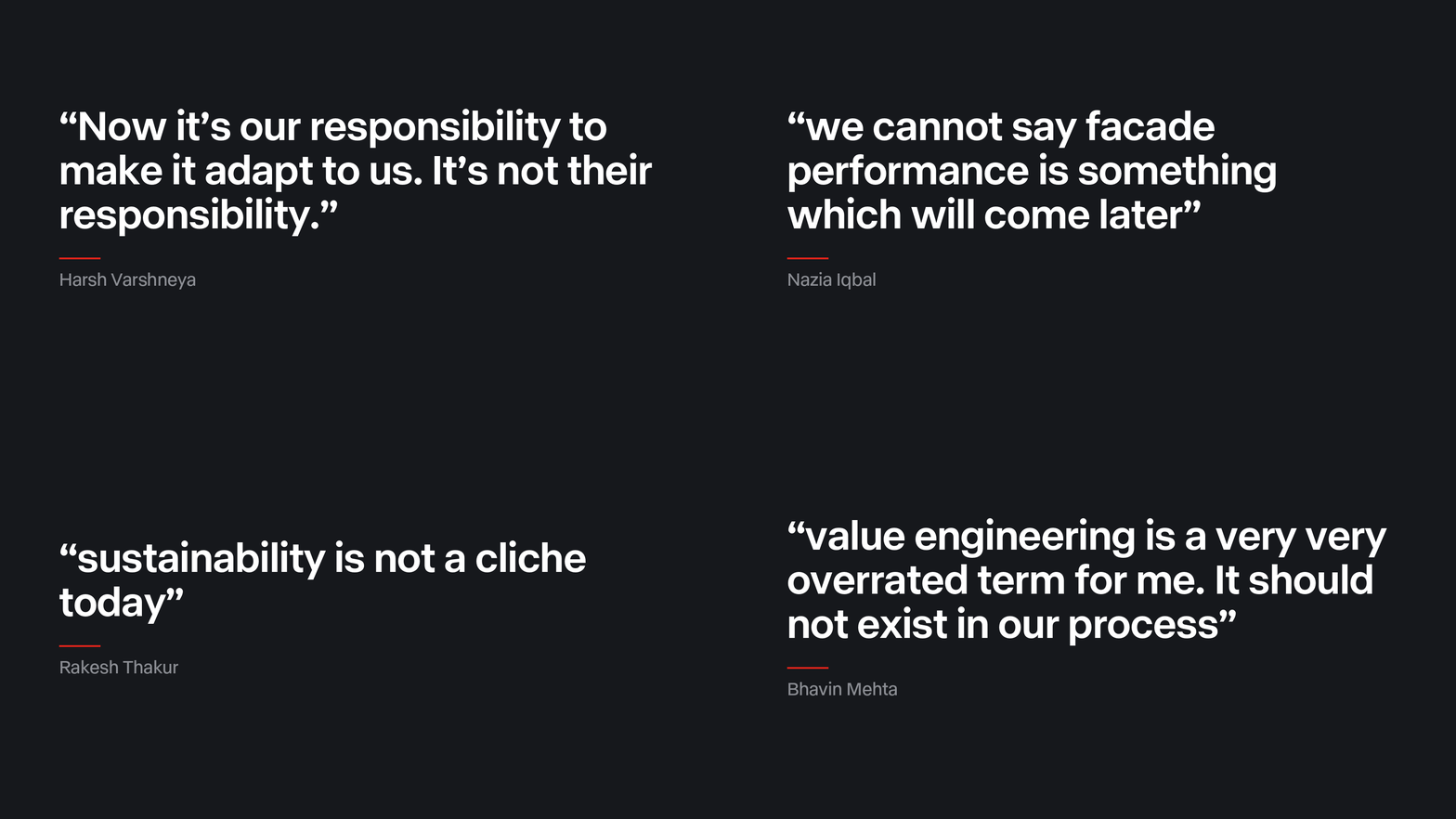
Now it's our responsibility to make it adapt to us. It's not their responsibility.
Harsh Varshneya, STHAPATI
Performance before the form is frozen
Nazia Iqbal argued the timing point directly. Façade performance belongs in the brief, ahead of concept, while the design is still evolving and there is room to act on the analysis: solar studies driving the glazing decisions, daylight and glare studies the ratio and the heat gain. They carry on through schematic and detail design, construction and post-occupancy evaluation rather than stopping at a milestone. Air quality has shifted most. Where energy efficiency and daylight once led, a client now asks whether the indoor air will hold, so the analysis is run early and repeated, and the test is whether the façade still performs across the life of the building rather than at handover.
we cannot say facade performance is something which will come later
Nazia Iqbal, Mott MacDonald
What the developer is weighing
Rakesh Thakur's reading of the market was cheerier than the architects expected. Grade A office occupiers arrive with sustainability ratings as a prerequisite, so the developer follows; on the other side sit fiscal incentives and extra floor area. Home buyers have caught up too, and not on appearance: they know a good façade is sound insulation, and that it moves the maintenance charge they will pay for fifty years. They arrive, he said, with their spreadsheets ready. What offsets a higher initial cost is speed, since a building finished sooner is let or sold sooner. His sharpest admission: embodied carbon is not yet on the table, and speed is why glass keeps going up.
sustainability is not a cliche today
Rakesh Thakur, BPTP
Value engineering, or an admission
The liveliest disagreement was over two words everyone uses. Mehta's position is that if the parameters, the brief and the purpose are set properly and the basics followed, value engineering should not be needed at all, and when he ends up in one of those meetings he feels he has missed something. It happens anyway, he accepted, and it starts the day the goalposts move, which is the argument for working with a developer in workshop mode from day one. The deeper cause is that the conversation is held against capital cost instead of a thirty-year life cycle. Thakur's answer was that value engineering is real and routine, but never at the cost of safety or performance.
value engineering is a very very overrated term for me. It should not exist in our process
Bhavin Mehta, Gensler
Is the glass box dead
Bhasin's closing provocation drew three answers and no agreement. Varshneya's was that it is not: glass is still loved and needed, and the same material reads completely differently in Singapore, the Gulf, Australia and a freezing American winter, so what is being learned is how to use it. Iqbal's reservation was that it should never be distributed uniformly, since each face meets different daylight and solar exposure and should be detailed accordingly, with other materials explored rather than glass repeated across an elevation. Mehta's was the flattest: the glass box will not go until something replaces it. Asked what each would change, they offered performance moved earlier, landscape and urban lungs at plot scale, jalis and a building that reads as a domicile of its city, and culture, climate and context.