


A panel of designers, developers and façade contractors makes the case for engaging the façade specialist during schematic design. In a building boom, they argue, early involvement is what protects a project's programme, budget and, most of all, its quality.
The friction in bringing a façade contractor in early, Marwan Abbas argues, is contractual rather than technical: reconciling a design-and-build approach, which wants the specialist's expertise up front, with the classical design-then-procure route that procurement law is built around. Resolve that, and early engagement pays the contract, the contractor, the client and the project at once. Decisions that otherwise surface late, how the façade is anchored, what performance and shading are required, are settled during design, so at execution the project is far less exposed to long-lead procurement and to changes that ripple back through it.
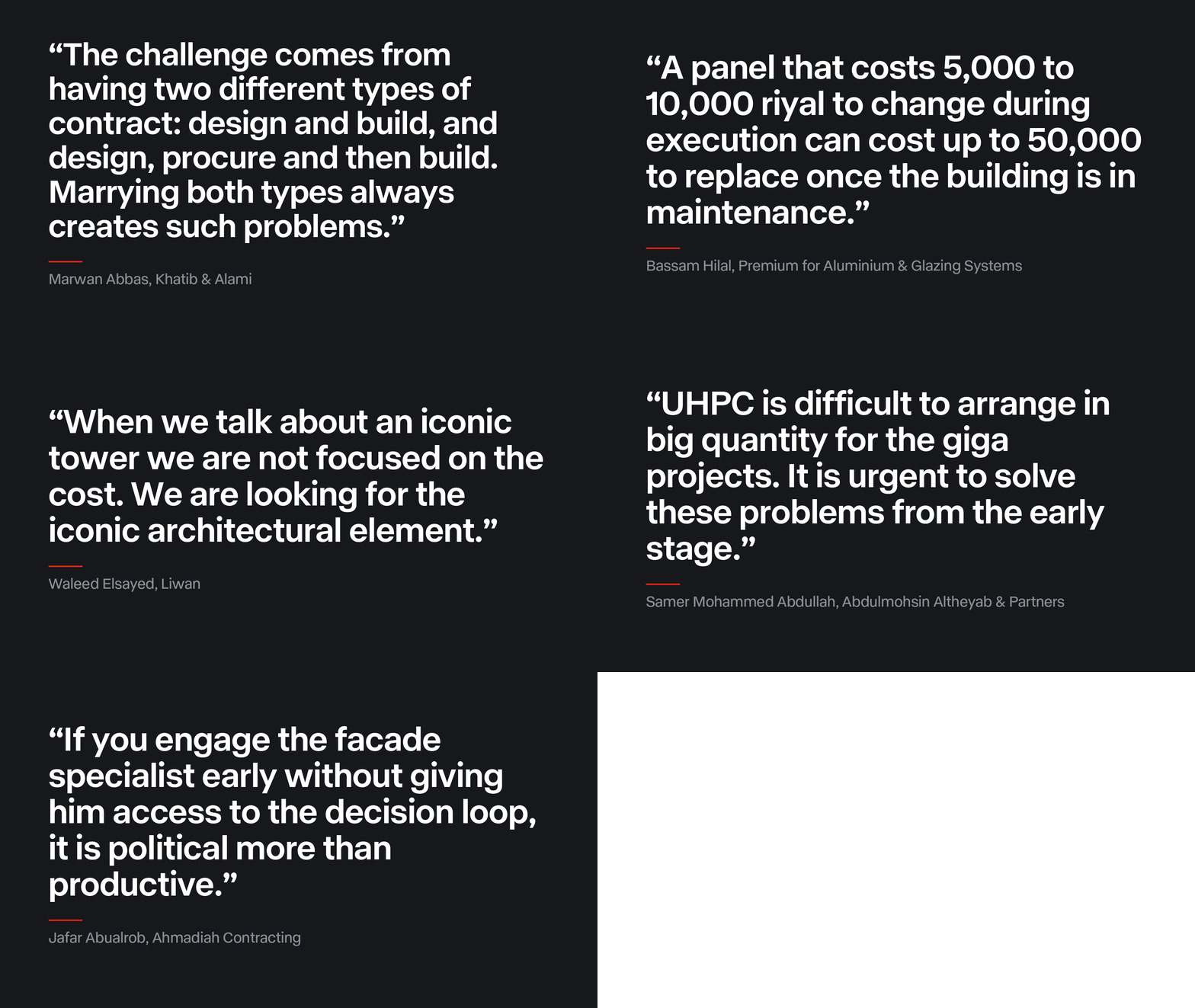
The challenge comes from having two different types of contract: design and build, and design, procure and then build. Marrying both types always creates such problems.
Marwan Abbas, Khatib & Alami
The economics: pay more to save more
Bassam Hilal frames the return on investment in two horizons. In the short term, early involvement lets a system be customised, tested and retested, produced locally and have its raw materials, glass among them, reserved ahead of time, while heading off risks around shipping, access and lifting equipment. In the long term it is maintenance that dominates: a large glass panel in a remote villa might cost 5,000 to 10,000 riyals to replace during construction, he notes, but up to 50,000 to change later for a thermal fracture, a cost early planning of equipment and local supply can cut or remove. Jafar Abualrob puts the same idea as "pay more to save more", and sets three conditions for it to work: timing, so the specialist is in before decisions are frozen; access to the decision loop, without which the involvement is political rather than productive; and cooperation, so stakeholders treat the specialist's input as value rather than resistance. Left late, he warns, the result is delays, disputes, redesign and hundreds of RFIs.
A panel that costs 5,000 to 10,000 riyal to change during execution can cost up to 50,000 to replace once the building is in maintenance.
Bassam Hilal, Premium for Aluminium & Glazing Systems
It starts with the developer
Waleed Elsayed traces the chain further back, to a developer clear enough to define the design objective and market segment from the outset. An iconic tower and a residential block call for different approaches, cost is not the driver behind a landmark, whereas a residential building's façade must be specified to its segment, whether economical or elite. On his own mixed-use project, spanning offices, hospitality and residential, defining the segment and involving a façade contractor early to fix the right system meant the work moved to site on time and on budget, with no delay in material approvals.
When we talk about an iconic tower we are not focused on the cost. We are looking for the iconic architectural element.
Waleed Elsayed, Liwan
A boom, and a race for materials
The current construction boom sharpens all of this. Samer Mohammed Abdullah describes the supply-chain difficulty directly: alternative materials are harder to source than traditional ones, ultra-high-performance concrete in the quantities a giga-project needs is his example, so the integration of designers, contractors, suppliers and fabricators has to start at design, with long-lead items studied early. Asked how early material decisions should come, Hilal's answer is blunt: as soon as the design is finished. The façade, he notes, broke away from the fit-out package precisely because it now innovates faster than other trades, and an early decision lets a contractor reserve a production slot, or at least know when to. The mock-up and samples become the milestone that unlocks deployment, since an approved mock-up means approved material, which means an approved selection. Abbas adds the lesson his firm has carried across its portfolio: in a boom you must secure long-lead resources early, before the design, shop drawings or mock-up are even finalised, because contractors have finite capacity and work first-come, first-served. As Hilal puts it, you cannot boil an egg in two minutes.
UHPC is difficult to arrange in big quantity for the giga projects. It is urgent to solve these problems from the early stage.
Samer Mohammed Abdullah, Abdulmohsin Altheyab & Partners
When quality is the casualty
Pressed for a project where the façade contractor was engaged early, Abualrob is candid that, on the mega-projects, he has yet to see it, what he sees is late engagement and its consequences. On several past projects, he says, a project manager, consultant or client approved a reduction in material specification to cope with long lead times. That is why he frames early engagement as a defence of quality first, ahead of cost and time: bring the specialist in during design, decision-making, material selection and vendor listing, and the specification need not be diluted later. Samer Mohammed Abdullah explains part of the client resistance from the designer's side, the pull toward traditional materials under the national vision, and clients' concern with cost, and the way through it, using value engineering across the whole project so the façade is weighed as one element of the building's cost rather than in isolation.
If you engage the façade specialist early without giving him access to the decision loop, it is political more than productive.
Jafar Abualrob, Ahmadiah Contracting
BIM as a risk tool, not a 3D model
On BIM, both Elsayed and Abualrob think it is still immature in the region and often misunderstood, using Revit in place of AutoCAD, Elsayed notes, is not the same as running BIM, which needs the team and the awareness to build the project virtually before it is built for real. Done properly, he argues, it can save around 30 per cent of the project life cycle by resolving issues on the model rather than on site, and on his own project he insisted on it from the design stage against pushback, so that today every subcontractor works in one environment and decisions are made on time. Abualrob narrows it to the façade, whose package he calls the highest in interface density, meeting structure, architecture, MEP and fit-out, so that any early coordination gap becomes a clash on site. Treated as a risk-elimination tool rather than a modelling exercise, he says, federated models catch clashes before production and validate tolerances, while 4D planning sequences installation, access, lifting and safety; run on a common data environment, it gives every party one source of truth. But it only delivers, he cautions, if the façade contractor is engaged early, otherwise BIM stays a beautiful 3D model, and it should run from design through handover into facility management, not be bolted on at the end.