Eric Claeys makes a deliberately provocative argument: that curtain walling has stood still for decades, that operational carbon, not embodied, is the real test, and that the answer is a simple, fire-resistant hybrid-steel system whose infill can be replaced without dismantling the building.
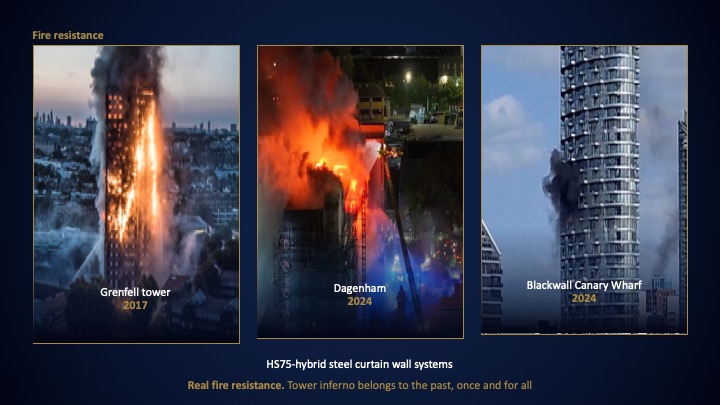
Speaking as a civil engineer, building physicist, economist and banker of more than forty years, Claeys frames the whole of façade engineering in one word: money. His charge is blunt, that the industry has spent decades copying itself, mistakes included, and that façade contractors go bankrupt at a startling rate. His response, developed over twenty-five years, is a system he calls hybrid: neither a stick system nor a unitised one but something in between, protected, he says, by some 800 patents, and offered in steel that carries the same weight as aluminium while remaining fire-resistant for one hour.
Keep it simple, or it will not be built
Whatever the label, Claeys argues, a curtain wall must in the end be fabricated and installed by people, so simplicity is the governing constraint. Even a simple detail, in his telling, is usually too difficult, and anything too difficult is both unbuildable and too expensive. The hybrid concept is pitched as the practical middle path: a durable structural framework paired with infill that ordinary labour can install.
Two sciences most people forget
Claeys returns to first principles his audience, he suspects, too often skips. A curtain wall is an envelope of structure and infill fixed to the primary frame, and it is governed by two sciences: building statics and building physics. Statics begins with gravity and with the fact that buildings are not stiff, they move, differentially, in every direction, which no decorative aluminium grid can simply absorb. Building physics is the skin's effect on the whole building's energy behaviour; his own office, he notes, generates more energy than it consumes, with revenue from the energy it sells exceeding its finance cost.
Embodied carbon is not the test, operational is
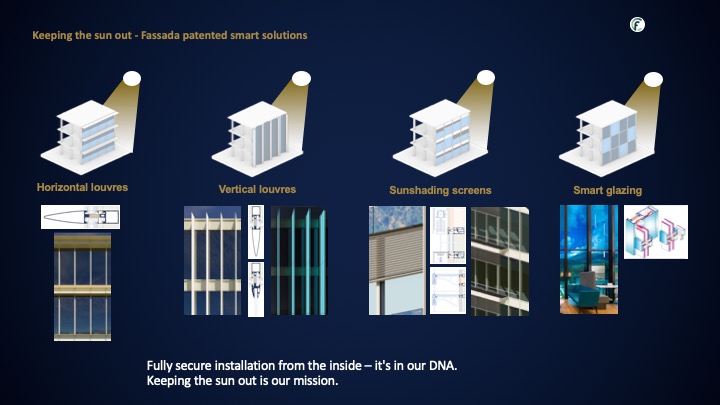
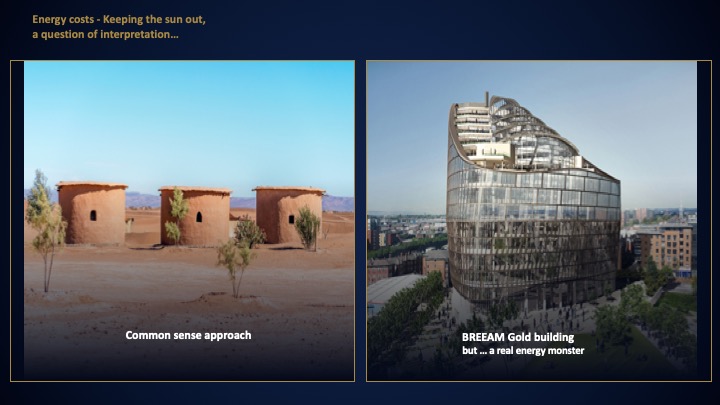
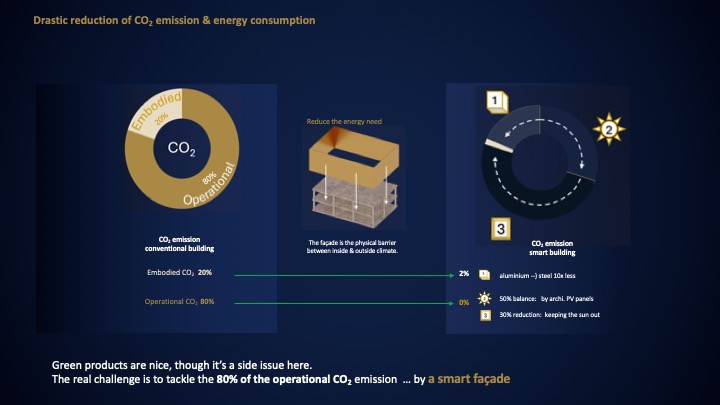
On sustainability Claeys is combative. Embodied carbon, he allows, accounts for roughly a fifth of a product's impact, but he treats it as a distraction from the real figure: operational carbon, driven by the skin and by the energy spent cooling and heating. Keeping the sun out, especially in a hot, low-energy-cost region where the incentive is weak, could, in his estimate, cut consumption by around half. A heavily glazed tower that carries a top sustainability rating while behaving like an energy monster is, to him, the central hypocrisy; the greenhouse effect, he points out, does not spare a certified façade.
Build it to be upgraded
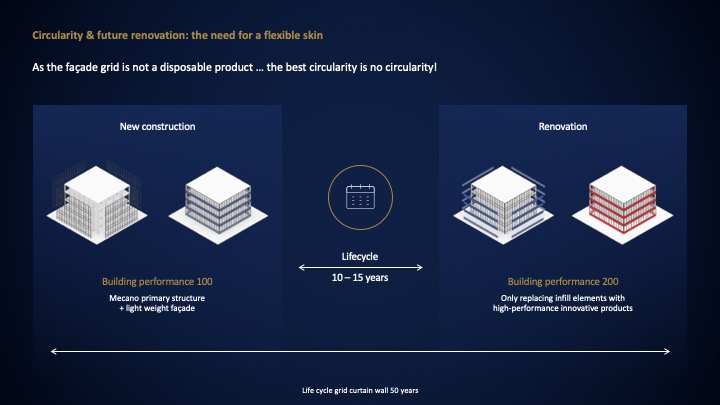
The final argument is about time. A structural grid may last fifty years, Claeys notes, but the infill will not, and tightening regulation means a façade built in 2025 will look dated by 2035. That calls for replaceable "tyre" systems that can be upgraded from inside, rather than structural glazing or unitised walls that cannot be changed without taking the building apart. Circularity, he adds, is best avoided by durability, stainless steel or titanium offering long guarantees in aggressive environments, much as a classic car stays in service rather than being discarded. To hold quality while cutting cost, he points to new highly automated "dark" factories, where he claims one manufacturer's production time fell by a factor of thirty. The green transition, in his reading, is a money-maker for developer and owner alike, but only for those willing to abandon systems designed decades ago.