


Scott Young traces a shift from treating façade fire safety mainly as a material-combustibility question to examining complete wall systems. Cavity spread, slab-edge separation, ventilation and weatherproofing now have to be resolved alongside fire performance rather than after it.
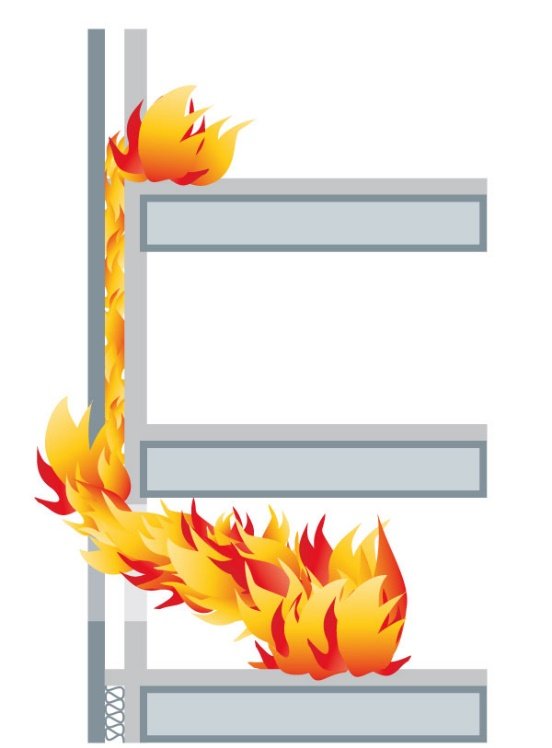
Façade fire compliance in Australia has evolved through failure. Young describes an earlier period in which external-wall fire spread was often treated as a narrow certification issue and façade engineering could sit at some distance from the main building-approval process. The combustible-cladding crisis changed that assumption. After the Lacrosse fire in Melbourne, scrutiny concentrated heavily on combustible materials, particularly aluminium composite panels with polyethylene-rich cores. Grenfell then widened the problem again by demonstrating that fire behaviour depends not only on the face material but on insulation, cavities, barriers, openings and the way the complete façade creates vertical paths for flame and hot gases.
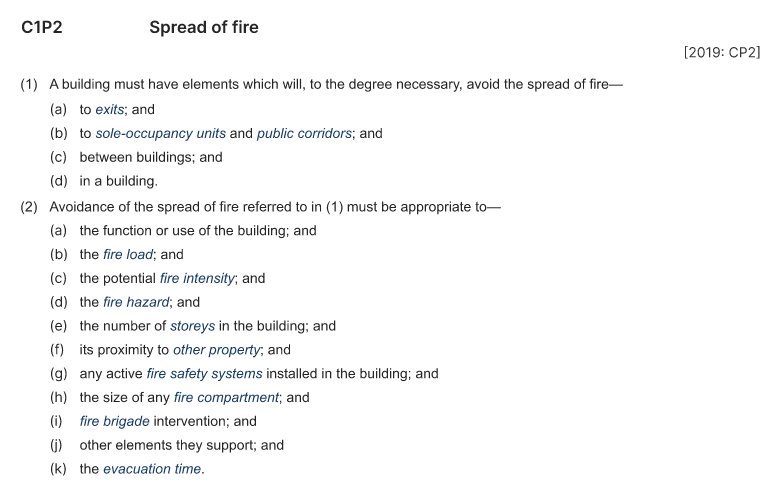
The history matters because regulation tends to respond to the failure that has just become visible. Young’s concern is that solving one problem too narrowly can create another. A requirement that simply removes combustible material may improve one aspect of safety but make it difficult to ventilate a cavity, drain water or seal movement joints. A façade has to resist fire spread while continuing to work as a weatherproof, thermally controlled and maintainable envelope. The compliance task is therefore increasingly about integrating fire engineering into normal façade design instead of adding isolated fire products to an otherwise complete wall.
From material classification to system behaviour
Young uses the Lacrosse period to show why small-scale material tests did not always describe the risk of composite cladding. An aluminium skin can protect a combustible core from the heat exposure of a limited laboratory test while a real building fire can breach that skin and release much more fuel. The problem is not that material testing has no role; it is that the scale and configuration of the test have to resemble the mechanism of concern. Once the industry recognised that gap, full-wall behaviour, product composition and the evidence supporting a façade approval came under much closer review.
Grenfell made cavity behaviour impossible to ignore. A ventilated or drained façade intentionally contains voids, yet those same voids can act as chimneys if fire enters them and compartmentation is absent or discontinuous. Cavity barriers and fire stops therefore have to interrupt vertical and horizontal spread while still permitting the façade to manage water and air in normal service. This is a difficult interface because the most effective fire closure may conflict with the opening a rainscreen needs for ventilation or drainage. Young sees that conflict as a reason for multidisciplinary design rather than a reason to prioritise one performance requirement and hope the others can be repaired later.
The slab edge is not a line on a drawing
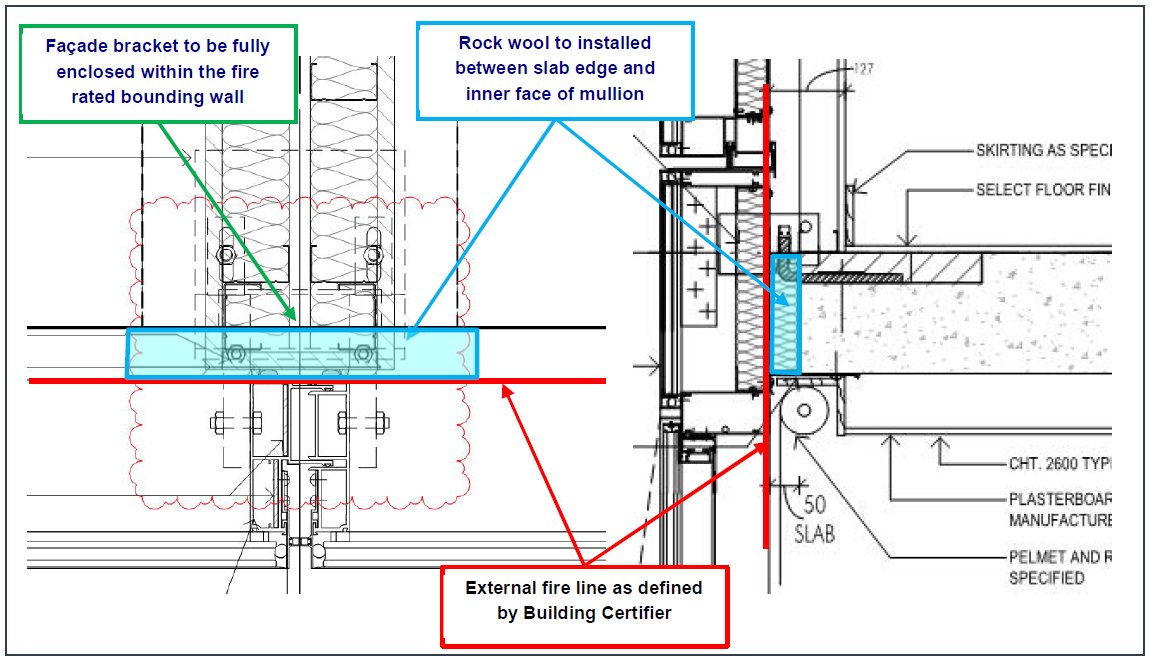
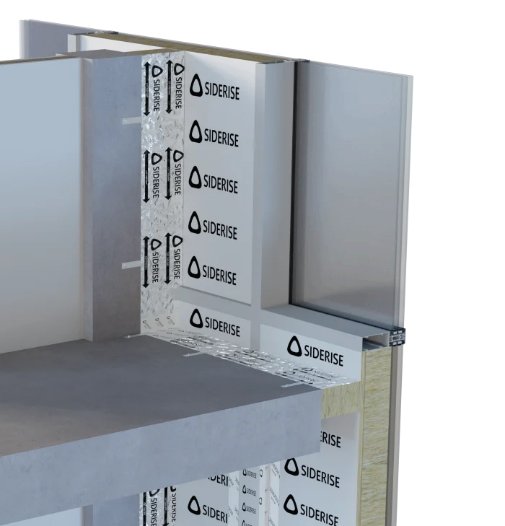
One of the recurring difficulties is maintaining fire separation where a façade passes the edge of a floor slab or an inter-tenancy wall. The architectural façade wants continuity; the fire strategy wants compartmentation. Young shows details in which rockwool, flashings, sealants and cavity barriers are used to close the path, but he emphasises that the exact solution depends on wall geometry and the way the façade drains and moves. A barrier that is perfect in a static section can fail if slab deflection, curtain-wall movement or installation tolerances open a gap that was not considered.
The National Construction Code has also had to recover some buildability after strong reactions to combustible-cladding failures. Young refers to later provisions that explicitly permit certain minor combustible components such as seals, gaskets and caulking where their use is necessary for the façade to function. The distinction is important. A high-performance curtain wall cannot simply eliminate every polymer; weather seals, thermal breaks and movement joints depend on materials chosen for flexibility and durability. Regulation has to distinguish between a minor functional component and a large continuous fuel source without creating loopholes that return the industry to the original problem.
Performance solutions are becoming normal façade work
Many contemporary façades do not fit neatly within every Deemed-to-Satisfy provision. Young argues that this makes fire-engineered performance solutions a normal part of complex façade design rather than an exceptional workaround. Verification method C1V3 can provide a pathway through full-scale testing and analysis, but it is costly and often specific to a system. For proprietary or repeatable wall systems, that investment may be justified because the evidence can support a defined family of configurations. For one-off architectural details, the design team still needs to establish an evidence chain that connects materials, geometry, cavity treatment and expected fire exposure.
The change Young describes is also organisational. Historically, a façade package could be developed by a specialist contractor after major architectural decisions and then checked by a certifier with relatively limited fire-engineering input. The combustible-cladding crisis exposed the weakness of that separation. Fire engineers are now more routinely involved in façade reviews, and design teams are expected to demonstrate how the wall meets fire objectives rather than relying on a material label or a broad concession. That increases coordination effort, but it also creates a clearer record of who has assessed the critical interfaces.

Young’s broader lesson is that code evolution should be read as a history of mechanisms, not only clauses. Lacrosse highlighted combustible composite cladding and gaps in approval practice. Grenfell showed how fuel, insulation and cavities can interact across a tall façade. Subsequent code changes and performance-solution pathways try to address those mechanisms while retaining the details required for real walls to drain, seal and move. The best response is therefore neither to chase the latest prohibited product nor to treat compliance as a paperwork exercise. It is to understand how fire could travel through the particular façade being designed and then coordinate the barriers with every other function of the envelope.
That approach inevitably makes façade engineering more collaborative. The architect, façade consultant, fire engineer, certifier, supplier and contractor all hold different pieces of the evidence required to demonstrate performance. If fire stopping is added after drainage cavities, window heads and movement joints are fixed, conflicts are almost guaranteed. If fire strategy enters early, the wall can be designed so that compartmentation and weather performance reinforce rather than defeat one another. The evolution Young describes is ultimately a shift from proving that individual materials are acceptable to proving that the complete façade behaves as intended.