


Nandan Tavkar, of Jacobs, works from the programme manager's chair, where sustainability is a risk register rather than an ambition: physical, transition and geopolitical, with the façade carrying a share of each.
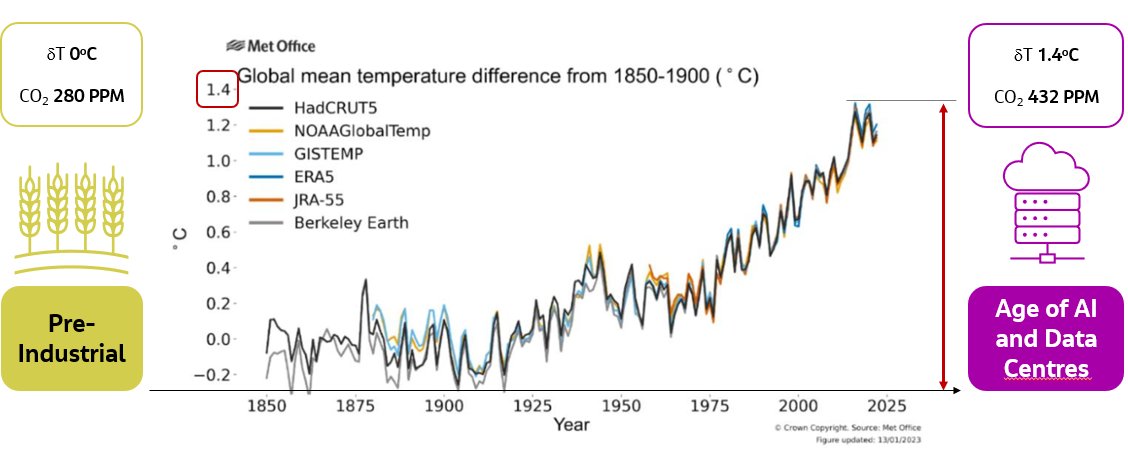
Nandan Tavkar, who works in Jacobs' climate response and ESG advisory team, began with arithmetic rather than ambition. Carbon dioxide is about 80 per cent of the greenhouse gases driving warming, and its concentration now stands at 432 parts per million, more than half again above the pre-industrial figure. There is a consensus, he said, that 1.5 degrees is gone; below 2 is still reachable, and the working global target is 1.8.
For 1.8 the world has a carbon budget of 525 gigatons, which cannot be exceeded, but the rate of emission can be managed. It runs at 58 gigatons a year and would have to fall to 30 by 2035, close to halving it. And the built environment accounts for 40 per cent of global energy-related carbon emissions, which makes design, construction and operation the largest single contributor and, on his reading, the largest opportunity.
He set the two futures side by side. On the sustainable pathway the temperature rise by 2100 is 1.8 degrees; on the trajectory the world is actually following, closer to 3. At 1.8 there is still around half a metre of sea level rise, displacing some 45 to 50 million people, and fresh water remains a risk. At 3 degrees it is 7 metres by 2100, a severe water shortage worldwide, fish species lost and crop yields down about a tenth. His argument for urgency was domestic: by 2100 our children will be old people who need a decent environment as much as a bank balance.
Which leaves two tracks to run at once. Mitigation, to avoid the 3-degree world, and adaptation, because the 1.8-degree one is arriving regardless.
Where a façade earns its place
Façade systems, he argued, are among the earliest and most impactful systems available for reducing energy demand, and they carry the adaptation work too.
Extreme heat is answered partly by fire resistance, and the simplest version of that is non-flammable material: rock or mineral wool rather than polystyrene, foam glass for roof insulation. Then there is surface: a high solar reflective index is negative radiative forcing, so where carbon dioxide warms the planet, a reflective surface cools it. Intense rainfall brings vegetated façades, which slow the flow of water, and a harder point about structure. When a deluge brought down part of the structure at Delhi airport a few years ago, the loads had been taken from current rainfall rather than from future projections, which is the kind of assumption that has to change. Drought argues for rainwater capture, and desertification for air tightness criteria, which he thinks have been neglected precisely because the codes only imply them.
Three kinds of risk
His frame for all of it is that sustainability is a risk register. Physical risks are the direct impacts. Transition risks are regulatory: policy will move quickly over the next three to five years as 2030 approaches, with carbon pricing and carbon taxes, and the European emissions trading scheme and carbon border adjustment mechanism already mean the emissions released in manufacturing a façade system carry a financial consequence. Geopolitical risks compound the others, and the answer there is local: supply chains and manufacturing in each region, which is already happening as manufacturers open hubs in the UAE and Saudi Arabia, alongside initiatives such as Make it in the Emirates and the circular economy measures the UAE is pushing.
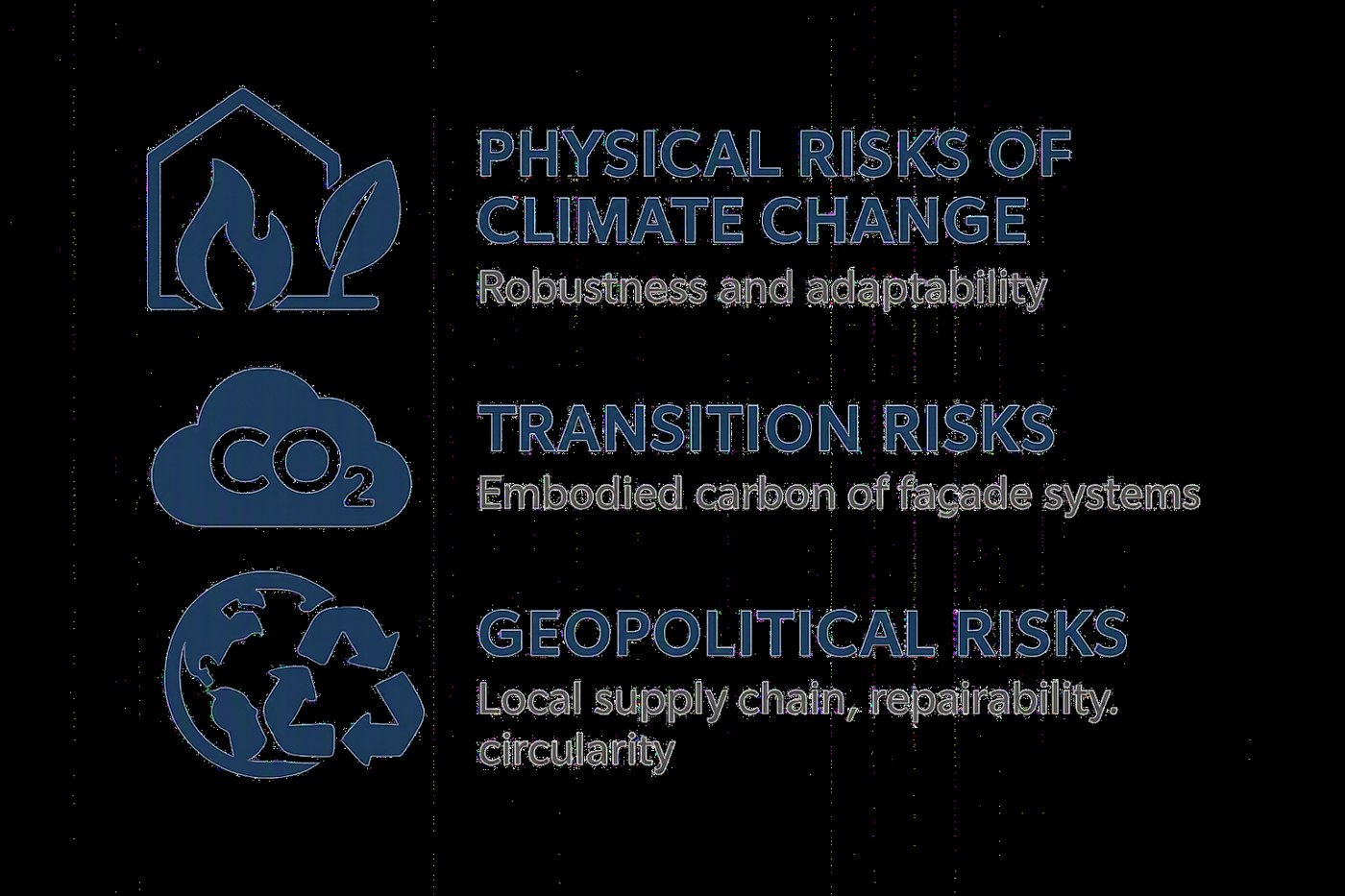
His slide put it in Buffett's terms: predicting rain doesn't count, building arks does.
Net zero as an equation
Written out, net zero is embodied carbon plus operational carbon plus user carbon minus renewable energy, equalling zero. That leaves two strategies: buy a great deal of renewable energy, which is expensive, or do both and cut embodied and operational carbon as far as they will go. For a façade that means the cradle-to-gate stages for materials on one side and the operational stage on the other, where insulation and thermal performance do their work, with environmental product declarations increasingly mandated to prove the first half.
The regulation he wanted people to actually read is ASHRAE 90.1, whose section 5.4 covers façades and is routinely overlooked, along with the move from LEED v4.1 to v5 and the air infiltration rate, which he quoted at 1.7 litres per square metre at 75 pascals.
Two portfolios
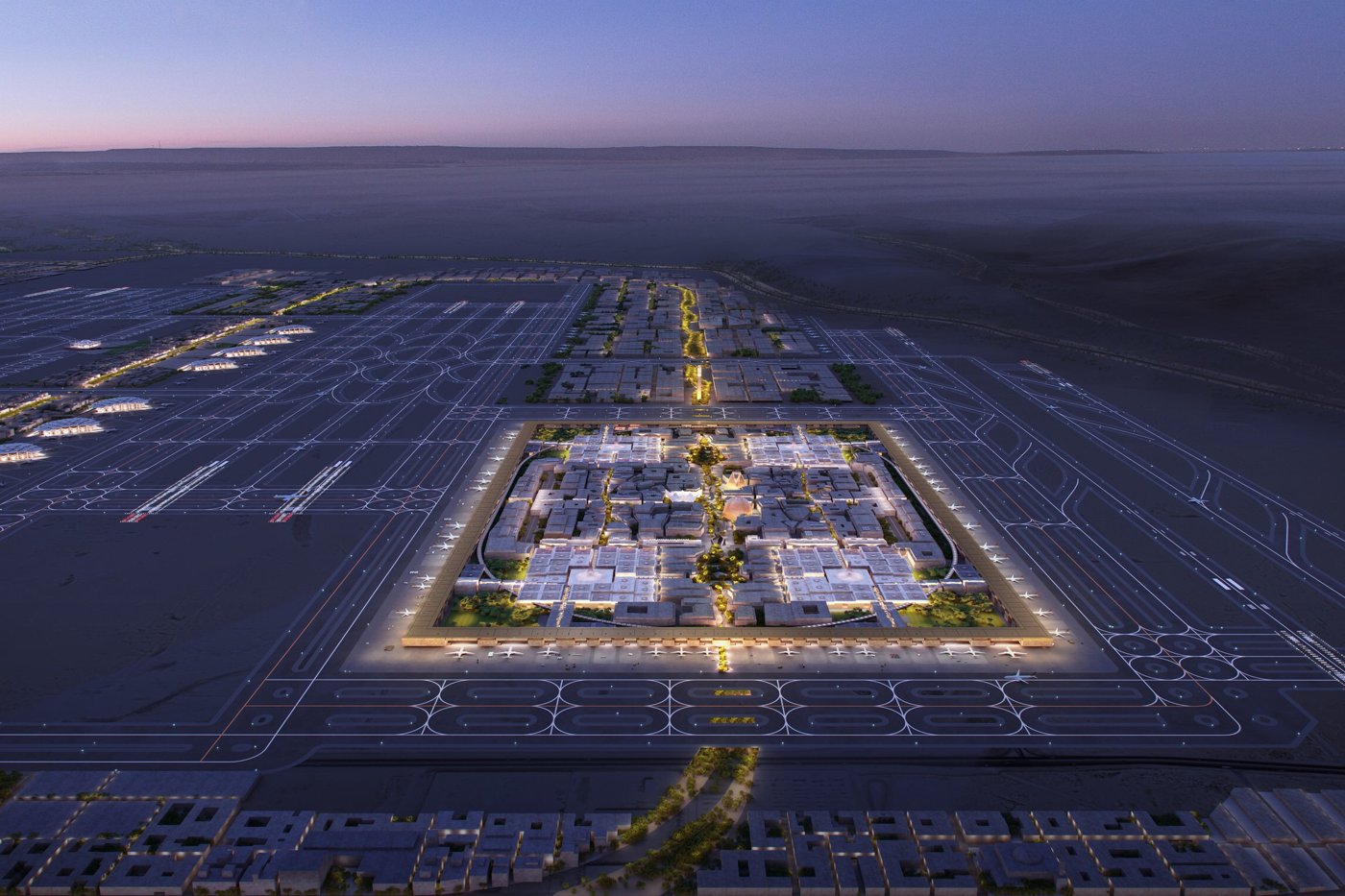
At King Salman International Airport the difficulty was typological. Terminals, air traffic control towers and warehouses each have different requirements, and all of them had to be met inside a net-zero-carbon-ready design. Non-flammable insulation went in everywhere. Where a trade-off was unavoidable, it was traded: a control tower cannot carry a high shading coefficient, so the balance was found in the remaining façade, roof and wall systems and in higher U-value glass elsewhere. The design was also prepared for building-integrated photovoltaics.
At Expo 2020 Dubai, Jacobs were the programme managers rather than the designers of any pavilion, which made the instrument different: sustainability and façade KPIs that every designer had to meet. The UAE pavilion carried integrated solar photovoltaics shaped like a falcon's wings; Terra, the sustainability pavilion, carried most of the rest. Embodied carbon was assessed over the life cycle and low-carbon materials specified, and environmental product declarations were effectively mandatory across the site, with manufacturers and contractors required to produce them.