


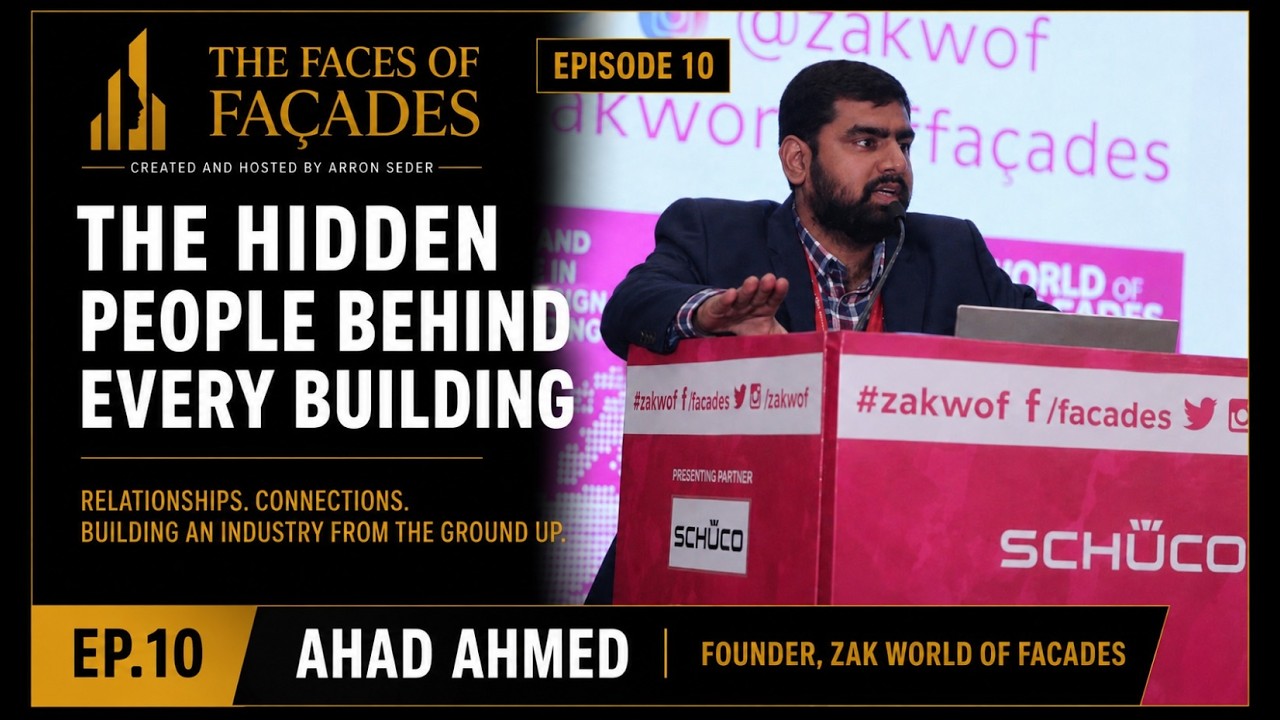
Ahad Ahmed built Zak World of Façades from a single event in a Delhi coffee shop into a platform that now runs in more than 50 countries, yet he calls himself a reluctant speaker, an accidental founder, and, above all, a connector. In episode 10 of The Faces of Façades, he joins host Arron Seder to talk about the father whose name the company carries, the handshake that started it all, and why the people who design, engineer and build our façades remain construction’s best-kept secret.
A name, not a brand
People often ask what “Zak” stands for, and I’d always assumed it was a company name. It isn’t, it’s your father’s name, Zakir.
That’s correct. Zakir is his name; they called him Zak in school and college, and he used that name to start a couple of businesses. He’s an entrepreneur at heart. He began with garment manufacturing, which is what India was known for in the late ’90s, and ran a garment exhibition. The bridge into construction was actually silicones: they’re used in garment manufacturing, and one of the companies exhibiting with him pointed out that silicones are also used in structural glazing, so why not do a show on glass?
He went to see glasstec in Germany around 2001, saw nothing like it happening in India during a boom in glass-façade buildings, and launched India’s first glass-processing exhibition, Zak Glass Technology Expo. It’s still the company’s bread and butter. A few years in, people wanted more than glass, so he added the doors-and-windows show, fenestration. He’s around 70 now and still very active. He’s my mentor and my inspiration, and the biggest thing I took from him is ethics, that’s the real binding factor as a company grows, how you treat your clients, customers and collaborators.
And it was your father who first said, “come to Germany, there’s this show called glasstec.”
Yes. A friend and client of his, the India agent for Wacker, one of the big German sealant companies, took him along to glasstec in 2001. By 2003 the first glass show in India had launched.
A handshake in a coffee shop
So how did the façades platform itself begin?
I joined in 2009 and took over the glass and the doors-and-windows shows. At the time we were chasing HALFEN, a German cast-in channel and anchor company. Cast-in channel is not a booth-and-wait product, you can’t just put up a stand and wait three or four days. It has to come very early in the planning stage; the main contractors and the façade engineers need to pre-plan it. Their India head hadn’t had much success with other events, and his real problem was that he needed to educate the audience.
We were sitting in a coffee shop in Delhi, and the idea came up, we proposed “Zak World of Façades” to him. He wrote the first cheque on the spot. The first event was in July 2012, and there was no looking back after that.
So you felt this industry deserved its own global platform.
Honestly, not when I started, it was more for the money. He had the budget but no platform, so we built it for him. But by year two or three the big European façade multinationals, Italian, German, American, started hearing about us. They’d been sending their global heads to speak at our Indian events, and when they saw what we were doing they said, “could you do this for us, over here?”
When we first spoke, you said something that made me smile, that you started it for fun.
For sure. He had the money in front of him and he needed it, so, let’s take it, and if it doesn’t work you lose one client. It was me and a friend of mine in that meeting; he’ll vouch for me. The real growth came after year three or four, when we went international.
Sri Lanka, and then everywhere
Our first step outside India was Sri Lanka, a 35-minute flight, everyone comfortable in English, a similar mindset to India, and a massive building boom; they were putting up more skyscrapers than parts of India were. Four hundred-plus people came. Foster + Partners were there, Safdie, Gensler, for a small country, so many practices had projects. After that came Dubai, then Singapore, and there was no looking back.
I’m still a little embarrassed at the events we produced in the early years. They were promotional, anyone who paid to sponsor or wanted to speak, we’d take them. We got the audience, because there was no other platform, but it was only by year four or five that we realised what the platform could really be.
Was that the point you realised façades weren’t simply part of construction, but an industry in their own right?
A little later. When you go to newer countries you see different problems and get different perspectives. There was no community as such, it was all very individual. My biggest surprise came in the UK, where I saw a lot of disjointed events happening here and there. And even now, façades are still a hidden profession for a lot of people. Ten years ago you’d never see a façade engineer or consultant’s name listed on a project, but you’d always see the structural engineer’s. That baffled me, when the façade is 20 to 25 per cent of a building and one of its most important parts.
Why the façade engineer gets no credit
Why do you think façade engineers don’t get the credit they deserve?
First, it’s a nascent profession, façade engineering is maybe 30 or 40 years old. Second, the façade wasn’t considered an important part of the building. The glass curtain wall came from the American architects, they call it enclosure design, and they were designing the façade, not engineering it, with the help of large façade contractors in a design-assist model.
As soon as façades became more complex, curvature, new materials, new shapes, the façade-engineering profession came to the forefront. But in most of the world it’s still seen as an optional external fee: “why pay for a façade consultant, let the architect handle it,” unless the building is genuinely complex or the architect puts their foot down. A lot has changed after Grenfell and after COVID; fire safety and sustainability have brought façades into the spotlight. From here, I only see the profession growing.
From 100 conferences to 200, in a third of the time
You recently celebrated Zak World’s 200th conference. It took ten years to reach 100, and then just three to reach the second hundred. What changed?
That one-year break in 2020, with not a single in-person event, was really about momentum. We already had a lot of requests, and after 2021 most economies opened very fast, people wanted to meet each other again after almost 18 months of zero activity. We were able to grow the team, and companies could invest more.
The early years were also a learning curve, the first four or five years I was still learning, and it was still fun. From 2015 we started building the core team, and that same core team is still with me today. I can only do part of it myself; I need a team behind me.
Family, and holidays that became events
Your family were with you at the 200th. Why was that so important?
I travel so much that my wife and kids want a piece of it. It coincided perfectly, they come to every London edition, because we hold it during their school holidays, and it happened that the London event was the 200th. I didn’t plan it; I was half-worried it would land on the 199th or the 201st. I have a home in London and I’m there about two months a year. Family is my energy, apart from the events, the rest is my family.
I combine holidays and work, and a couple of places I first visited on holiday became events within a year. The best example is Australia. When I asked my father about it, he was still describing the Australia of the ’80s and ’90s, “kangaroos outnumber humans.” But I flew into Sydney in December 2016, and as we were landing I counted more than 40 cranes on the skyline. When you see cranes like that, you’re looking at a construction boom, and within a year we’d run our first event there.
“Worthy of the name it carries”
You once talked about building something worthy of the name it carries. Looking back, do you feel you’ve achieved that yet?
I don’t think so, there’s lots more to do. Speaking globally, not from any one region, façades aren’t where they need to be. It may be a level playing field in Europe, but not in much of America, the Middle East or Asia-Pacific. In most of the world a façade consultant is still hired just for the sake of it, unless the building is very complex or the architect has insisted.
We’re only a catalyst. I can’t influence people’s decisions, but we can excite them about what’s new in the world of façades. It’s all about ideas, mine was just an idea that we managed to scale, and I’m sure other people get ideas too. If they do, they’ll start taking the façade much more seriously.
The connector
One thing that stands out talking to you is that Zak World isn’t really about conferences, it’s about relationships. You’ve spent 20 years meeting people from every corner of the industry. What have those relationships meant to you?
I had an advantage over others. When my father was running the glass and windows shows, I was still in school and college, and the curtain-wall producers and window fabricators were his friends. I called them uncle. I visited their factories, saw their setups, understood their problems. So I grew up meeting the people who actually build façades, and I came at this bottom-up, from the people who build it, then engineer it, then design it, rather than top-down.
I’d call myself a connector. I love connecting smart minds together, with no vested interest, when two people meet, ideas happen, and then magic happens. My first seven or eight years were mostly listening and learning. The façade subcontractor was always the hidden piece of the puzzle, even the word “subcontractor” isn’t very polished, and I started with them first.
Those relationships are built on trust and reputation, which is earned slowly and can be lost very quickly. In a world obsessed with personal branding, do you still believe reputation is built face to face?
A hundred per cent, face to face. I’m not a fan of personal branding, today it’s me, tomorrow it’s someone else. I’ve had plenty of push from agencies telling me to do this and that, but I’m a very, very reluctant speaker. I told you that when you first approached me. I hate going on stage, but I have to, because unfortunately I’m the only one who can tell the story of how this started.
I’m an introvert; my father is the complete opposite, a natural public speaker. I used to shiver at the first few events. Now I don’t even read off a script, but given the choice I’d rather not be up there. It’s not about me. I’d rather be behind the scenes, getting things moving.
So the stage is your kryptonite.
[laughs] You have to get comfortable being uncomfortable sometimes. Someone has to do it, and I can’t pass the baton just yet.
The quality the best people share
You’ve met a lot of professionals over the years. When you think about the very best of them, what do they have in common?
Knowledge transfer. The people in this industry genuinely love it and want the profession to continue, you don’t want to end up in a position where there are no façade engineers, no talent pool. The industry has clearly acknowledged that it’s not about holding on to knowledge but about mentoring other people, other consultants. They want this profession to grow and continue even after they retire.
The concern that keeps coming up
After more than 200 conferences, is there a conversation or a theme that has stayed with you more than any other?
I won’t pick one highlight, because every region is different, but one thing is common to almost every edition: the shortage of good façade subcontractors and fabricators. Count the ones that were active 20 years ago against the ones now, and the number hasn’t increased, it’s the same, or fewer. Big curtain-wall producers, even companies 30, 40, 50 years old, are going into administration at a record pace. That’s alarming when façades are getting more complex and you need people with real experience and expertise designing and building them.
Façade contractors are suffocated, cash flow, and retention money of five or ten per cent held for a year against whether the façade performs. And the next generation, their own children, don’t want to take on that responsibility and risk; they want an easier life. Curtain-wall subcontracting is highly specialised. So who takes these companies forward? That genuinely worries me, and it’s a side of the industry people don’t talk about enough.
Awareness and education
One reason you started The Faces of Façades is that so many young people don’t even know the industry exists. Why do you think that is?
Because façade subcontracting is still a fairly disorganised, un-glorified industry, so it isn’t very appealing to youngsters, and Gen Z think differently. Put it to ChatGPT, “should I start a career in façade curtain-wall contracting?”, and you’ll be surprised: it tells you it’s a high-risk industry. I even flagged that as inaccurate. People are deciding their careers on what AI or Google tells them, and that needs to change.
In the UK, students study construction, architecture and engineering and still don’t know the façade industry exists. Is the biggest challenge awareness, or that we haven’t told our story well enough?
Both awareness and education. How many courses in the UK actually teach façade engineering as a profession? Really just one, at UWE Bristol. More need to come, when you have more courses, you have more people joining the different specialisms in the façade value chain. Those are the two things we have to create: awareness, and education.
If you had two minutes in front of a classroom of 16- and 17-year-olds, what would you tell them?
That in construction, façades are the most beautiful part of the building. First is construction, second is interior design, but interiors you only see if you’ve been inside. A façade, anyone can see from anywhere. You can point at a building and say, “that’s the façade I designed, engineered or built.”
There’s a lot of demand. You’ll find a hundred civil engineers, but at the same time only ten façade engineers, and every building the civil engineer works on still needs a façade. The opportunity is there. It’s just which side of the pond you’d like to be on: the hidden side, where all your work is invisible, or the front, where you can walk a friend past and tell them, “this is what I did here.”
If one student watching this remembered a single thing, what would you want it to be?
That the façade is 20 to 25 per cent of a building and its most beautiful part, and that there’s a shortage of talent in the industry. That means they won’t be lost in the crowd; they’ll be in a niche, with plenty of opportunities, because the profession is growing faster than the talent pool. Architecture studios are already hiring in-house façade experts. With computational design, AI, and some engineering knowledge from mentors in the industry, a young person can create a niche within a niche.
What he’s proudest of
When you look back over everything you’ve done, what are you most proud of?
That we created a network, and a voice, for the façade industry. When we started, there were no façade events in 90 to 95 per cent of the countries we went into. Now there’s a platform where architects, consultants, developers and investors talk about façades for one full day, no structures, no vertical transport, no interiors. There’s an event the industry can look forward to.
In Australia we ran the first façade-specific awards. A veteran of that industry came up to me and said, “we used to do a boys’ night out in the façade industry, but you made a night of nights for the façade industry itself.” Nobody had done it there in 35 or 40 years. Things like that make it worth the risk. And then opening new markets, Albania, Georgia, Uzbekistan, Cyprus, Greece, New Zealand. In New Zealand we had 550-odd people; they queued from 7am, from both the North and South Islands, for something no one had ever done there. In mature markets people come to network; in new ones you start with the basics, stick versus unitised curtain wall, so we curate content that’s relevant to each place.
And finally, what legacy would you like to leave behind?
More awareness. A boy from a small city in India, a computer-science engineer, not even a civil engineer, was able to spread the word about façades around the world. So imagine what the people who actually have the expertise could give back. I’d urge every façade consultant and engineer to contribute a little of their time to training new people, to share their knowledge, and to push the universities and colleges they know for a standalone façade course, a diploma, a masters, or an undergraduate degree.
Universities often don’t list a façade course because they assume the seats won’t fill, but they’re sitting on a gold mine that’s completely unused. List the course, take the help of the local industry, the glass companies, the systems companies, who are happy to support it, and it will only grow, year on year.
Ahad Ahmed spoke to Arron Seder on episode 10 of The Faces of Façades. “Business is often measured by growth,” as the conversation closed, “but it’s sustained by people, and relationships are the standards we choose to uphold every day.”