Michael Min Ra's answer to aluminium's carbon problem is to do less to it, not less with it: an almost pure alloy left unfinished, which patinas rather than fails and skips a whole process step. Beside it he sets an argument for one model carrying the work from concept to the machines that cut it.
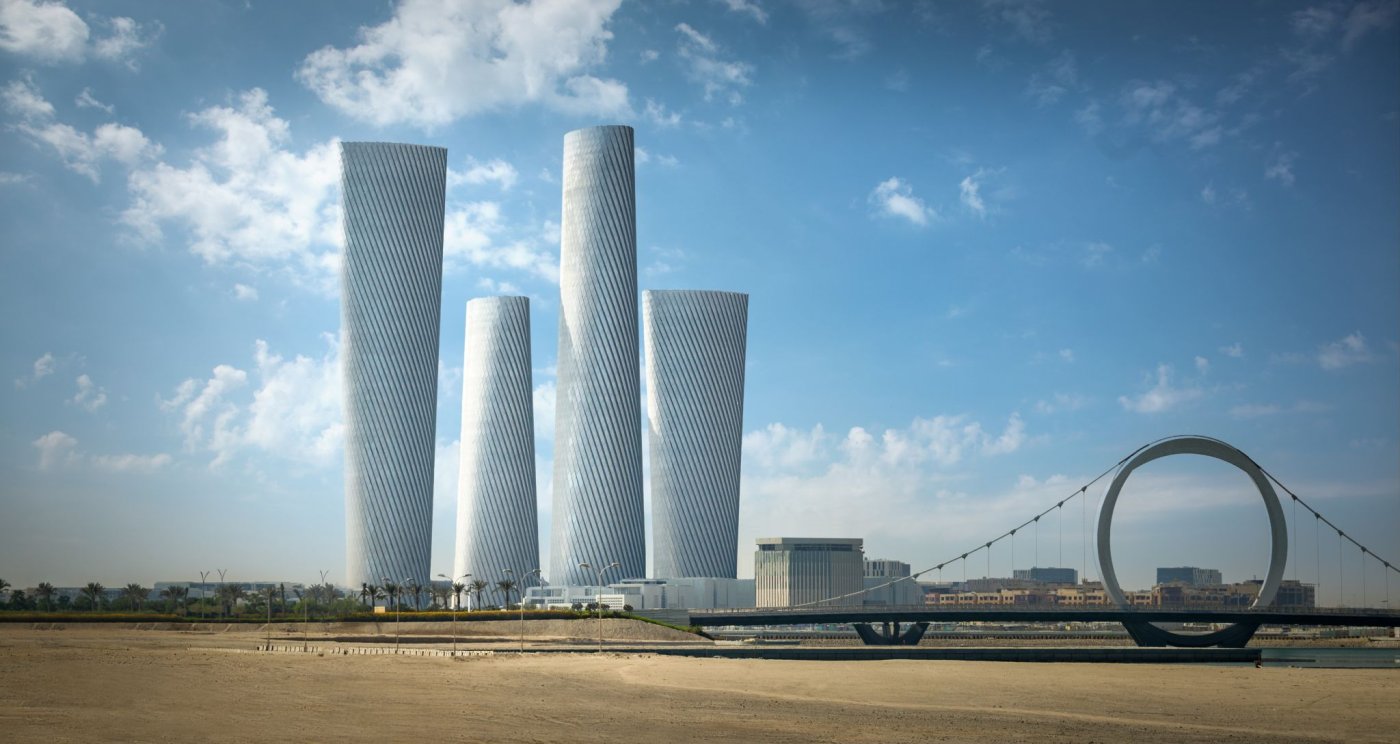
Four towers, 1.1 kilometres of height. Lusail, in Doha, ran 244 storeys across four towers from autumn 2018 to completion in 2022, on a programme fixed by the World Cup.
Aluminium and glass are the pair this industry knows best, and aluminium is now also the material most often held up as a carbon problem. Michael Min Ra's response is not to abandon it but to reduce what is done to it. A great deal of the environmental cost, and much of the long term risk, sits in the finish, and there are alloys that do not need one.
Aluminium that is left alone
The precedent is a store in Beverly Hills whose façade panel is a single aluminium sheet, fifteen metres wide and four metres tall, hot rolled as one plate and fabricated by people who normally make aircraft wings. The question at the time was not environmental at all; it was simply how to finish a panel that size. The answer was to not finish it. Unfinished aluminium generally corrodes, but the panel used a 1000 series alloy, almost pure aluminium, whose corrosion resistance is good enough that it still looks as it did on the day it went up.
The same move served a quite different intent on a project with Bing Thom, who wanted a building rough outside and smooth within, "like an oyster". Raw aluminium gave him that, and it deleted a process: no anodising, no coating, one less step with an environmental cost attached. It also lets the surface age. A painted finish either holds or fails, whereas an unfinished one patinas, which Min Ra treats as character rather than defect.
One model, carried through
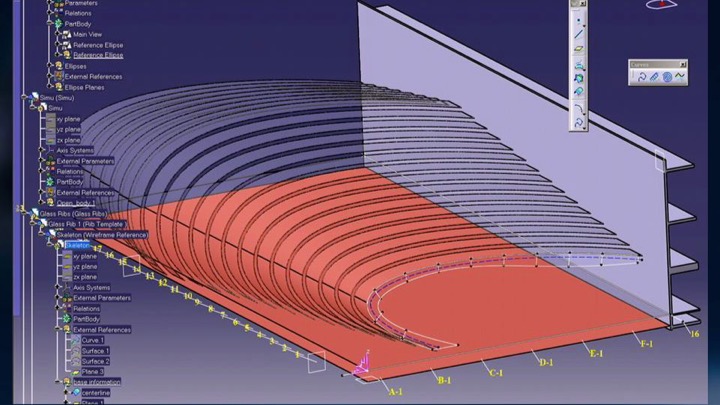
One model, not a chain of them. The first test of the idea was built on CATIA: the same model produced the client views, the details, the engineering and then the fabrication information.
His second argument is about process. Draw the usual sequence from concept through fabrication to construction and there is a break in the middle, between designing and building, and that break is where the difficulty collects. Some twenty two years ago the practice began testing whether façade work at least could be brought under a single umbrella. The trial was an enclosure for a glass manufacturer's office and showroom in Brisbane, a simple series of ribs, and it was never built. One model produced the views for the client, the details and the engineering, and then generated the fabrication drawings.
The value of that shows up late rather than early. If a bolt hole through a glass panel turns out to sit too close to an edge, and the discovery comes late, correcting it by hand means reissuing thousands of fabrication drawings; held in the model it is close to instant. The practice later developed the approach and named it Elephant. It does not suit every project, only the ones where the work can genuinely be gathered up.
What each scale asks for
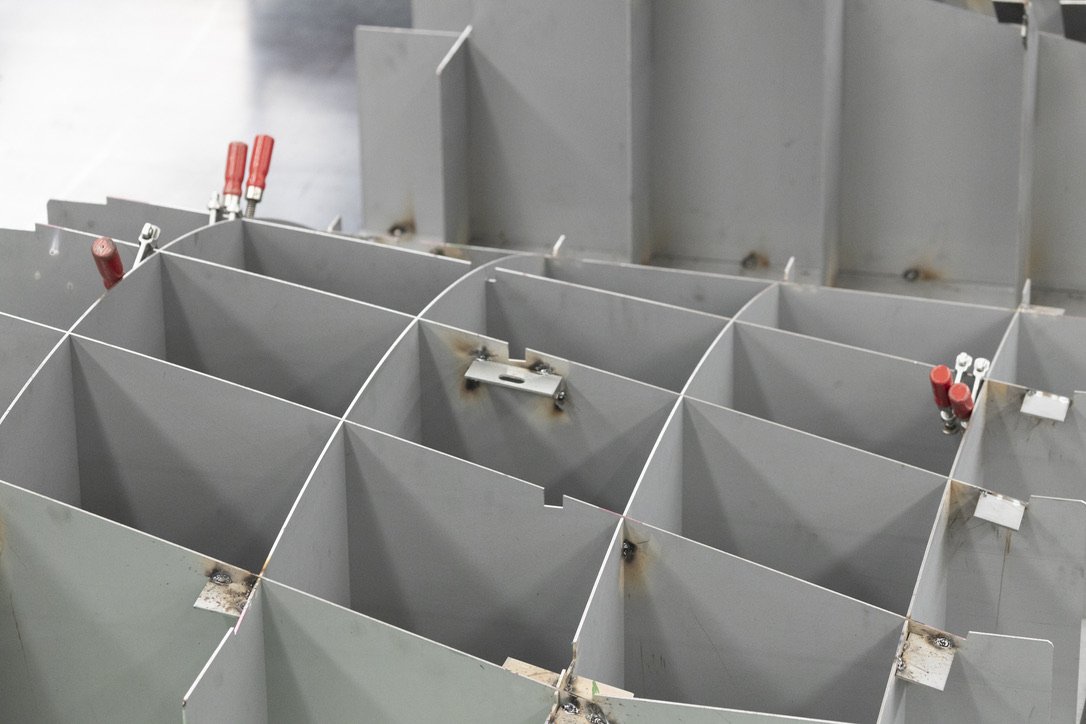
A wing, not a casting. The bench borrows aircraft construction, a waffle grid of flat plates that will take almost any shape, skinned over in four millimetre aluminium sheet.
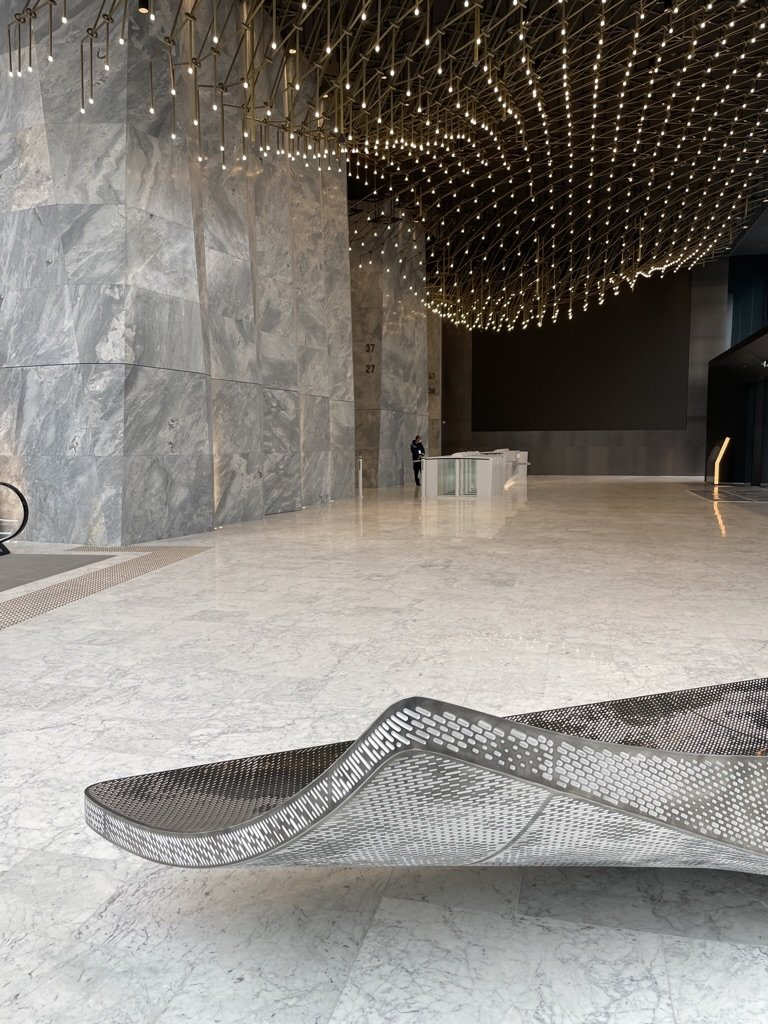
The smallest of the three is a bench in the main lobby of the Kai Tak Airside building. Kai Tak was an airport, so the bench borrows how a wing is made: a waffle grid of flat plates, which will take almost any shape, skinned in four millimetre sheet. The alloy is 5754, marine grade, again uncoated. Plain sheet was rejected for a tinny quality that cheapened the material, so the surface was built up instead, through a vibration finish, milling with bits kept thin and freshly sharpened so the grooves did not tear, then sand blasting and buffing. Leathery rather than tinny. Alloy 5754 left uncoated, worked up through a vibration finish, sand blasting and buffing, with the laser welded seams ground back until they disappear.
A one third mockup was built first to test the treatments and the quality of the laser welds. What comes out is a surface with a satiny, almost leathery feel, unlike most aluminium anyone has touched. The bench was also modified as it went, with the manufacturer, to suit what they could actually do and what it could cost.
The framing is the shading. Instead of framing plus a screen, triangular louvres do both, subdivided into plots that answer the farmland around the site.
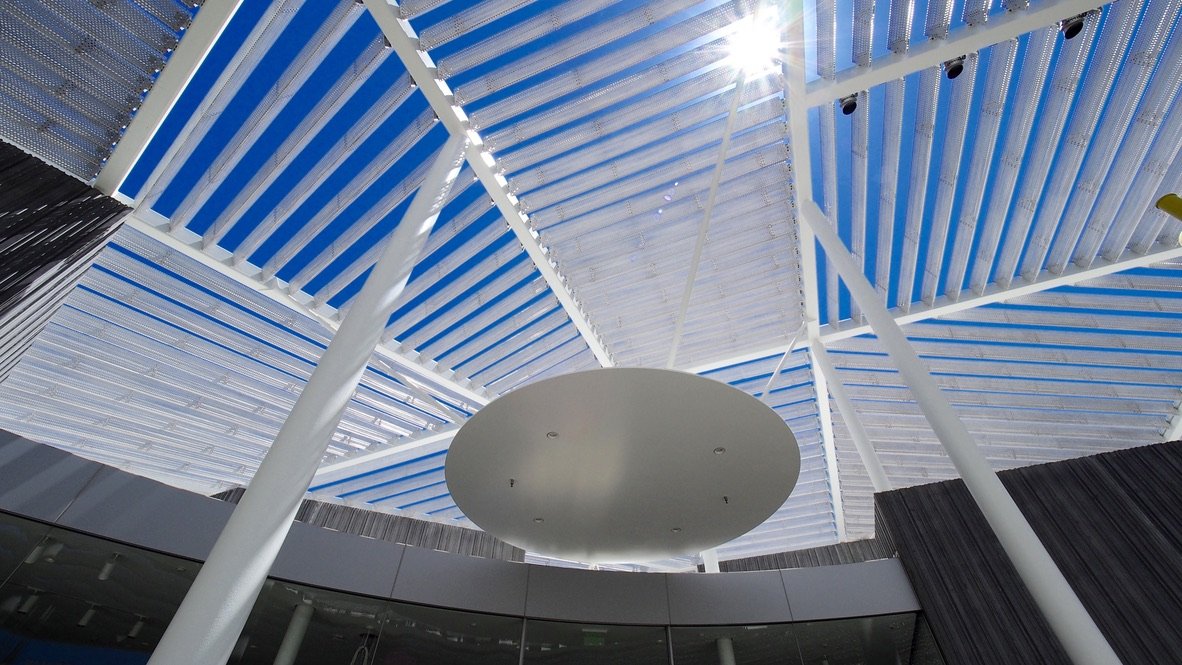
The middle project, a museum at UC Davis with SO-IL and BCJ, took the logic further by removing a layer. Rather than framing plus a shading screen, the framing is the shading: triangular louvres, three dimensionalised, subdivided into plots that answer the farmland around the site. The section was tuned by intent and then justified by analysis, broadened at the top where more shade was wanted and squeezed at the bottom where less was needed, and the extra material at the top turned out to supply exactly the stiffness required. Predicted and tested performance agreed closely. Because the assembly is light and its support points were coordinated in advance, the installing contractor finished two and a half months early.
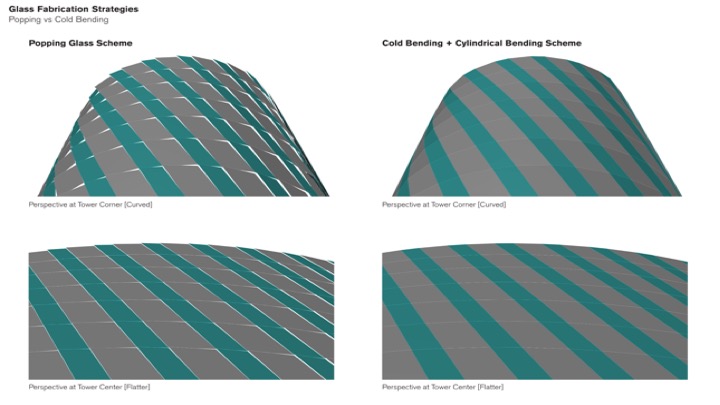
Three ways to wrap a curve. Triangulation, flat panels that pop, and cold bending were all compared; cold bending held the design intent, produced faster, performed better thermally and cost less.
The largest is Lusail Towers in Doha with Foster and Partners, and it reads as a twist that is not one. The form is squashed at the base, rotated ninety degrees and squashed again at the top; it is the skin wrapping that shape which suggests torsion. Three ways of panelising the curve were compared. Triangulation works, and so do flat panels that pop, an approach that had served an earlier double skin façade well because there the inner skin carried the performance and the outer could be flat, cheap and quietly characterful. Here cold bending won on every count that mattered, holding the design intent while producing faster, performing better thermally and costing less. Making it stand up meant working down to interlayer, spacer and secondary seal stresses as the glass was pushed into shape, and then being in the factory while the panels were made, which Min Ra describes as the only way the programme was met.