


The usual loop picks a façade system, tests it against the building's targets, fails and picks another. Jincy Mariam Rinu and Elia Galatolo, of Arup, run it the other way round and let each discipline grey out what misses its own line.
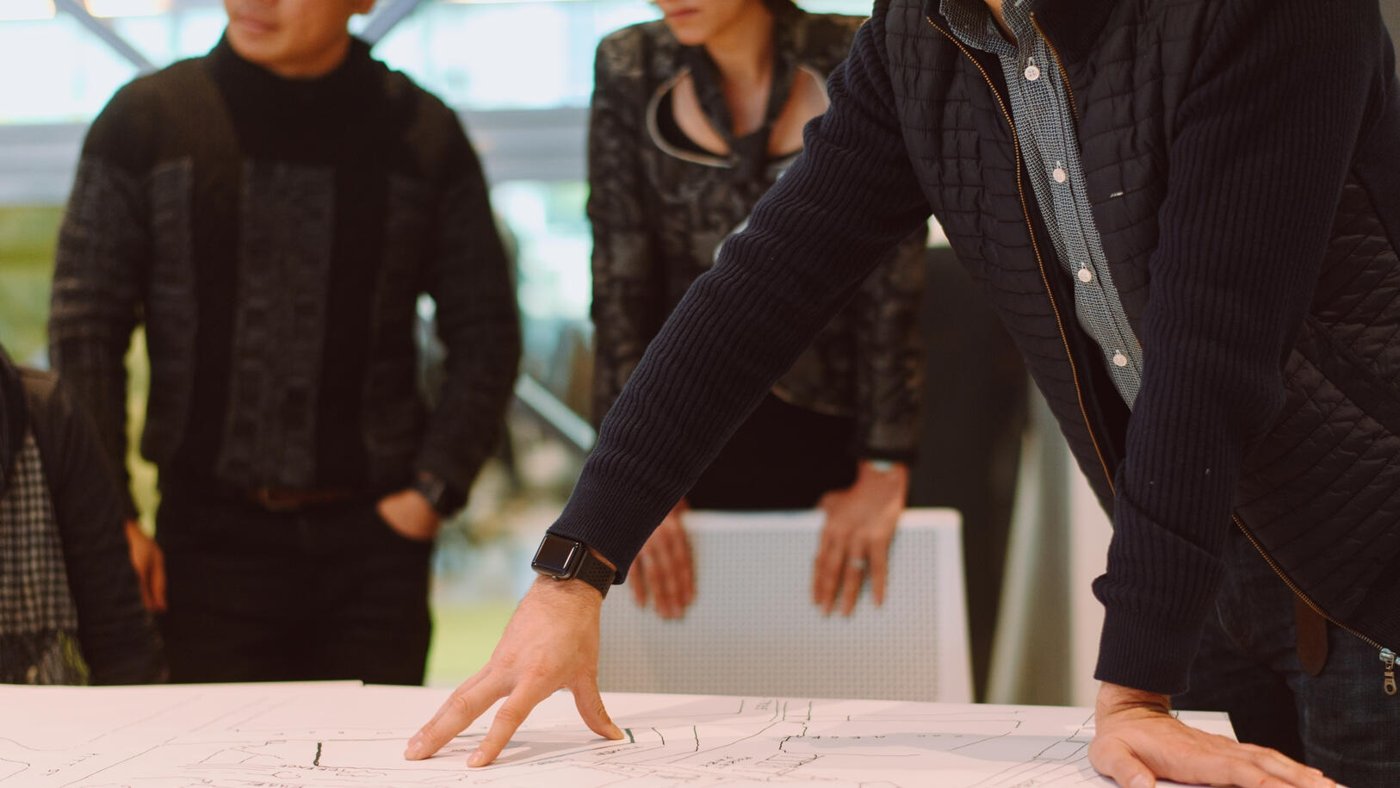
Jincy Mariam Rinu set the frame and Elia Galatolo did the demonstration. Arup's founder held that engineering was not merely technical but had to bring architecture, creativity, design and social impact together, which the firm now calls total design: those things integrated from the outset rather than handed between disciplines. The façade practice has run since 1989 and holds some 300 specialists.
Rinu's point about the region is that a façade already sits at the intersection of architecture, MEP, building physics, performance and sustainability, and the Middle East sharpens all of it: hard conditions, ambitious architecture, complex geometry, fast programmes. What is changing is the shift towards retrofit, away from demolition and new build and towards extending the life of what exists, which leaves very little room for error at delivery.
The loop everyone knows
The variables are coupled, which is the problem. Window-to-wall ratio moves the g-value; the g-value moves thermal and energy performance, and cost with it; the façade zone, the U-value and embodied carbon are in the same knot. So design turns iterative in the least useful sense: select a system, take its performances, plug them into the building's, ask whether the targets are met, and when they are not, go back and select another. That loop ends with an option somebody can justify rather than the best one available.
Make the outputs the inputs
Their inversion is simple. Instead of inputs, calculation, outputs, start from the building's performance targets and the façade performances actually achievable, put all of it into one parametric model and run it. Thousands of options come back, are filtered to those that work and are already approved, and what remains goes to the design team to choose from on design intent.
The method around it matters as much. Everyone agrees at the start which variables are in play and what range each may take; the model is simplified to keep the computation tractable; and when it has run, the same group reconvenes on the outputs rather than receiving a recommendation.
Three thousand combinations, in London
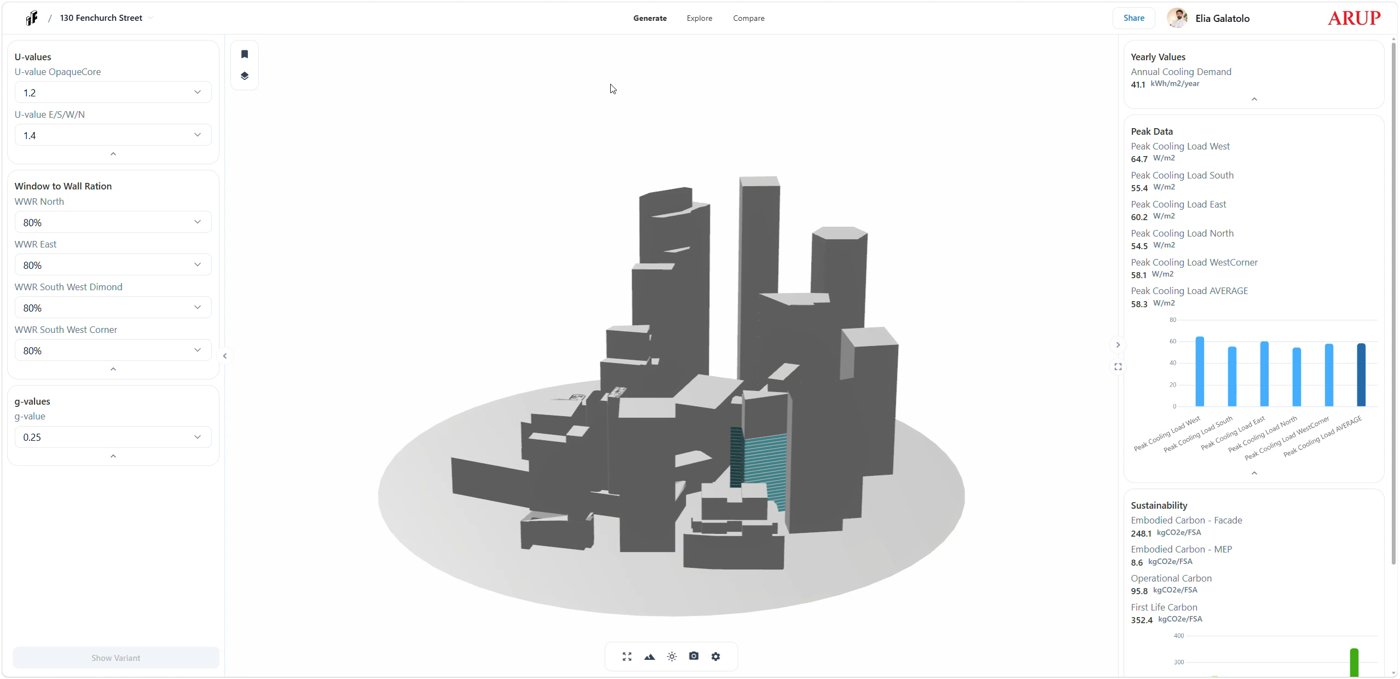
On 130 Fenchurch Street the inputs were U-value, with different build-ups tested; window-to-wall ratio, varied by orientation; and g-value, which was also used to set the façade system, so a single skin, a single skin with internal blinds and a double skin all sat in the same run. The outputs were annual cooling energy, measured against the rating the project was chasing, peak cooling load for local comfort, and both embodied and operational carbon, with the g-value tied directly to the embodied figure.
That produced over 3,000 combinations, and greying out the ones fixed by technical performance removed almost half, leaving the variables actually in play. In the tool the inputs sit left, the outputs right and the geometry between them, updating as a variable moves. The useful mode is explore, a parallel-coordinates chart where each discipline sets its own line: the MEP team's 45 kilowatt hours per square metre and their peak cooling figure greyed out everything that missed them, and then the architects added theirs, since the window ratio had to stay high enough for the view over the City. What survived both was compared side by side, with the numbers.
The campus
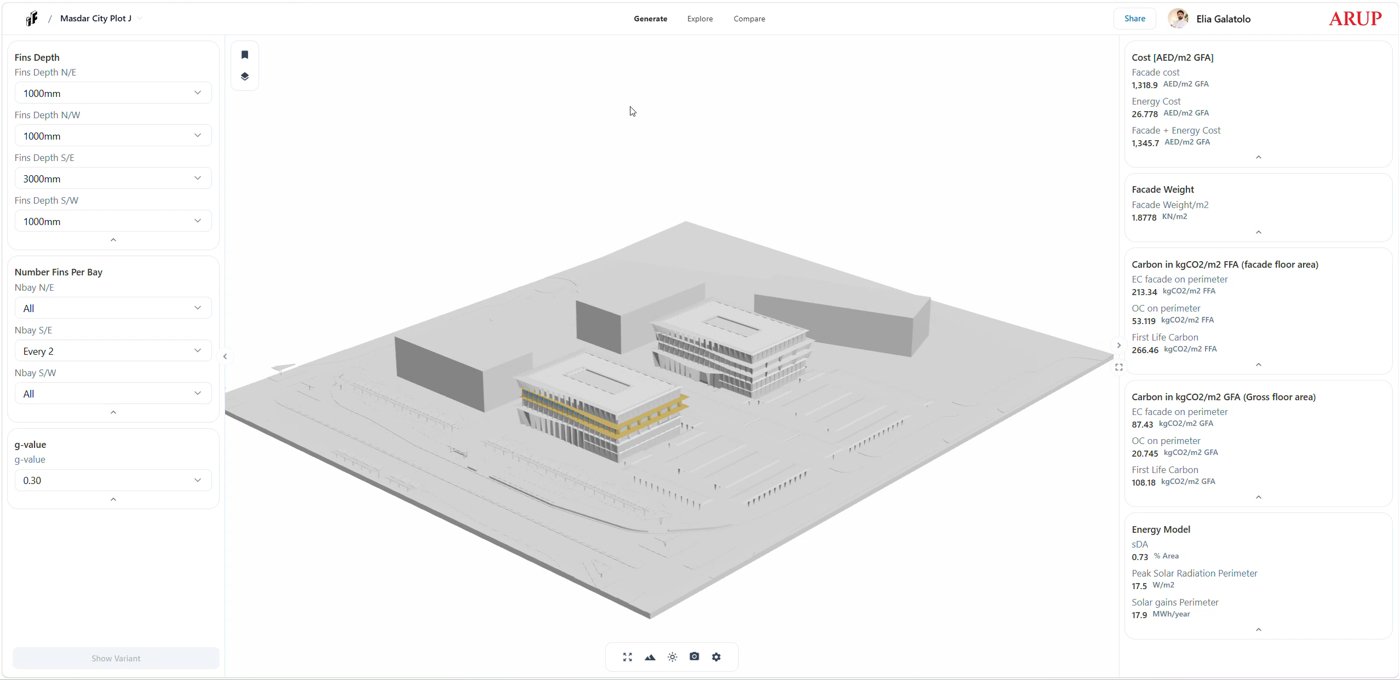
A zero-energy research campus in Abu Dhabi ran on the same platform with the variables swapped out: shading depth, façade weight, daylight, cost, embodied and operational carbon. Here the geometry was the subject rather than the energy, the question being how the shading elements pull on every other discipline. The design intent went in as a baseline, and the constraints came after it, a ceiling on cost per square metre of façade, a floor under the daylight factor, until the options that met all of them were the only ones left.
Which is Galatolo's real claim. Parametric modelling is not about energy, and it is not about sustainability. It is a method for optimising a design, whatever the design happens to be optimising for.