Hugh Dutton traced a career in structural glass from its origins with Peter Rice at La Villette to three recent projects of his own, a hurricane-proof Miami canopy that cools by catching the sea breeze, a 'daylight chandelier' of mirrors and glass reviving a dark Paris courtyard, and a series of Tiffany 'glass diamonds', arguing throughout that engineering should serve a poetic intent.
Dutton introduced himself through his lineage. Trained at the Architectural Association during a moment of crisis in the profession, he decided the way to understand architecture was to learn to build, and went to work with the engineer Peter Rice. At twenty-five he found himself on the La Villette science-museum façades in 1982, the first use of structural glass with spherical bearings and cable trusses, a system now used worldwide, and he co-wrote the book on structural glass with Rice, whom he remembered as a poet as much as a brilliant engineer.
Learning to build
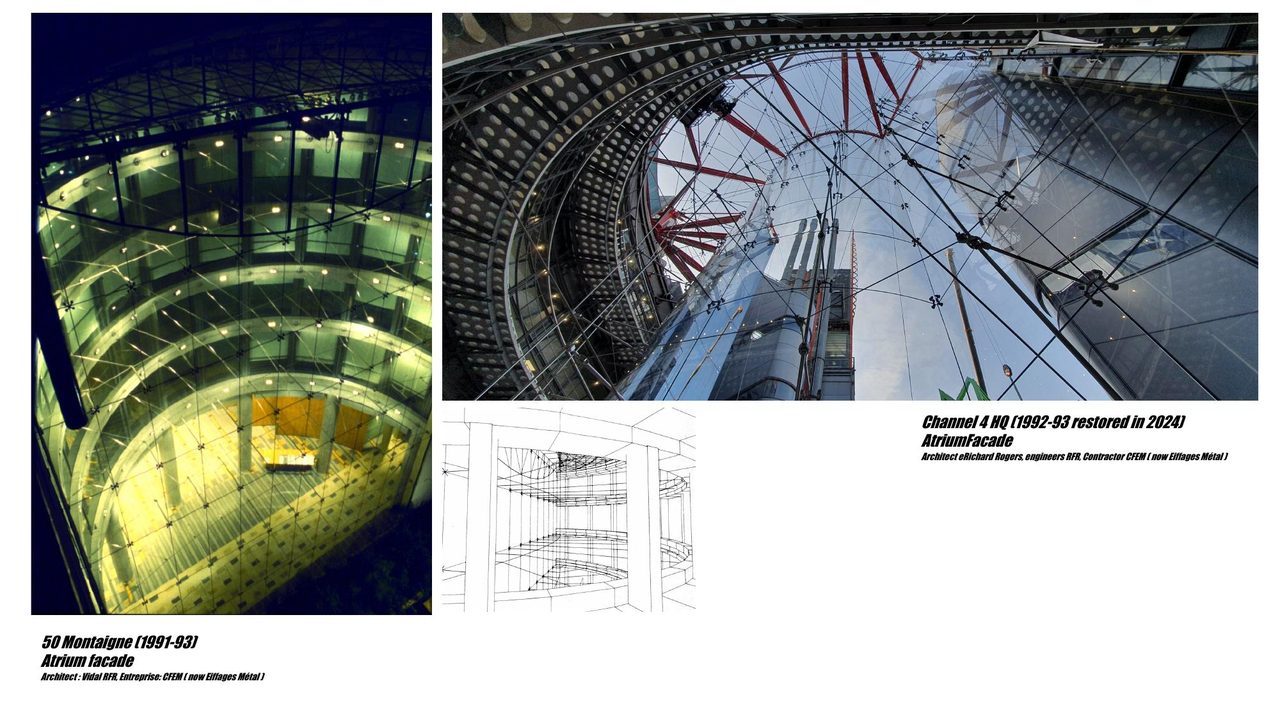
That same system produced some of the era's most striking glass: a suspended façade on Avenue Montaigne, since demolished, where each sheet hung from the one above; and a curved-glass wall for Channel 4 with Richard Rogers's office, recently restored and now a listed monument. The last project Rice worked on before his death, a cathedral, replaced glass almost entirely with structural stone, a translucent arch on the same cable-truss logic, a reminder that the method was never only about glass.
Glass that revives monuments
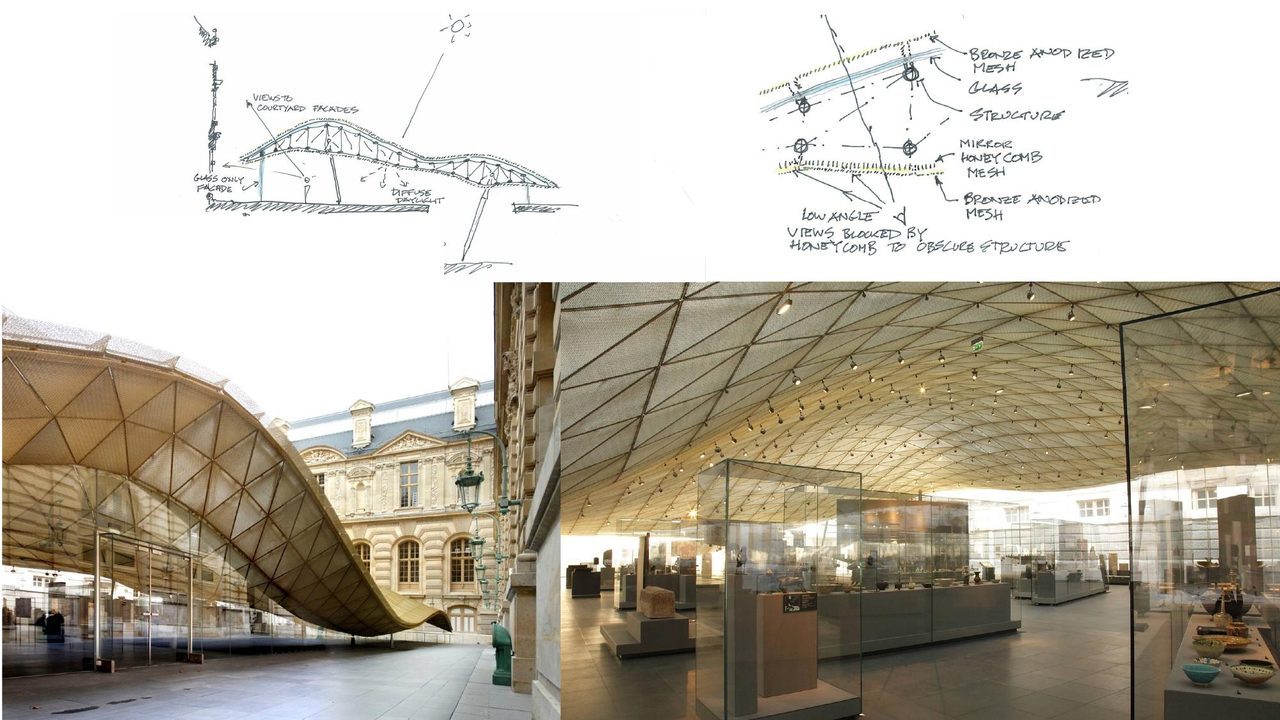
Much of Dutton's argument was about glass and sustainability, and specifically about giving old buildings new life. At the Acropolis Museum with Bernard Tschumi, two sheets of glass form a chimney that evacuates heat while leaving a clear, mullion-free view of Athens at eye level. At the Louvre, work with Rice on Pei's scheme, and later on the Department of Islamic Art courtyard with Ricciotti and Mario Bellini, turned a dusty former ministry into a public museum. Glass, he argued, is a reason to reuse buildings rather than demolish them; even the Louvre's first use of low-iron glass, chamfered to throw rainbow dispersion, was about bringing joy into a reused monument.
Catching the breeze
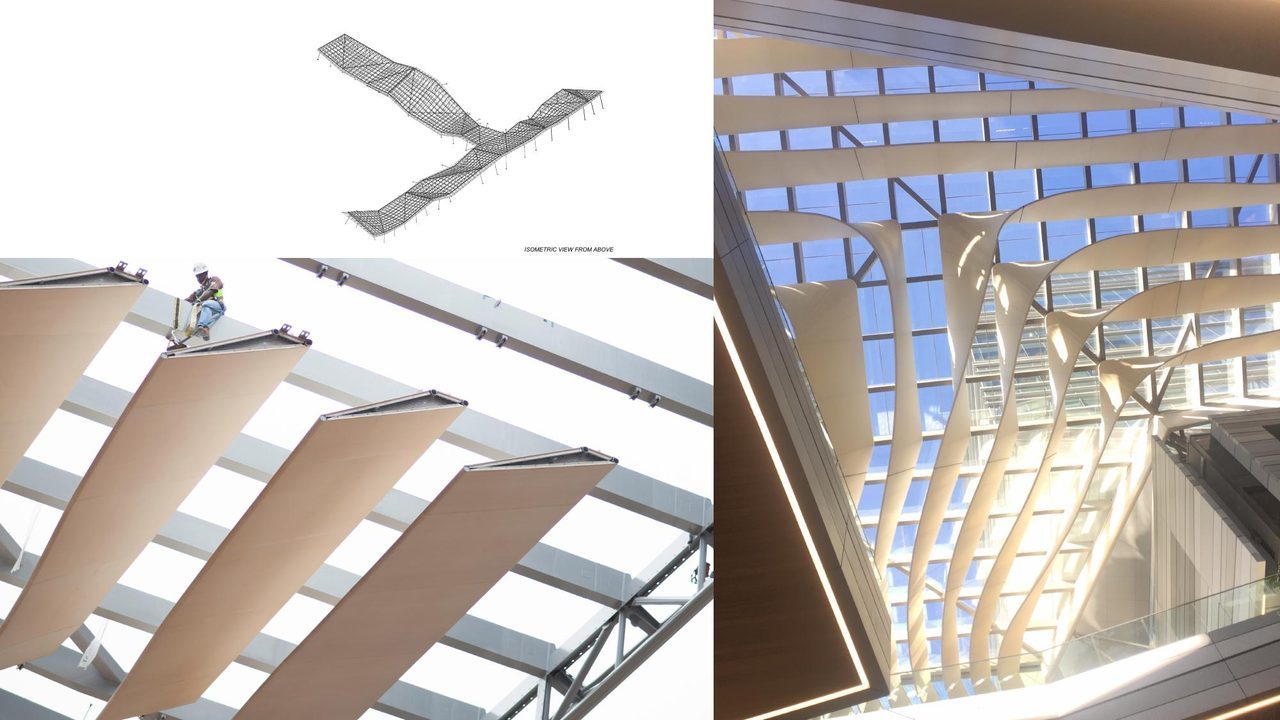
The first of his own recent projects was the Climate Ribbon at Miami's Brickell City Centre, a 100,000-square-foot canopy in ionoplast-laminated glass over a pedestrian street. The brief was a roof with no air conditioning, which sent Dutton back to childhood memories of common-sense climate design in Jamaica. Shaped to catch the constant south-easterly sea breeze, with scoops at the entrances and spoilers where the air leaves, the canopy accelerates the breeze through the space, each shading blade oriented to the annual path of the sun and smoothed into flowing form. Modelled first on open-source software and then fully with a specialist wind consultant, it shades the shopfronts without direct sun, and when Hurricane Irma struck Miami directly in 2017 it took no damage.
A daylight chandelier
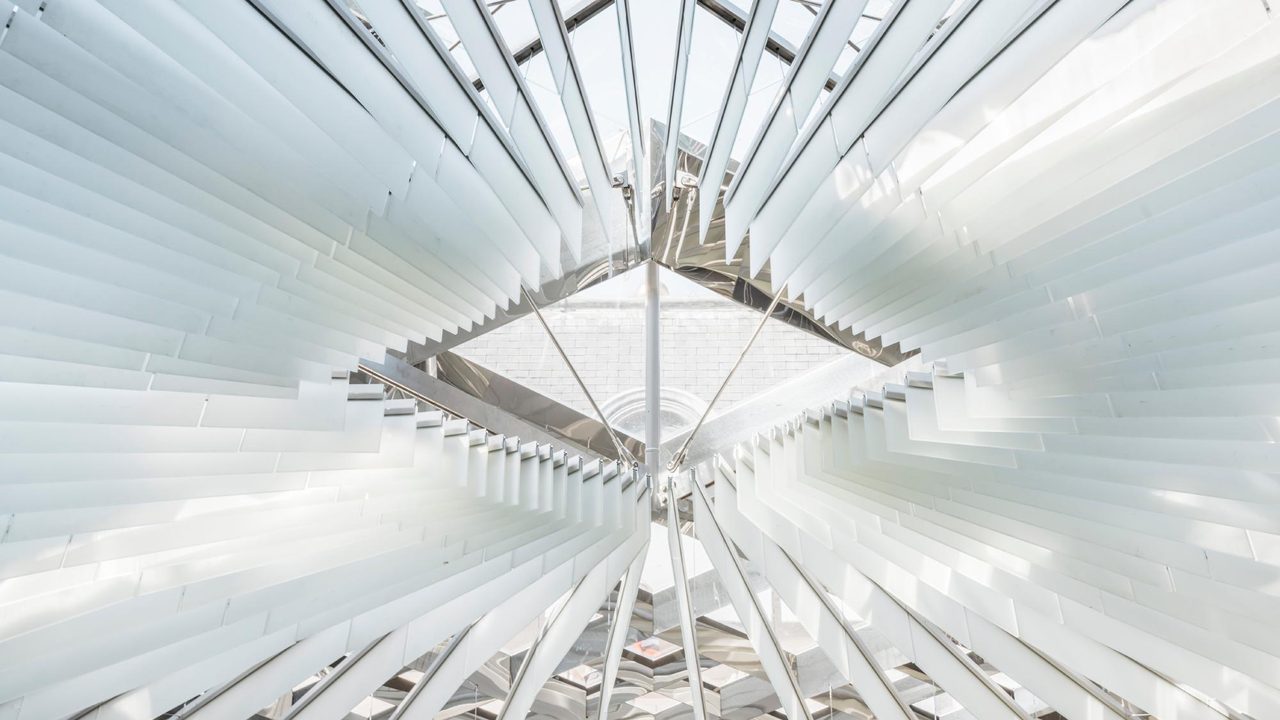
The second project, an entrance canopy at the Hôtel de la Marine in Paris, solved a preservation puzzle. A later stucco addition had darkened a courtyard originally built only to its 1784 cornice, and the brief was to hide those upper floors while still admitting light. Inspired by dappled light off Metro tiles and by the way old chandeliers used crystals to spread candlelight, Dutton built what he called a daylight chandelier: mirrors above, V-profiled so they cast no shadow, bouncing daylight down through sixty tons of glass and steel, huge 14-metre laminated panes with no joints, softened by a lightly reflective coating and an acid-etched face so the profiles glow rather than glare.
Glass diamonds
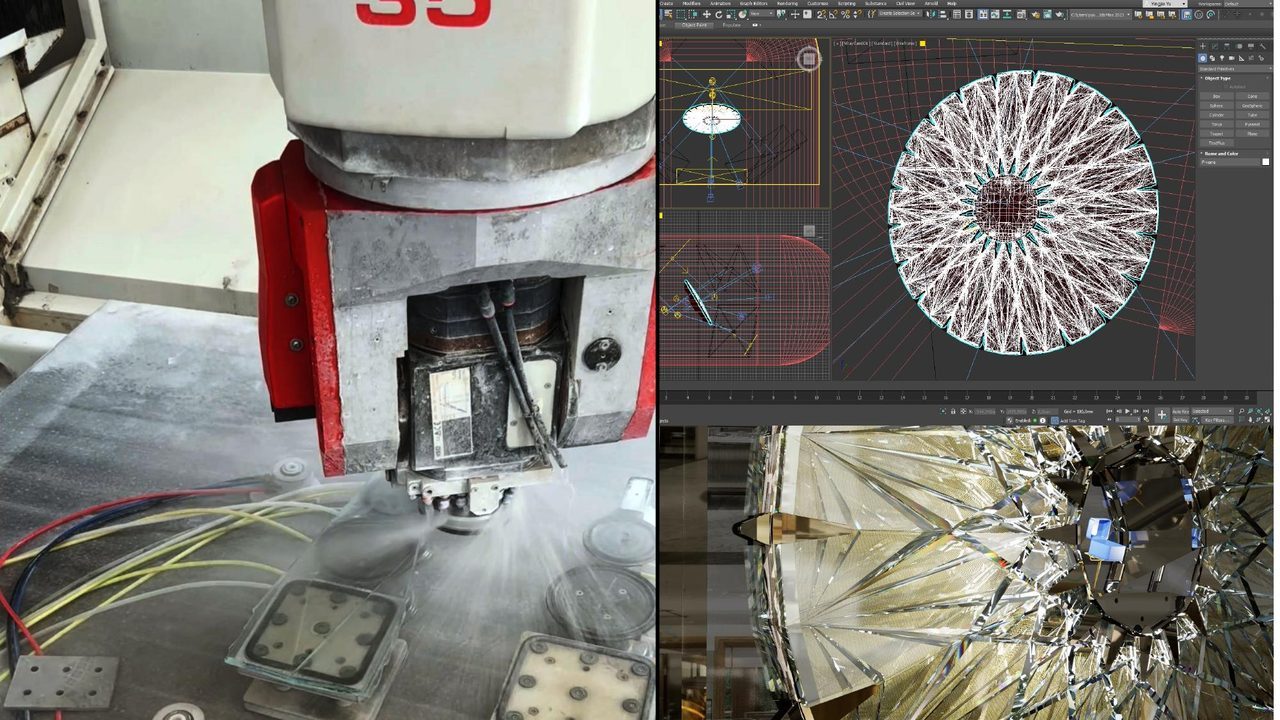
He closed with a run of work for Tiffany, his "glass diamonds", made not to imitate diamonds but to enjoy light the way they do. A 1.6-metre engraved display piece in a bicycle-wheel tension structure uses low-iron glass to pull a tight Tiffany blue along its edges; a Fifth Avenue skylight, unable to reach real sky beneath six floors of offices, instead uses cast crystal to catch the colour of the video screens; and staircases in Milan and Chengdu weave diamond motifs and cable-net crystals into the glass. The thread through all of it, he argued, is that the engineering exists to serve a poetic intent, that the real objective of the work is to make art.