


Brian Hubbs took an all-glass pool near the top of Vancouver’s Butterfly tower and its three near-impossible jobs: keep the rain out of a low-slope skylight, keep the pool from leaking into the offices below, and stop humid air raining back down the glass. The answers were a system rebuilt in silicone, a monitored redundant membrane, and ductwork notched into slender precast that the architect never wanted to see.
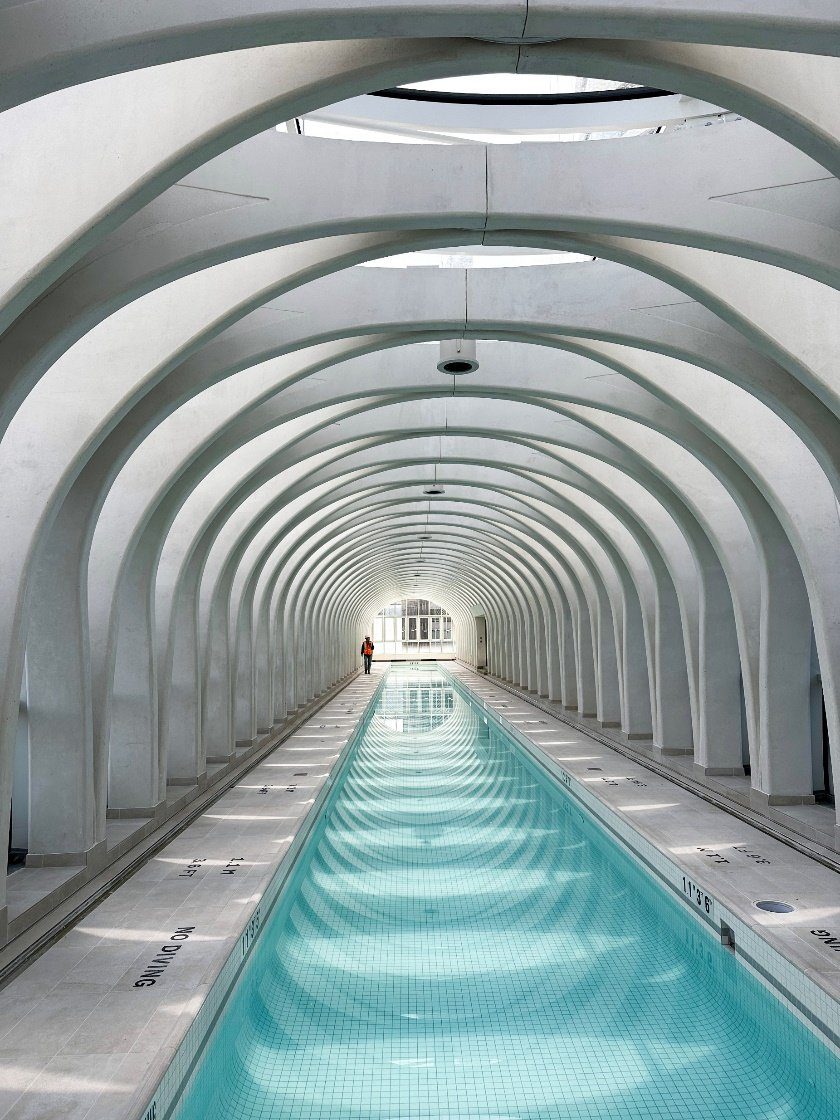
A pool is one of the higher-risk things an enclosure consultant ever builds, and Hubbs came from Vancouver, a temperate rainforest a good deal colder than Melbourne, to explain why. His subject sits near the top of The Butterfly, a tower raised over a heritage church downtown: the developer bought the airspace above the church, which let the tower grow and paid for the church’s heritage reconstruction. The pool is a glass cube carried on very slender arch-like precast that answers the church below.
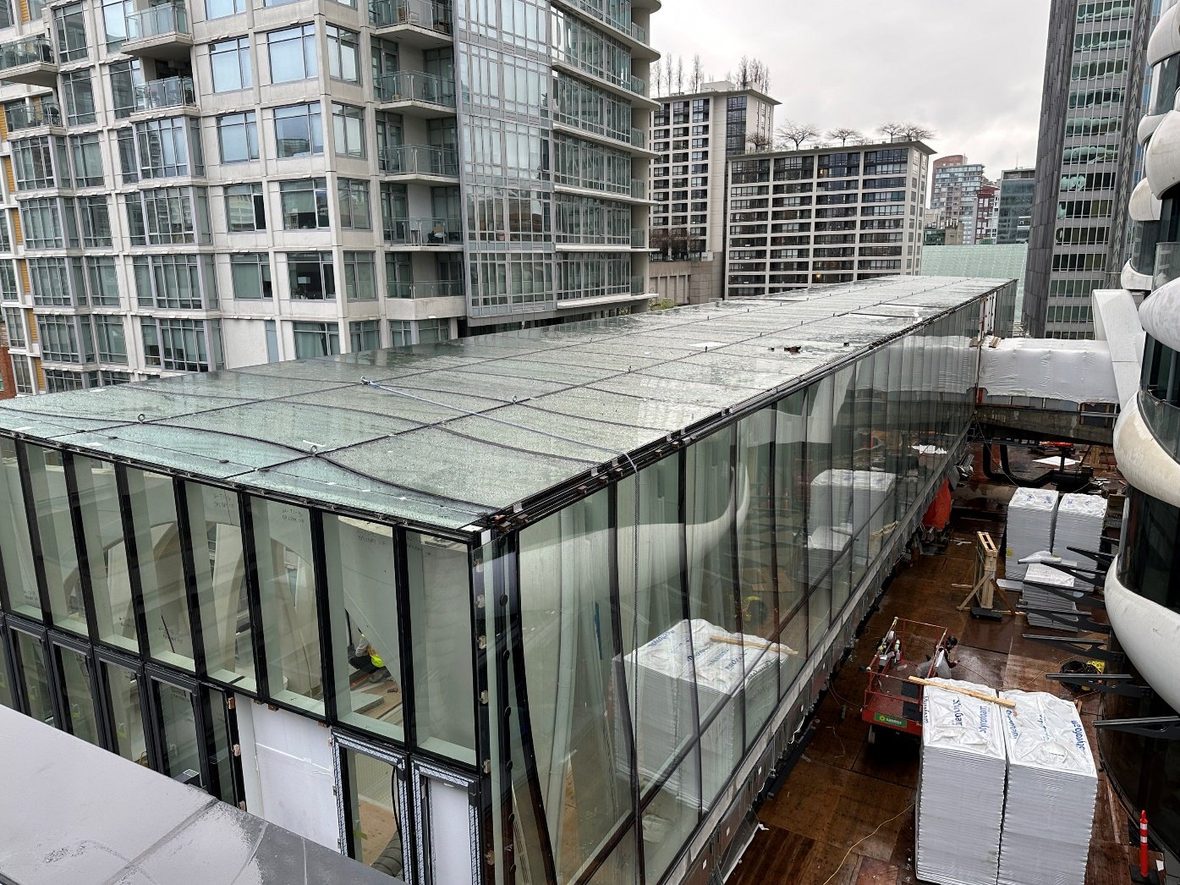
What a pool actually wants is no windows and a great deal of well-insulated wall. This is all glass and no wall, which leaves three jobs: keep water out, keep water in, and keep water off the inside.
Keeping water out sounds like the easy one, except that this is a very low-slope skylight in a city where it rains every day all winter, and low-slope skylights tend to leak. The system they chose has a continuous gasket spanning onto the glass, a toggle holding the glass down, a continuous silicone weather seal outside, and purlins draining into rafters and out at the bottom, so nothing interrupts the line of weathertightness. The catch was in the base specification: EPDM gaskets relying on a butyl sealant. Everything else on the assembly has a 50-year life expectancy and sealant has rather less, and nothing will be done to it until there is a problem. So the manufacturer was asked to rebuild the system in silicone throughout, every gasket and every drainage channel, so the gutters could be welded into one continuous sheet and the whole thing would age at one rate, with no weakest link buried inside it.
Then they tested it: a flood test run deliberately with no weather seal outside, so only the internal gutters, toggles and seals were doing any work. It leaked. The culprit was the toggle that holds the glass, screwed through an EPDM gasket that was assumed to self-seal because nobody had ever tested it that way. The manufacturer and the glazing contractor objected that you cannot test a system without its weather seal; his answer was that he was not testing their system, he was looking for what had been missed. They bedded the screw in silicone and reran the test with no leakage. It would have passed with the seal on. The point was year twenty, when nobody has maintained it.
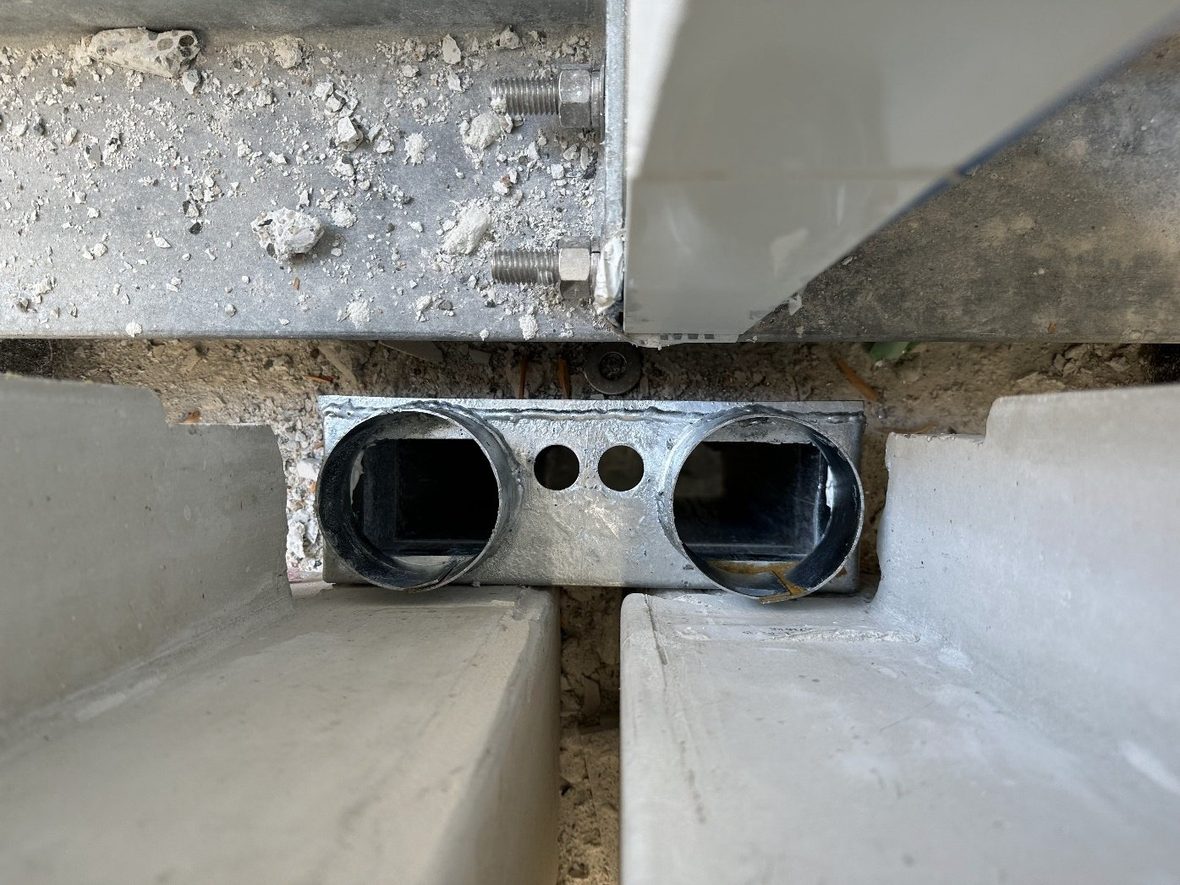
Keeping water in has case law behind it. The pool sits over occupied office space, so a leak is not only an annoyance below but, over years, a structural problem: he had heard NIST present at a forensic conference on the Florida pool that collapsed a building, an investigation that now looks like an air crash inquiry, every piece tagged and laid out in a field, and its lesson was to think past the first twenty years, build in a backup and keep records forever. So the build-up is redundant: waterproof membrane on the structural slab, drain mat, then the pool structure and its plaster, another membrane, another drain mat, tile. If the liner leaks, the water drains away rather than into the building, and a monitor on that drain water raises an alarm so somebody fixes the liner. Penetrations were the hard part, because structure cannot pass through a membrane and a structural engineer wants concrete onto concrete: they are welded hot-dip galvanised plates cast into the slab with the membrane sealed to them, galvanised because pool water, salt or chlorine, corrodes and will find the wrong grade of stainless steel.
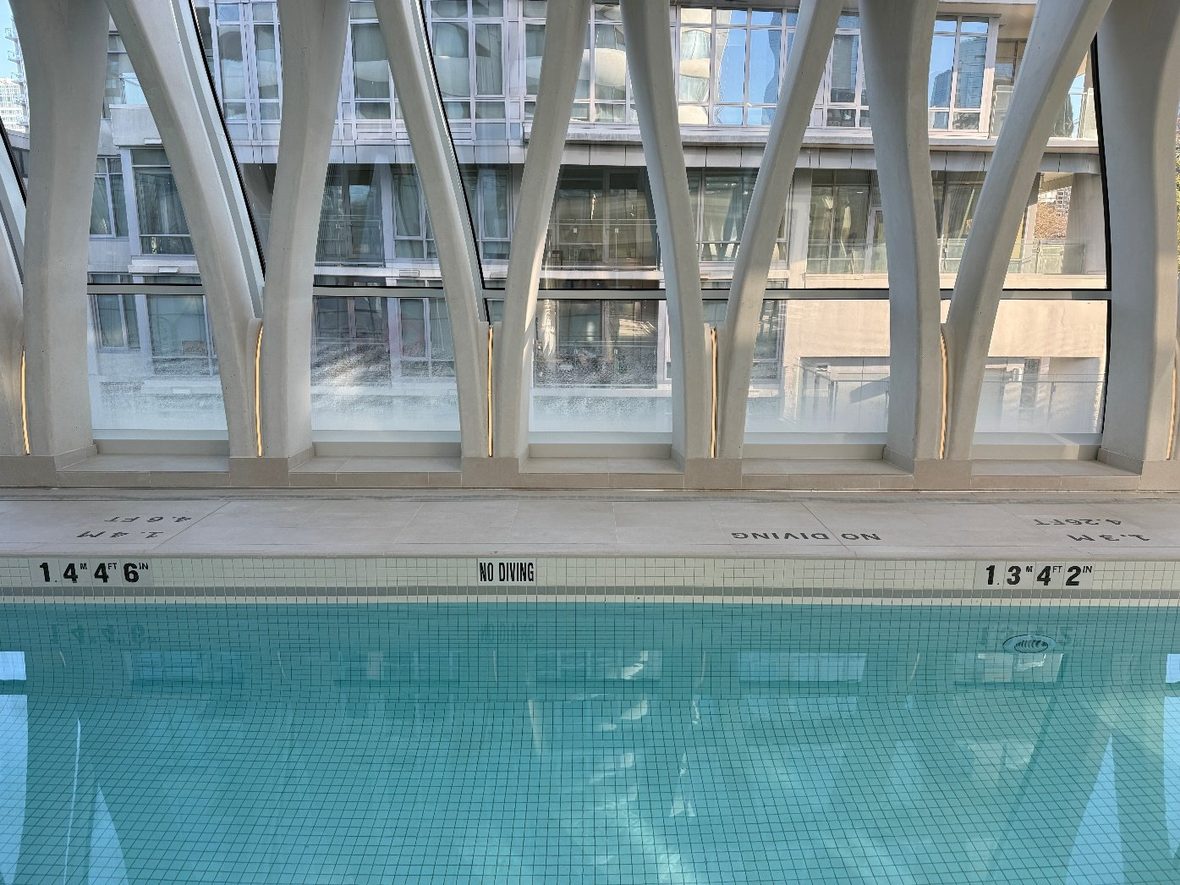
The real problem was condensation. A pool runs at 50 to 65 per cent humidity and Vancouver reaches minus 7 to minus 18 outside, and the architect’s rendering had no mechanical system in it at all. Hubbs drew on a whiteboard the metre-and-a-half duct down the centre that would normally blow dehumidified heated air at both faces of the glass, and the architect’s reply was that he could have as much mechanical as he wanted, so long as it looked like the rendering. The first model came back red across the January 2.5 per cent condition, meaning no view out and water dripping from the ceiling, so the glazing went from double to triple to lift the inside surface temperature. Then he asked the precaster for space inside those slender elements, which had barely 50 mm to spare and were carrying a great deal of weight. The answer, after a proof-of-concept unit was cast, was a notch, nothing more and preferably less. The ducts hide in it but are not cast in, because a mechanical system has to be serviceable, and they drop onto the same galvanised boots tied into the waterproofing.
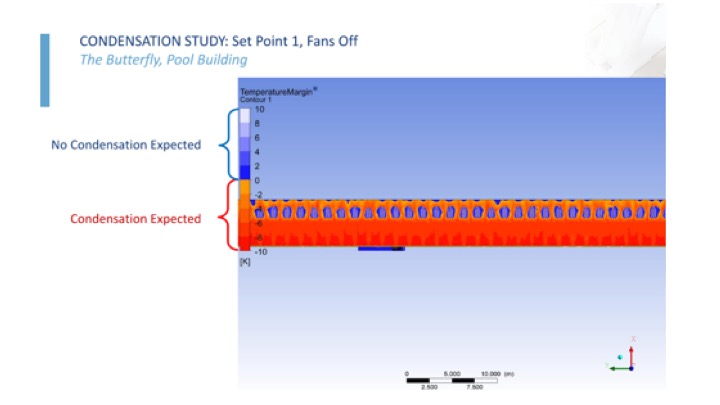
Computational fluid dynamics settled the rest. With the fans off the ceiling condenses and it drops; with the side ducts running it improves, but the middle of the roof still sheds water; with five axial fans blowing upward the condensation falls to a level nobody would notice, and the same held on the north wall. Everything in the plane of the glass inside is inorganic, so a little condensation wets it and dries again without growing anything, and 2.5 per cent of January is acceptable where all the time is not. The diffusers were designed for the best possible air wash across the glass. On opening day the call came to say it had not worked, and there was indeed a great deal of water, because the mechanical system had not been switched on; once it was, the glass cleared within hours. What was delivered is close to the rendering: look up and you see sky and mountains, and no mullions to speak of.