


As codes push down the glazed share of a façade, the solid part can carry photovoltaics. Oliver Ng, Pete Kennon, Bobby Wei, Blair Stratton and Stefan Brey took building-integrated PV from 550 Spencer’s thin-film skin and 435 Bourke Street’s bifacial sunshades to the fire test that passed on everything but debris, and the tender process that keeps killing the idea.
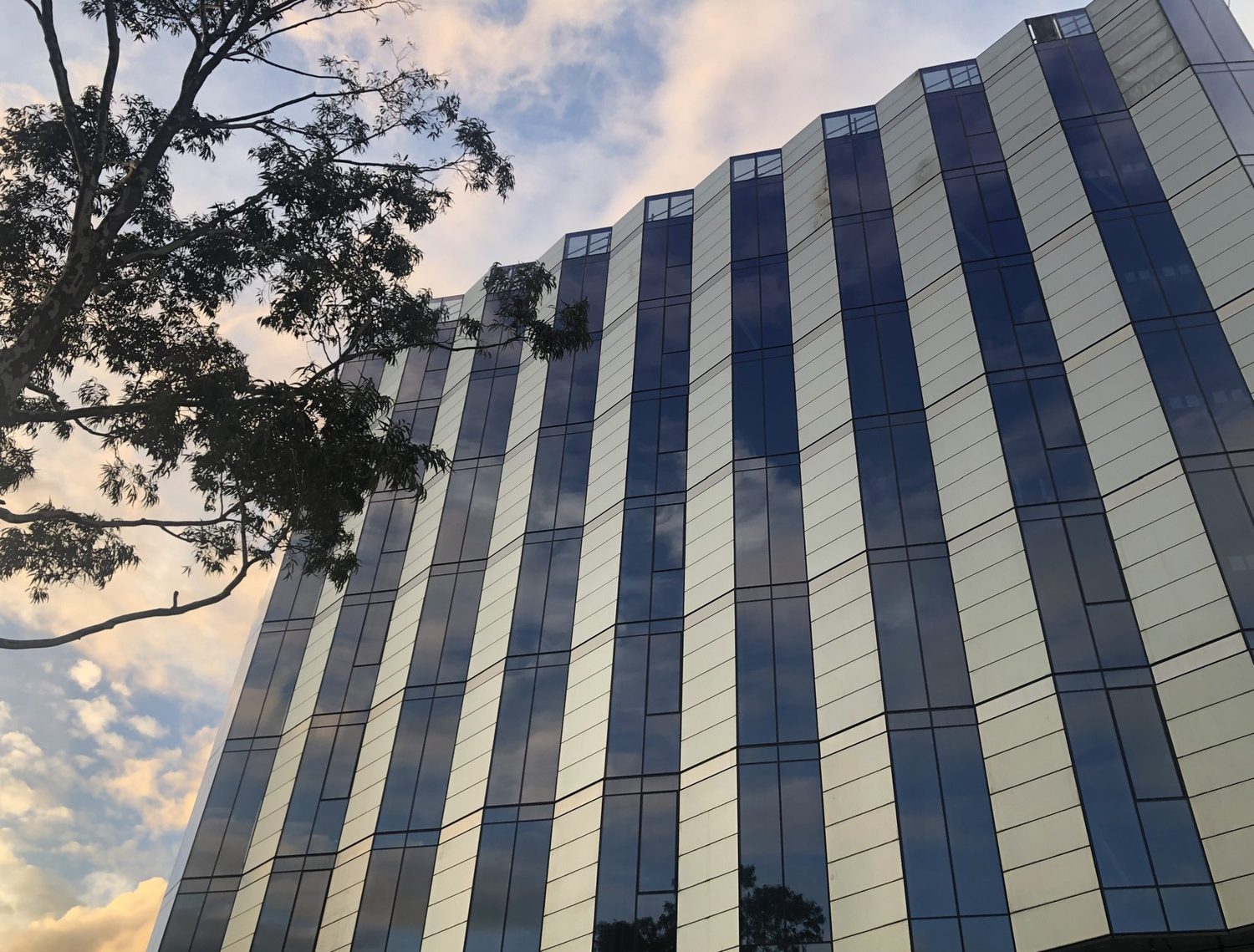
Construction codes are moving, and an all-glazed façade is getting harder to rate. The industry is settling towards a 50/50 or 60/40 split of solid to glazed, and the premise here was that if part of a façade has to be solid, in Pete Kennon’s words, “we may as well make it work for us”. Oliver Ng of BG&E Façades took that from design to delivery with two architects, Pete Kennon of Studio Kennon and Bobby Wei of Bates Smart, the fire engineer Blair Stratton of RED Fire Engineers, and his BG&E colleague Stefan Brey.
550 Spencer Street came first. Kennon was commissioned at the start of 2020 by a client who had inherited the land, a doctor with no developer’s brief who wanted a legacy rather than a yield. He found a thin-film product on a website that had never been used in the southern hemisphere, flew the managing director of Avancis out to pitch it, and set an aesthetic rule: the building should work like a high-performance car, with the engine under the bonnet and nothing about the bodywork announcing it.
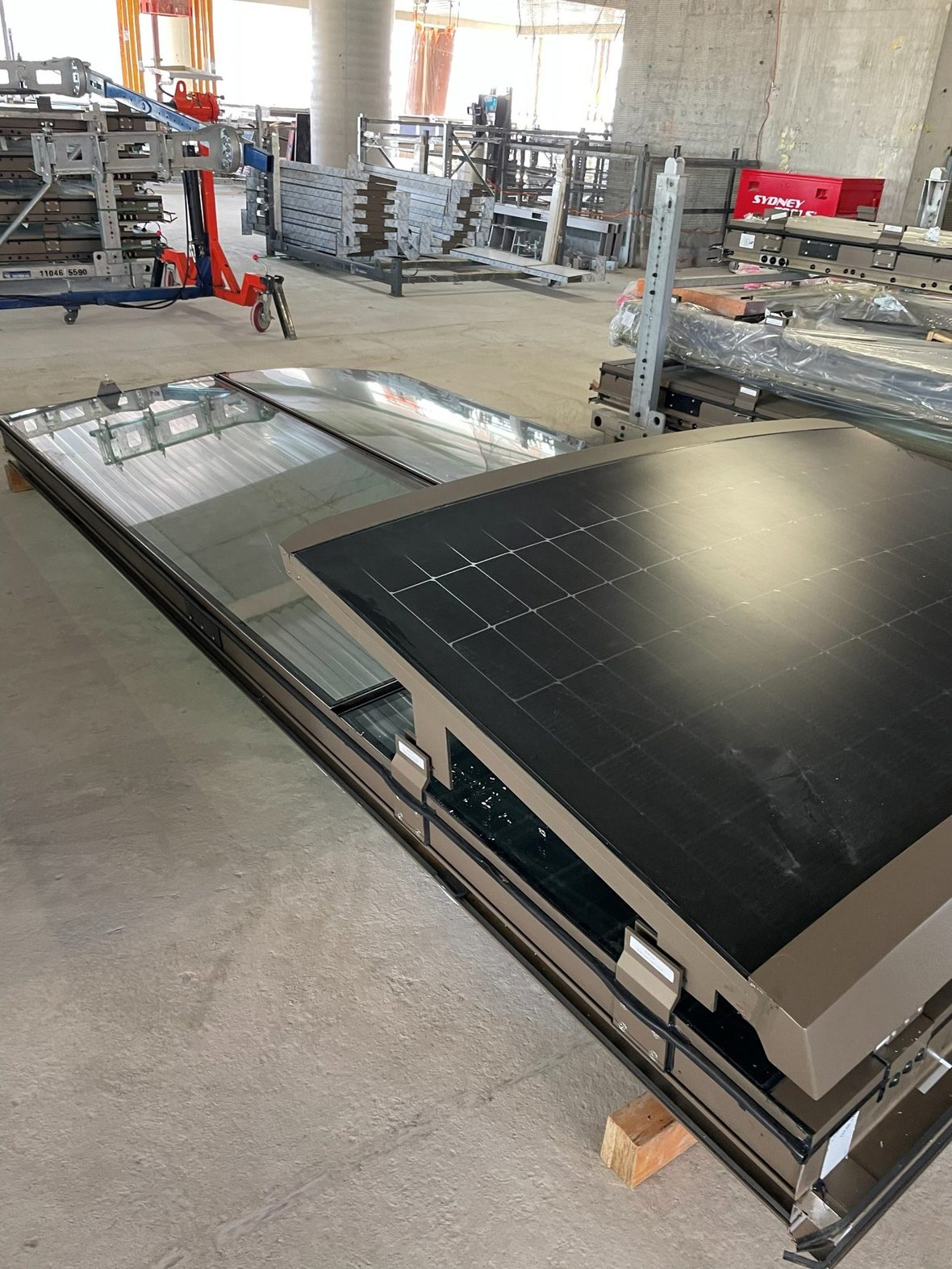
Compliance took the pandemic to achieve. With the programme relieved and everyone at home, the team built a four-storey rig carrying every colour of the product and put it through a Warrington fire test, watching the mock-up burn from their kitchen benches; the appointment alone took three or four months, though council, pleased with the result, was quick. A Grasshopper script had given the façade a thousand angular panels, and Avancis rationalised that back to their standard unit, advising that the product works best in fives. Each bay between slab spandrels is now a horizontally fitted group of five, with a colour-matched aluminium spandrel panel in between and the wiring running back to a converter in the core, from where the building sends the power to wherever it is wanted: if levels three and five are empty, it goes elsewhere.
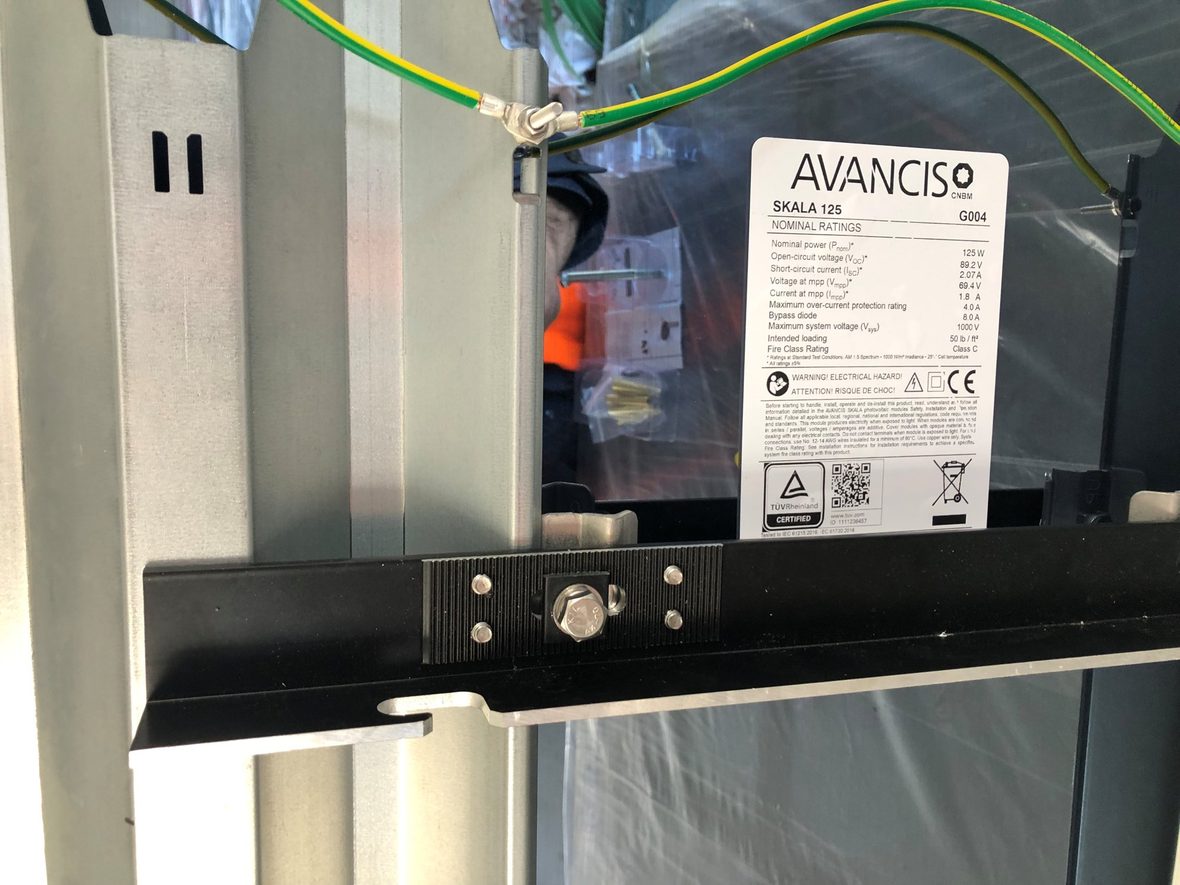
Ng put the tender problem plainly: you design it, and by the time the panels are actually bought, “it’s two years down the road”. The change Brey pointed to was in the process. Past tender the design-and-construct component effectively disappears, because what gets built has to be what was tested: a full prototype, shop drawings, fabrication drawings, and a contractor with the extrusions already in stock who can install a test wall in weeks. Nobody had put a unitised curtain wall through a full-scale AS 5113 test before.
Stratton’s fire engineering ran small, big, bigger. Small was the CFMEU headquarters, where a window-integrated product bounces photons off a thin strip of cells into what looks like a very thick frame: little for a fire engineer to say, since the fuel load is smaller than the desk and chair beside the window. Big was 550 Spencer. The AS 5113 test puts a timber crib a metre and a half tall under three storeys of real façade, wing wall included, because at that scale stack effect and geometry start to matter. It answers what a sprinkler failure or a nearby truck fire would do and, unlike a small-scale test, it tells you about debris. The panel passed every criterion but that one: the standard allows 2 kg of debris on the floor at the end of the test, not counting the wood crib, and this produced about 200.
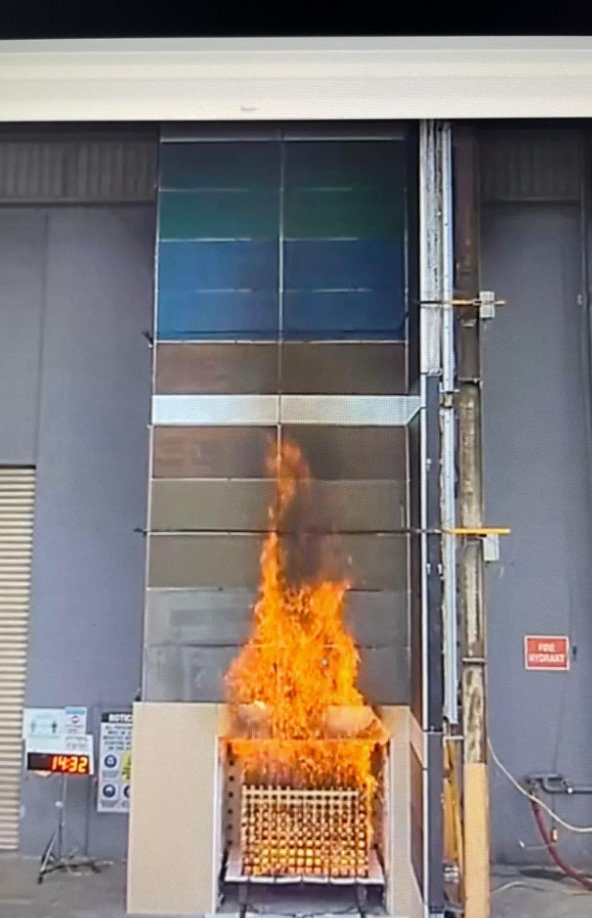
Each module is bonded, so when one goes it goes as a whole pane, and Stratton’s view is that laminated glass on structural silicone would behave much the same. It had been anticipated: an awning runs around two-thirds of the building to catch what falls, with several ways out and several ways in for the brigade. That, with the test data, satisfied the Building Appeals Board.
Bigger is 600 Collins Street: roughly 3,000 square metres on one elevation, 47 storeys above a podium set back five metres, which weakens every one of those arguments. Three storeys is as far as a test can economically go and no computational fluid dynamics model will predict a larger fire, so the strategy becomes making sure a fire that size never starts, through enhanced sprinklers, reliable detection, cascading evacuation and the brigade consulted early. The brigade was content enough but said its policy is not to approve such things. Then the client asked the Board to consider two panels at once, the Board refused the lot, and a year and a half of work ended in a rejection at the end of 2024, by which time neither tested panel was still on the market. Stratton is now proposing a Goldilocks test, small enough to run repeatedly and large enough to learn from.
435 Bourke Street took the opposite design decision. Wei’s 53-storey tower at Bourke and Queen targets 6-star Green Star, 6-star NABERS, WELL Platinum and operational carbon neutrality, and carries the largest photovoltaic façade on an Australian commercial tower. Where 550 Spencer committed to one technology and worked out its constraints, Bourke Street started at square one across the whole range, thin film to monocrystalline, with five or six options built as full-scale prototypes before one was chosen. What won was a bifacial monocrystalline panel doing the work of a sunshade: the gaps in the cell grid throw a reverse shadow across the space inside, and light returning onto the panel’s underside lifts its output.
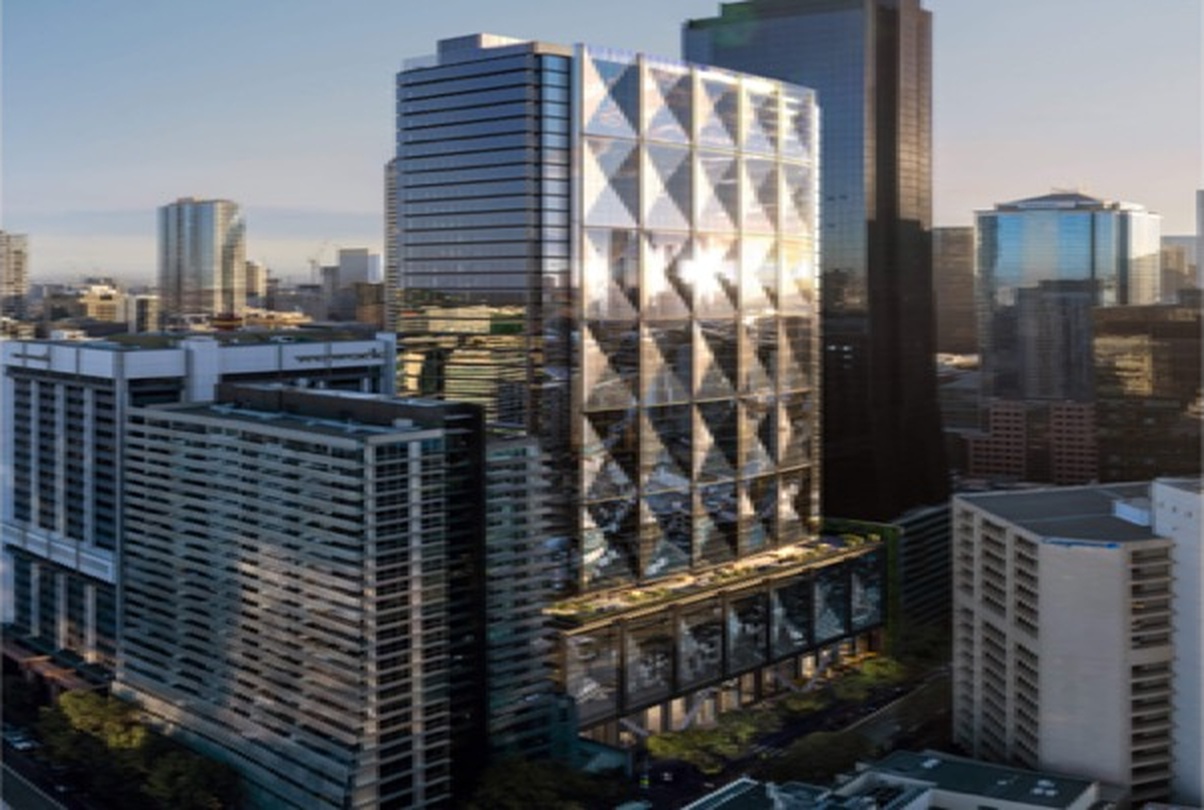
Which is why the cells are visible from inside rather than tucked behind an architectural treatment. Wei wanted “a tangible demonstration of this technology”, so that anyone using the space knows it is generating while it shades them, and it tells the anchor tenant what sort of building they are in. And the anchor tenant is what pays for it. Roughly $200 a square metre separates premium A-grade rents from high-end but not quite, and it is that return, underwritten by institutional tenants’ own ESG policies, that carries the feasibility. Nobody is doing it for the electricity, and 550 Spencer has provision for a battery that was never installed. Ten years ago, Brey noted, the same meeting would have been about a gas-fired co-generation plant for exactly the same outcome; now it is this, “because gas is no longer cool”.
The candid note was how rarely it survives. Since 550 Spencer, Kennon has proposed a photovoltaic façade on five or six projects and it has been pulled off every one. Brey’s diagnosis was procurement. An AS 4284 test can be specified and handed down to the contractor because the industry knows it can be passed, and tweaked and retested if it is not; building-integrated photovoltaics have no such accumulated confidence, so the testing has to happen before tender documents go out, which he called mission impossible. There are two supply chains to reconcile, the specialist laminator and the façade contractor, a set of standards that contractor has never had to meet, and a risk profile that changes building by building, debris on one job and the electrical stringing on the next. The cells moved so fast during Bourke Street, through M2, M6 and M10 ingots, that the panels were designed to be swapped: what replaces them in thirty years was worked through rather than deferred.