


A panel led by Tom Donald tackled a question the profession has been asked to answer: what is the core scope, and the competency, of a façade engineer? With Gareth Winstanley, Elizabeth Carpenter, Vera Tchikina and Alison Potter, it worked from four competency criteria through what New South Wales’ Design and Building Practitioners Act actually demands, why nobody uploads a regulated design, and what the bill replacing it should learn.
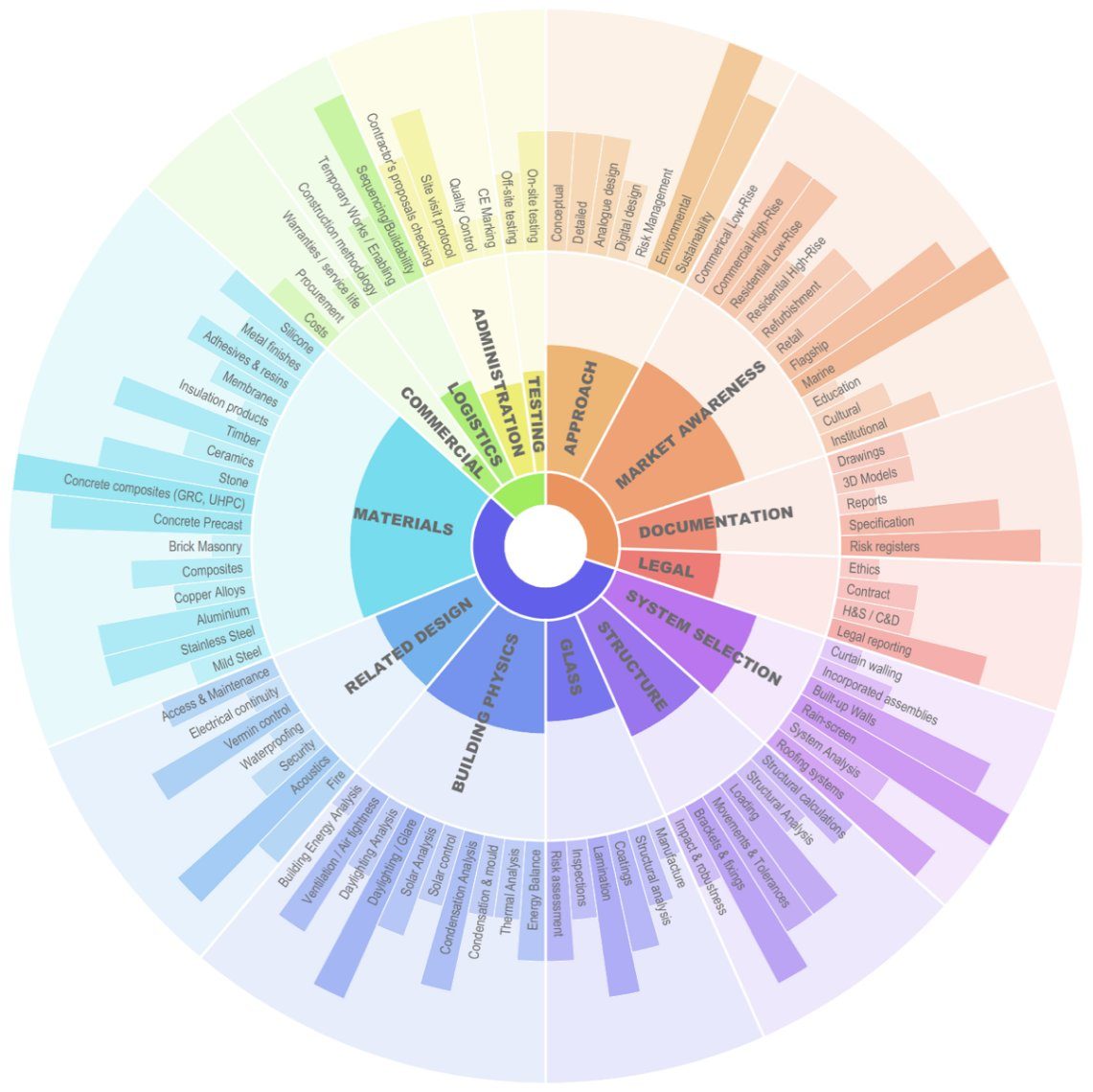
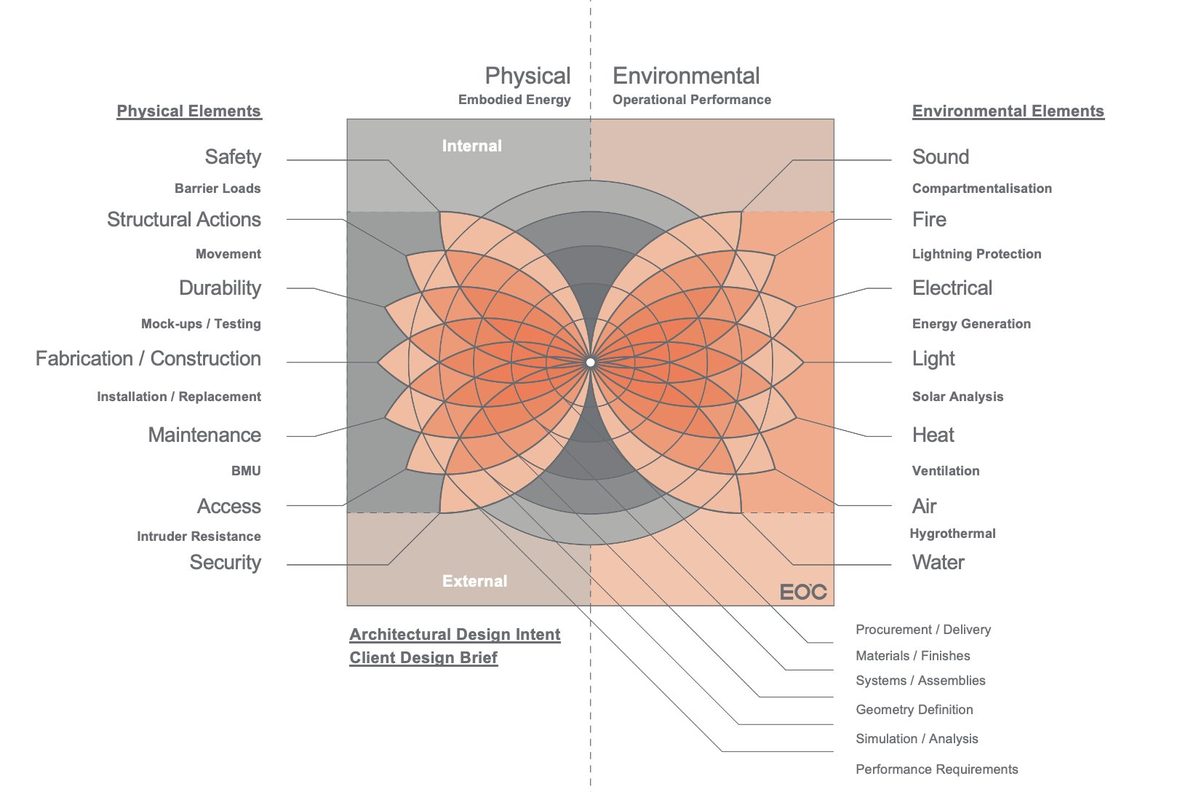
Tom Donald opened by welcoming everyone to his ongoing professional existential crisis. The question is what a façade engineer is, and it is live because the profession has been asked to define the scope and competency of façade consultants, and no common definition exists. Eckersley O’Callaghan’s own map of scope runs across environmental elements, physical elements, design intent and process, and nothing will ever contain all of it, which is why the panel introduced a narrower idea: core scope, the essential part a façade engineer must own.
Competency then rests on four criteria the Society of Façade Engineering has been working from. Skills, the practical, process-based part, which implies training and some way of tracking it. Knowledge, the educational part, tied directly to scope, which implies a definitive list of things one must know and a route to learning them. Experience, which implies time and relevance, and awkwardly implies a pre-experienced state: when does the clock start? And behaviours, covering ethics, conduct and responsibility, which imply regulation, which implies registration, which implies a body to administer it.
What makes the question urgent is New South Wales’ Design and Building Practitioners Act, which Gareth Winstanley attempted in five minutes. It exists to stamp out defects in New South Wales residential construction, arriving barely a year after a concrete column cracked through the middle of the Opal Tower on Christmas Eve. Anyone undertaking building work on a class 2 or class 3 building in the state is caught by it, and building work is not just construction: procurement, arranging a contract and supervision all count. If a commercial development contains a class 2 portion the whole development falls under the Act, so a tower with a hotel, apartments and offices is subject to it entire. Nor can it be drafted around: “in exactly the same way that I can’t contract myself out of murder”, Winstanley said, you cannot contract yourself out of the Act.
Three features matter to façade people. The Act separates designers from builders, each with their own sections and regulations. It formally recognises façade engineering as a class of design practitioner, and it is the only Australian legislation that actually mandates design, which the NCC does not. And you do not certify under it, you declare: a design practitioner declares the design NCC compliant in its entirety, not merely the structural or thermal part they did, which forces a great deal of coordination, and a building practitioner cannot start work without a regulated, declared design in hand.
Then the liability. Everyone doing building work owes a duty of care for the economic loss of the building’s tenants regardless of what any contract says, so a contractual scope is no longer a place to hide. In a recent Sydney case an owners’ corporation sued the developer, who argued proportionate liability on the grounds that it builds nothing; the court held the duty applied anyway. The same reasoning catches companies that fold and reappear under a new name, and individuals can be found personally liable.
Winstanley was even-handed about how it is working. The volume of design has gone close to exponential, with the administration to match. Designers have no access to upload their own designs to the Building Commission, so the builder controls when, and whether, a design goes up. And there is a real conflict between the economic-loss duty and the compliance declaration: find a hob 20 mm below the external tiles while replacing a panel and the detail cannot be declared, so a repair becomes a million-dollar wall. Against that, compliant details are actually appearing: boards taped down to hobs, sarking wrapped behind windows, sill tapes sealed properly, clearer responsibility, better documentation, and a focus on compliant details that rather implies there were none before.
Vera Tchikina set Victoria’s approach beside it. The difference is peer review: a designing engineer and a reviewing engineer, so engineers check engineers, with all the disagreement that invites in the grey areas where good building practice is not written into any standard. Under the DBPA it sits with one design practitioner, the one and only engineer, who “can declare whatever design they want”, with the commission rather than another engineer looking at it.
The trade runs the other way too. The Act forces a designer to think about scope and to cover the interfaces, where in Victoria it remains possible to say you only did the awning and leave the rest to the contractor. Its blunter achievement is that it obliges someone to engage a façade engineer and to call that person a façade engineer. The tier one projects were never the problem; it is the ordinary suburban work that was being built without one, and, Tchikina said, most definitely not to the NCC. Accountability has pulled façade people in earlier, to the point where architecture practices now ask for briefings on how to design waterproofing, though a developer can always ask why anyone is needed and build to whatever is cheapest.
The middle scale is where the gap sits, and it is a registration question: an unregistered architect can work up to a certain scale under the Act, and past that the competency is simply not there. Elizabeth Carpenter set the Architects Act beside it, and noted that the core of both is consumer protection rather than whether a building looks remarkable. As buildings grow more complex, she said, architects rely on façade consultants as “that bridge between what we want to do” and what industry can actually provide.
Her practical tip was to employ a façade consultant inside the practice, which is what lets a firm push boundaries and talk to suppliers early enough to understand what is possible. But that reliance only works if the consultant is competent, and how an architect establishes that is still reputation, published research and who is out testing products. Alison Potter described the collaborations that have worked as early and conducted from first principles, and valued the consultant who can say they have seen this before and it went badly. There is, she said, “a lot of onus on us to de-risk the projects super early on”, which is precisely why the specialist knowledge has to arrive in the design phases.
Which brought the panel to the regulated design, and whether one can really be taken to 100 per cent and handed over to be built. Winstanley’s answer was that we are not building submarines: a submarine can be modelled entirely, sliced up and manufactured, where a building carries a latency in design that cannot be removed, so the curtain wall is on the boat from China when the mechanical engineer, who started later, arrives wanting a plenum through the middle of a window. Staged design is now being discussed at the Building Commission. Meanwhile the workaround on tier one is not to upload the design at all, since it is the builder’s job to do so, which keeps the right to change what was never regulated. Tchikina sees both extremes still reaching the commissioner’s office: minimum-effort submissions saying the cladding is this product, follow the supplier’s requirements, with nobody checking anchors, fixing centres or the interfaces where everything unravels; and fully engineered designs carrying construction-level detail worked out with no contractor on board, which still get tweaked once construction starts.
Donald’s own summary was that the whole thing should have been called learning from the DBPA for the next iteration of regulation. The timing is not accidental. New South Wales is looking at repealing the DBPA, and a new building bill keeps its major elements while trying to improve and streamline them, with a genuine appetite to fix the matrix of responsibilities and the gaps that sit at the junctions between one profession and the next. Tchikina’s closing point was that legislation to date has been reactive, from tower fires to composite panels being stripped off buildings, and that it has power but must be built with the people who do the work, which is why reviewing and commenting on standards matters. Carpenter’s was that the architects’ registration board is independent rather than a membership body, which is what makes it trusted and accountable, and consumer protection is what that independence is for. The work of defining core scope has only just begun, and the invitation was open to anyone who wants to help write it.