


Jordi Marasse argues that façade sustainability is a balance between operational energy, embodied carbon, durability, resilience and circularity. Optimising one metric in isolation can simply move environmental impact elsewhere in the system.
Sustainability becomes less useful when it is reduced to a single favourable number. Marasse's central argument is that the building envelope sits at the intersection of operational energy, embodied carbon, material supply, durability, resilience, manufacturing and end-of-life recovery. Improving one of those dimensions can worsen another. Additional glazing layers and insulation may lower operational energy while increasing upfront carbon. A material with excellent thermal performance may be difficult to recover or recycle. A high recycled-content claim may improve one product's declaration without increasing the amount of secondary metal available to the market. The design task, therefore, is to understand the trade-offs rather than search for one universal "green" specification.
The distinction between embodied and operational carbon is a useful starting point. The industry has spent years reducing energy demand through better U-values, tighter envelopes, solar control and improved mechanical systems. Marasse does not argue against that work; he argues that success makes the embodied side of the equation more visible. A triple-glazed façade uses more glass than a double-glazed one. Thicker insulation and additional barriers also carry manufacturing impacts. The lowest whole-life result may sit between extremes, with envelope performance tuned to climate, programme, service life and the actual carbon intensity of the chosen materials rather than to the maximum value available in one category.
Carbon has to be read across the value chain
Marasse uses aluminium to illustrate how easy it is to mistake a product-level improvement for a system-level one. The deck estimates that currently available recycled aluminium could satisfy only about 36 per cent of global aluminium demand. The remainder still has to come from primary production. Under that constraint, one manufacturer securing a very high proportion of recycled feedstock does not automatically increase the total amount of secondary aluminium in circulation; it can simply reduce the share available elsewhere. Marasse calls this a zero-sum problem and argues that the carbon intensity of primary aluminium therefore remains important alongside recycling rates.
The same whole-system view applies to existing buildings. Hillside Place in Toronto, shown as a net-zero retrofit example, represents the enormous opportunity in improving building stock that is already standing. Marasse also points to renovation programmes and community housing as areas where operational carbon can be reduced without incurring the full embodied cost of replacement. The logic is circular before it is technological: preserve useful structure, improve deficient components and postpone demolition where possible. A new high-performance façade may be impressive, but the lowest-carbon intervention can be the one that keeps more of an existing building in service.
Prefabrication can protect both carbon and construction
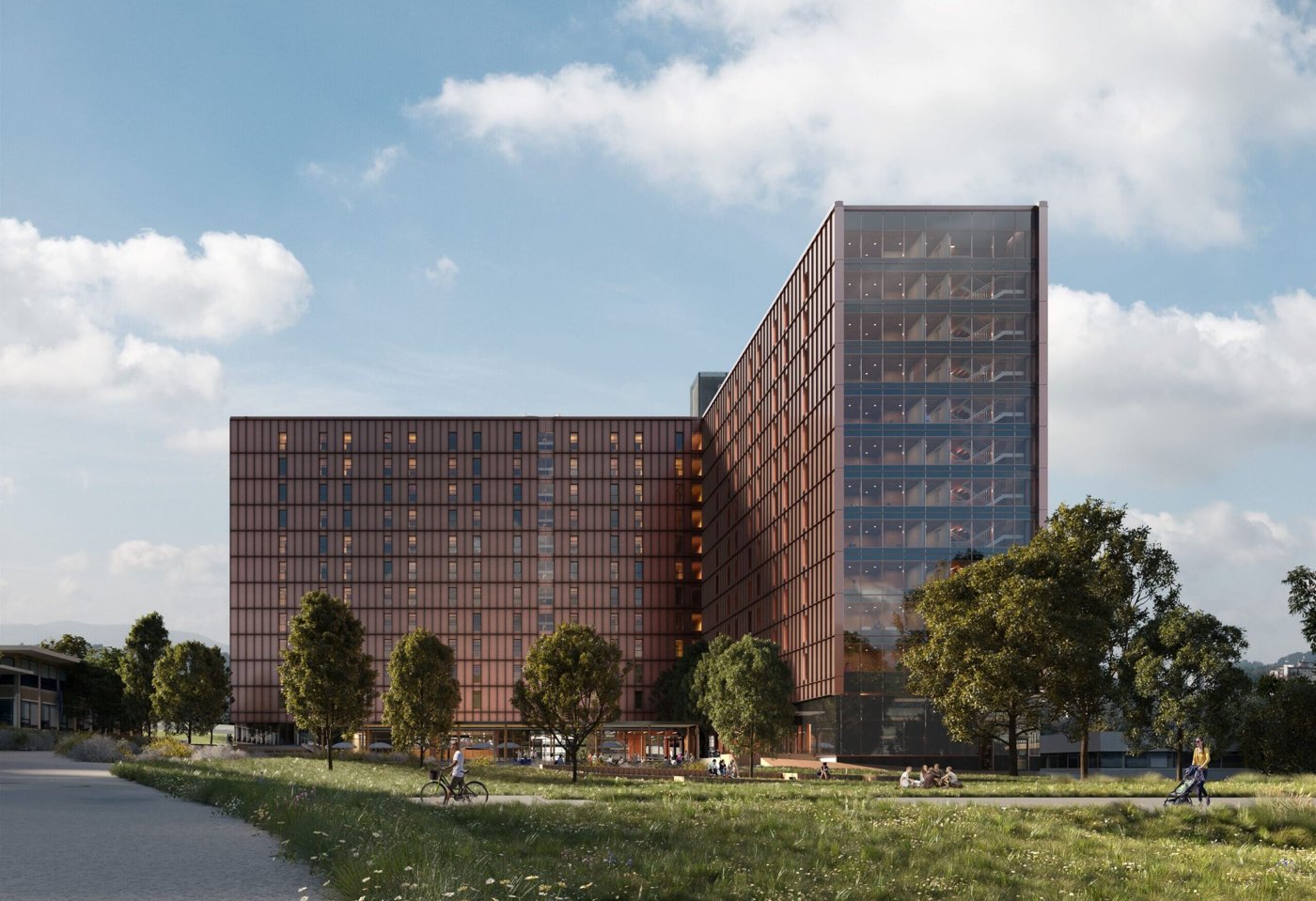
BCIT Tall Timber Student Housing in Vancouver shows another connection between envelope design and whole-building strategy. The project combines mass timber with a highly prefabricated façade. Marasse describes moisture exposure during construction as a central risk for the timber structure, so the wall system was conceived to arrive ready for rapid installation as the frame advanced. Prefabrication was not only a productivity choice. By reducing the time the timber remained exposed, the enclosure became part of the construction-phase durability strategy. It also illustrates how design for manufacture can reduce on-site uncertainty while coordinating air, water and thermal control in repeatable modules.
That approach leads naturally to eco-design: use only as much material as the loads and spans require, rationalise profiles and components, and reuse common gaskets, fasteners or sections across product families where possible. Marasse frames overdesign as a carbon issue as much as a cost issue. Extra wall thickness, redundant metal and unnecessary component diversity all carry manufacturing and logistics impacts. The most sustainable system is not necessarily the lightest at any cost, but it should be materially intentional. Optimisation should also consider how assemblies come apart, because an envelope that is technically recyclable but bonded into inseparable composites may never realise that potential at end of life.
Circularity needs evidence, not instinct
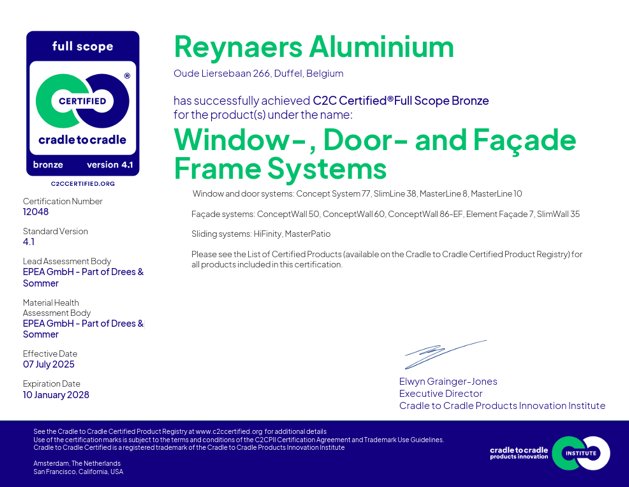
Marasse repeatedly returns to documentation. Cradle to Cradle certification is one route he identifies for assessing material health, recovery and disassembly characteristics. Environmental product declarations provide another evidence base for comparing embodied impacts. Reynaers also uses project-level calculations to estimate the carbon associated with a specific system mix rather than relying only on generic averages. The underlying point is broader than any certification scheme: sustainability decisions should be traceable to data. A product should not be accepted as low carbon because its marketing language sounds plausible, and design teams should ask what part of the lifecycle a claim actually covers.
Durability belongs in the same calculation. Aluminium's long service life and recyclability are central to Marasse's case for the material, but he also stresses extreme-weather resilience. A façade with a low declared carbon footprint that fails early in a hurricane zone, overheats in a desert climate or requires premature replacement has simply shifted impact into the future. That is why North American regional differences matter: products serving cold Canadian climates, high-wind coastal markets and hot dry interiors cannot be selected against one performance profile. Resilience, thermal performance and embodied carbon have to be solved together for the actual exposure.
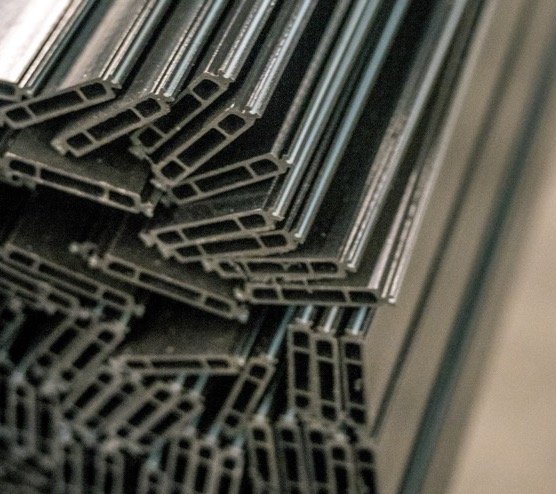
Marasse also addresses the carbon intensity of primary aluminium directly. The figures he cites are company-reported: a global average of about 15.2 kg CO2 per kilogram of aluminium, a European figure around 10.48, and a Reynaers average of 3.31, with a stated target of 2.81 by 2030. The important editorial point is not to treat those figures as universal benchmarks, but to note the direction of the argument. If recycled supply cannot satisfy total demand, decarbonising primary production and verifying its energy source become necessary parts of façade procurement. Recycled content alone cannot carry the whole sustainability story.
Product passports extend responsibility beyond handover
Responsible sourcing adds another layer. Marasse points to the Aluminium Stewardship Initiative as a way of extending traceability back through raw-material extraction, including questions about how bauxite is mined and what labour conditions sit behind the supply chain. At the finished-product end, digital product passports can preserve information about where a component was fabricated, who installed it, when it was installed and what material or carbon data belongs to it. That information becomes valuable decades later, when maintenance, replacement or disassembly decisions have to be made by people who were not involved in the original project.

The wider lesson is that sustainable façades cannot be designed from a single column in a spreadsheet. Operational energy matters, but so do the materials required to achieve it. Recycled content matters, but so does the carbon intensity of unavoidable primary production. Prefabrication can improve quality, yet its value grows when it protects vulnerable structure and supports disassembly. Certification helps only if teams understand what it measures. The strongest strategy is therefore a portfolio of linked decisions - efficiency, durability, responsible sourcing, repair, reuse, recyclability and evidence - considered across the life of the envelope rather than optimised one at a time.